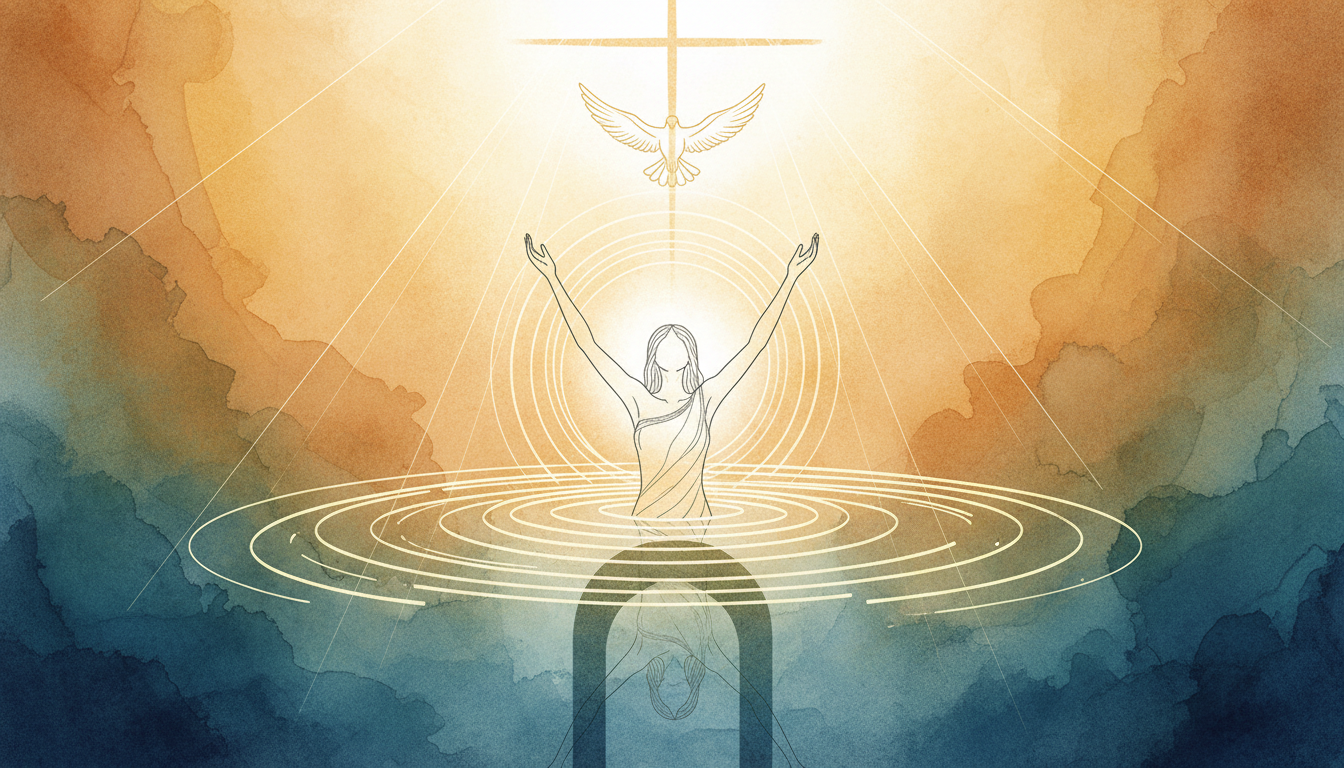
Baptism in the New Testament: Incorporation into Christ and God's Covenant Community
A five-chapter study exploring how baptism in the New Testament incorporates believers into Christ and God's covenant community, transforming the whole person into resurrection life. This course moves from Jesus's own baptism as the foundational pattern, through the early church's practice and theology, to Paul's vision of baptism as death-and-resurrection union with Christ, and finally to baptism's role in both individual transformation and corporate belonging. Each chapter is anchored in primary biblical texts and enriched by historical, cultural, and theological insight.
What you'll study
Jesus's Baptism: The Pattern and the Promise (Matthew 3:13-17 and Mark 1:4-11)
Then Jesus came from Galilee to the Jordan to be baptized by John. But John tried to deter him, saying, 'I need to be baptized by you, and do you come to me?' Jesus replied, 'Let it be so now; it is proper for us to do this to fulfill all righteousness.' Then John consented. As soon as Jesus was baptized, he went up out of the water. At that moment heaven was opened, and he saw the Spirit of God descending like a dove and alighting on him. And a voice from heaven said, 'This is my Son, whom I love; with him I am well pleased.' (Matthew 3:13-17) And immediately, coming up from the water, he saw the heavens parting and the Spirit descending upon Him like a dove. Then a voice came from heaven, 'You are My beloved Son, in whom I am well pleased.' (Mark 1:10-11)
John's Baptism and the Baptist's Witness: Preparation and Proclamation (Mark 1:4-11 and John 1:29-34)
John appeared in the wilderness, preaching a baptism of repentance for the forgiveness of sins. The whole Judean countryside and all the people of Jerusalem went out to him. Confessing their sins, they were baptized by him in the Jordan River. (Mark 1:4-5) The next day John saw Jesus coming toward him and said, 'Look, the Lamb of God, who takes away the sin of the world! This is the one I meant when I said, "A man who comes after me has surpassed me because he was before me." I myself did not know him, but the reason I came baptizing with water is that he might be revealed to Israel.' Then John gave this testimony: 'I saw the Spirit come down from heaven as a dove and remain on him. And I myself did not know him, but the one who sent me to baptize with water told me, "The one on whom you see the Spirit come down and remain is the one who will baptize with the Holy Spirit." I have seen and I testify that this is God's Son.' (John 1:29-34)
The Great Commission and Pentecost: Baptism as Trinitarian Incorporation and Corporate Belonging (Matthew 28:19-20 and Acts 2:38)
Therefore go and make disciples of all nations, baptizing them in the name of the Father and of the Son and of the Holy Spirit, and teaching them to obey everything I have commanded you. And surely I am with you always, to the very end of the age. (Matthew 28:19-20) Peter replied, 'Repent and be baptized, every one of you, in the name of Jesus Christ for the forgiveness of your sins. And you will receive the gift of the Holy Spirit. The promise is for you and your children and for all who are far off—for all whom the Lord our God will call.' (Acts 2:38-39)
Baptism as Death and Resurrection: Whole-Person Transformation in Christ (Romans 6:3-11 and Colossians 2:11-12)
Or don't you know that all of us who were baptized into Christ Jesus were baptized into his death? We were therefore buried with him through baptism into death in order that, just as Christ was raised from the dead through the glory of the Father, we too may live a new life. For if we have been united with him in a death like his, we will certainly also be united with him in a resurrection like his. (Romans 6:3-5) In him you were also circumcised with a circumcision not performed by human hands. Your whole self ruled by the flesh was put off when you were circumcised by Christ, having been buried with him in baptism, in which you were also raised with him through your faith in the power of God, who raised him from the dead. (Colossians 2:11-12)
Baptism and the Spirit: Unity, Incorporation, and the Ongoing Work of the Holy Ghost (Acts 8:12-17, 1 Corinthians 12:13, and Galatians 3:26-29)
But when they believed Philip as he proclaimed the good news of the kingdom of God and the name of Jesus Christ, they were baptized, both men and women. Simon himself believed and was baptized. And when the apostles in Jerusalem heard that Samaria had accepted the word of God, they sent Peter and John to Samaria. When they arrived, they prayed for the newly baptized believers there that they might receive the Holy Spirit, because the Holy Spirit had not yet come on any of them; they had simply been baptized in the name of the Lord Jesus. Then Peter and John placed their hands on them, and they received the Holy Spirit. (Acts 8:12-17) For we were all baptized by one Spirit so as to form one body—whether Jews or Gentiles, slave or free—and we were all given the one Spirit to drink. (1 Corinthians 12:13) So in Christ Jesus you are all children of God through faith, for all of you who were baptized into Christ have clothed yourselves with Christ. There is neither Jew nor Gentile, neither slave nor free, nor is there male and female, for you are all one in Christ Jesus. If you belong to Christ, then you are Abraham's seed, and heirs according to the promise. (Galatians 3:26-29)
Chapter 1 · Free to read
Jesus's Baptism: The Pattern and the Promise (Matthew 3:13-17 and Mark 1:4-11)
Then Jesus came from Galilee to the Jordan to be baptized by John. But John tried to deter him, saying, 'I need to be baptized by you, and do you come to me?' Jesus replied, 'Let it be so now; it is proper for us to do this to fulfill all righteousness.' Then John consented. As soon as Jesus was baptized, he went up out of the water. At that moment heaven was opened, and he saw the Spirit of God descending like a dove and alighting on him. And a voice from heaven said, 'This is my Son, whom I love; with him I am well pleased.' (Matthew 3:13-17) And immediately, coming up from the water, he saw the heavens parting and the Spirit descending upon Him like a dove. Then a voice came from heaven, 'You are My beloved Son, in whom I am well pleased.' (Mark 1:10-11)
The Text
Then Jesus came from Galilee to the Jordan to be baptized by John. But John tried to deter him, saying, 'I need to be baptized by you, and do you come to me?' Jesus replied, 'Let it be so now; it is proper for us to do this to fulfill all righteousness.' Then John consented. As soon as Jesus was baptized, he went up out of the water. At that moment heaven was opened, and he saw the Spirit of God descending like a dove and alighting on him. And a voice from heaven said, 'This is my Son, whom I love; with him I am well pleased.' (Matthew 3:13-17) And immediately, coming up from the water, he saw the heavens parting and the Spirit descending upon Him like a dove. Then a voice came from heaven, 'You are My beloved Son, in whom I am well pleased.' (Mark 1:10-11)
Matthew 3:13-17; Mark 1:4-11; cf. Luke 3:21-22; John 1:29-34 (NIV (Matthew), NASB (Mark). Mark's account uses the more dramatic 'heavens parting' (schizomenous ton ouranous) and 'descending upon Him' (katabainontos), while Matthew uses 'heaven was opened' (aneōchthesan) and 'alighting on him' (kai katēlthen). Both emphasize the visual descent of the Spirit and the audible heavenly voice. The theophanic language (heaven opening/parting, Spirit visible, divine voice) marks this as a moment of divine self-revelation and commissioning.)
Key Terms
- βάπτισμα (baptisma) · baptisma
- Immersion or submersion in water; the ritual act of baptism. In Jewish context, ritual washing for purification; in Christian context, incorporation into Christ's death and resurrection, forgiveness of sins, and reception of the Holy Spirit.
- πληρόω δικαιοσύνην (plēroō dikaiosunēn) · plēroō dikaiosunēn, 'to fulfill righteousness'
- To complete, accomplish, or fulfill the demands of righteousness. Jesus says baptism is proper 'to fulfill all righteousness.' This phrase indicates that submission to John's baptism accomplishes or fulfills what is righteous and required—it aligns with God's redemptive plan.
- Πνεῦμα Ἅγιον (Pneuma Hagion) · Pneuma Hagion, 'Holy Spirit'
- The Spirit of God; the third person of the Trinity. In this account, the Spirit visibly descends in the form of a dove upon Jesus. In Jewish thought, the Spirit represented God's power, presence, and prophetic anointing. In Christian theology, the Spirit is the agent of new birth, sanctification, and empowerment for witness.
- υἱὸς (huios) · huios, 'Son'
- Son; child; male offspring. In the voice from heaven, God addresses Jesus as 'my Son' (ho huios mou). This is not merely filial relationship but a title of unique identity and authority—the messianic Son of God.
Historical Foundation
Early First Century CE - The Ministry of Jesus and Apostolic Age
This was a pivotal moment in Jewish religious history. John the Baptist was calling Israel to repentance through ritual immersion in the Jordan River—a practice rooted in Jewish purification traditions but given eschatological urgency. The Jewish people were anticipating the Messiah and the coming judgment. Roman occupation of Palestine created political instability and messianic expectation. Within Judaism, various groups (Pharisees, Sadducees, Essenes at Qumran) practiced different forms of ritual cleansing and had differing views on purity, atonement, and God's kingdom. Jesus's baptism by John was shocking to his contemporaries—why would the sinless Messiah submit to a baptism of repentance? This question itself reveals how the early Jewish and Christian communities understood baptism: as a mark of repentance, covenant entry, and divine acceptance. The movement from John's baptism to Christian baptism represents a theological shift from preparation for the Messiah to incorporation into the Messiah's body and reception of the Holy Spirit.
Cultural World
In the ancient Near East and Mediterranean world, ritual immersion, lustration, and purification were widespread religious practices. The Hittites, Egyptians, Greeks, and Romans all practiced ritual washing before worship or significant religious acts. However, Jewish baptismal practice was distinctive. Unlike pagan lustrations (which could be repeated and were often priestly duties), Jewish baptism—especially as practiced by John the Baptist—was a one-time immersion marking covenant entry or radical transformation. The Qumran community (Essenes) practiced daily ritual baths (mikva'ot) as part of their purity regimen, and members underwent an initiation immersion upon entry into the covenant (1QS, Community Rule). Proselyte baptism (immersion of Gentiles converting to Judaism) may have been practiced by the first century, though the earliest clear rabbinic references come from post-70 CE sources. John's baptism appears to be influenced by this Jewish baptismal tradition but with prophetic urgency: it is a baptism of repentance specifically tied to the coming kingdom of God. The voice from heaven (bat qol) echoing from Mount Sinai was a recognized phenomenon in Jewish apocalyptic literature (Deuteronomy Rabbah 5:4, later sources), representing God's continued communication with Israel. The dove imagery connects to both Genesis 1:2 (the Spirit hovering over creation) and the restoration imagery of Isaiah 11:6-9. The entire scene—baptism, Spirit descent, heavenly affirmation—has no exact parallel in Mediterranean pagan religion or ANE practice. It is distinctively Jewish (covenantal baptism, prophetic voice, messianic anointing) but theologically transformed in the Christian revelation.
What the Evidence Shows
Jesus's baptism establishes baptism as the foundational Christian practice and defines its essential meaning. When Jesus 'goes up out of the water' (Matthew 3:16) and the heavens open, Matthew signals a theophany—a moment where God reveals his character and intention. The Spirit's descent is not private mysticism but visible confirmation witnessed by John (John 1:32-34 records John's witness: 'I saw the Spirit come down from heaven as a dove and remain on him'). The heavenly voice—'This is my Son, whom I love; with him I am well pleased'—combines two Old Testament texts: Psalm 2:7 (coronation of the messianic King) and Isaiah 42:1 (the Servant anointed with God's Spirit). Jesus's baptism is his coronation moment, his public commissioning as Messiah. But it also inaugurates a new pattern. Jesus tells John 'it is proper for us to do this to fulfill all righteousness'—baptism is now the righteous response to God's kingdom, the act by which disciples align themselves with Jesus's mission. After Pentecost, the Apostles immediately connect baptism to the Spirit and forgiveness (Acts 2:38: 'Repent and be baptized... and you will receive the gift of the Holy Spirit'). This is not a separate development but an application of what Jesus established: baptism is the public covenant act, performed in water, by which believers are identified with Christ's death and resurrection (Romans 6:3-4) and incorporated into his body (1 Corinthians 12:13). The Spirit's descent at Jesus's baptism becomes the pattern for the Spirit's gift at believer baptism (Acts 19:5-6). Baptism moves from John's preparatory baptism of repentance to Christian baptism as incorporation into Christ and reception of the Holy Spirit. Jesus's submission to baptism 'to fulfill all righteousness' establishes that baptism is not optional or peripheral—it is the necessary expression of covenant entry and obedience. The visible descent of the Spirit confirms that baptism is the divinely appointed context for the Spirit's gifting and empowerment.
Scholarly Witness
Gill emphasized that Jesus's baptism established the pattern for Christian baptism: 'Christ being baptized shows that baptism is not merely a Jewish ceremony to be laid aside, but an ordinance to be observed by all believers.' Gill connected baptism directly to the Spirit's gift: the Spirit's descent was not merely for Jesus's personal empowerment but as a sign to John and the church of what baptism signifies—the Spirit's reception.
Henry taught that the heavenly voice at Jesus's baptism was a public declaration of sonship and favor, establishing baptism as the moment of covenant affirmation: 'This was Christ's anointing for his prophetical, priestly, and kingly offices.' He noted that the Spirit's descent was visible and audible confirmation that baptism is the divinely appointed ordinance for incorporation and empowerment.
Cole argues that Jesus's phrase 'to fulfill all righteousness' (Matthew 3:15) means that baptism is not an optional religious act but the necessary expression of covenant obedience. He writes: 'Jesus's submission to baptism establishes it as the covenantal response to the kingdom of God—not as works-righteousness, but as the righteous alignment with God's redemptive purpose.' Cole emphasizes that baptism inaugurates Jesus's messianic mission and becomes the pattern for all disciples.
Keener emphasizes the Spirit's role in Jesus's baptism as establishing the pattern for the Spirit's empowerment of believers: 'Jesus's baptism is not an example of personal repentance but a commissioning scene in which the Spirit equips him for ministry. When the Apostles teach baptism as the context for Spirit reception (Acts 2:38), they are applying this pattern—baptism is where the Spirit comes.' Keener connects the visible Spirit descent to later accounts of the Spirit's empowerment in Acts.
Carson highlights that all four Gospels record Jesus's baptism, establishing its historical centrality and theological importance. He notes: 'The baptism inaugurates Jesus's public ministry and demonstrates that the righteous submission to God's covenant plan is expressed through baptism. The theophanic elements—the opened heaven, the Spirit's descent, the heavenly voice—transform baptism from a Jewish purification ritual into the Christian sacrament of covenant incorporation.' Carson emphasizes the continuity between John's baptism (preparation) and Christian baptism (incorporation into Christ).
Bruce argued that Jesus's baptism is the hinge between John's preparatory ministry and the new covenant community: 'Jesus's baptism by John was an act of solidarity with Israel and acceptance of the role designated for him in God's purpose. The Spirit's descent and the heavenly affirmation inaugurate his public ministry and establish baptism as the mark of entry into his kingdom.' Bruce emphasized that Acts 2:38 and the subsequent apostolic practice apply the pattern established at Jesus's baptism.
Discovery Questions
1.Read Matthew 3:14-15 carefully. What is surprising about John's response to Jesus, and what does Jesus's reply 'to fulfill all righteousness' tell us about why baptism matters?
John recognizes Jesus doesn't need repentance (he is the Lamb of God, John 1:29). Yet Jesus chooses baptism 'to fulfill all righteousness.' This phrase (plēroō dikaiosunēn) means to complete or accomplish what is righteous and required. Baptism is not about personal sin but about covenant obedience and alignment with God's redemptive purpose. Jesus is inaugurating baptism as the righteous response to the kingdom—the necessary expression of entry into God's covenant community. This establishes baptism not as optional but as essential to the kingdom inaugurated by Jesus.
2.Why does Matthew describe the heavens 'opening' (aneōchthesan) and Mark describe them 'parting' (schizomenous)? What is the theological significance of the Spirit's visible descent as a dove?
The opening/parting of heaven signals a theophany—God revealing himself to the world. Matthew uses language of opening (suggesting a passageway); Mark uses schizomenous (literally 'torn' or 'split'), emphasizing the dramatic breach of the heavenly realm. The visible descent of the Spirit is not a private mystical experience but a sign given to John the Baptist (John 1:32-34 confirms John witnessed the Spirit's descent). The dove imagery connects to Genesis 1:2 (the Spirit hovering over creation at the beginning) and suggests restoration, innocence, and peace. The visible Spirit establishes that baptism is not an invisible spiritual transaction but a covenant act confirmed by God's visible presence and empowerment. This becomes the pattern: Acts 2:38 teaches baptism as the context for the Spirit's reception; Acts 8:14-17 and 19:5-6 show the Spirit given at baptism. The visible descent at Jesus's baptism grounds the church's expectation that the Spirit is given at believer baptism.
3.Compare Jesus's baptism (Matthew 3:16-17) with the disciples' Pentecost experience (Acts 2:1-4). What parallels do you notice? What does this connection tell us about the meaning of baptism?
Jesus's baptism establishes the pattern: water baptism + Spirit's descent + empowerment for witness. Pentecost follows the same sequence (Acts 2:38-39: 'Repent and be baptized... and you will receive the gift of the Holy Spirit. The promise is for you and your children'). The gift of the Spirit is not separated from baptism but given through baptism. Acts 19:5-6 shows Paul's practice: believers are baptized in Jesus's name, then the Spirit comes upon them and they prophesy. The connection is not accidental—Jesus's baptism establishes that the Spirit's empowerment is the normal result of baptism in Christ. This moves Christian baptism beyond Jewish purification ritual into the realm of covenant incorporation and Spirit reception. The parallels show that what happened uniquely at Jesus's baptism becomes the pattern for all believers: baptism is where the Spirit is given.
4.How does Jesus's baptism address the question 'Why should a Christian be baptized?' What does the event itself teach about baptism's purpose and connection to the Spirit, and how does this connect to Paul's teaching in Romans 6:3-4?
Jesus's baptism establishes four dimensions of baptism's meaning that the rest of the New Testament develops: (1) Covenant Obedience—baptism is the righteous response to God's kingdom (Matthew 3:15), not optional but necessary. (2) Spirit Reception—the descending Spirit establishes that baptism is the divinely appointed context for the Spirit's gifting (Acts 2:38, 1 Corinthians 12:13). (3) Messianic Identity—the heavenly voice 'This is my Son' establishes baptism as the moment of covenant affirmation and commissioning. (4) Death and Resurrection—Romans 6:3-4 teaches that baptism represents burial with Christ (death to old life) and resurrection to new life. These are not competing meanings but complementary dimensions. When the Apostles baptize believers in Acts, they are enacting Jesus's pattern: baptism as covenant entry, marked by the Spirit's presence, incorporating the believer into Christ's death and resurrection. This synthesis—rooted in Jesus's baptism and developed through the Apostles' teaching—makes baptism not a cultural form but the essential visible sign of invisible grace: the death of the old self, the receipt of the Spirit, the entrance into Christ's body, and the beginning of eternal life.
Connected Passages
- Isaiah 42:1-4 (Servant anointing) and Psalm 2:7 (Davidic coronation) — The heavenly voice at Jesus's baptism ('This is my Son, whom I love; with him I am well pleased') directly quotes these texts, establishing Jesus as both the Davidic King and the Suffering Servant. This double identity shapes the entire Gospel narrative—Jesus's mission is both royal coronation and servanthood. Baptism becomes the coronation moment.
- Genesis 1:2 (Spirit hovering over waters at creation) — The dove descending over the baptismal waters echoes the Spirit's presence at creation. Jesus's baptism inaugurates a new creation—the kingdom of God breaking into the world. Believers baptized into Christ participate in this renewal (2 Corinthians 5:17, Romans 6:4: 'raised to life... just as Christ was raised').
- Romans 6:3-4 (Baptism as death and resurrection) — Paul explicitly teaches that baptism represents burial with Christ (death to the old self) and resurrection to new life. This meaning is rooted in Jesus's own baptism—his submission to the waters is his acceptance of the redemptive pattern that will culminate in his actual death and resurrection. Believers follow the same pattern: baptism enacted; actual death to sin and rising to righteousness in daily life.
- Acts 2:38-39 (Peter's Pentecost baptism command) — Peter immediately applies Jesus's baptism as the pattern for the new covenant community: 'Repent and be baptized... and you will receive the gift of the Holy Spirit.' This is direct application of what happened at Jesus's baptism—water + Spirit + covenant entry—to the believer's experience. The Apostles are not inventing a new practice but extending the pattern Jesus established.
- 1 Corinthians 12:13 (Baptism and Spirit incorporation) — Paul teaches that believers are 'baptized by one Spirit into one body' and given the Spirit to drink. This echoes the descent of the Spirit at Jesus's baptism but now applied corporately—the Spirit received at baptism makes the believer part of Christ's body. Baptism is not isolated but places the believer in the communion of saints.
- 1 Peter 3:21 (Baptism saves us, through resurrection of Christ) — Peter connects baptism directly to Christ's resurrection: 'Baptism... now saves you... by the resurrection of Jesus Christ.' This grounds baptism's power in Jesus's death and resurrection, which Jesus's baptism foreshadows and which baptism sacramentally represents. The pattern established at Jesus's baptism—death, descent of Spirit, resurrection to new life—is enacted in believer baptism.
- Titus 3:5-7 (Baptism as rebirth and renewal by the Holy Spirit) — Paul teaches that baptism is 'renewal by the Holy Spirit,' connecting it to the inner transformation that the Spirit's descent at Jesus's baptism inaugurated. Believers experience the same renewal—the Spirit's presence not as a one-time event but as ongoing empowerment and transformation.
- John 1:29-34 (John the Baptist's witness to Jesus's baptism) — John the Baptist explicitly testifies to Jesus's identity based on the baptism: 'I saw the Spirit come down from heaven as a dove and remain on him... I have seen and I testify that this is the Son of God.' This provides canonical confirmation that the Spirit's descent and the heavenly affirmation establish Jesus's messianic identity. John's witness connects the Old Testament expectation (Messiah anointed with the Spirit) to Jesus's realization of it.
Takeaways
- Jesus's baptism is not merely a personal choice but a divine establishment of baptism as the essential pattern for kingdom entry. When Jesus says 'it is proper for us to do this to fulfill all righteousness,' he is inaugurating baptism as the righteous response to God's redemptive purpose—not optional but foundational. Every subsequent Christian baptism follows the pattern he established.
- The Spirit's visible descent at Jesus's baptism establishes that baptism is the divinely appointed context for the Spirit's reception and empowerment. This is not accidental to baptism but central to it. Acts 2:38, Acts 8:14-17, Acts 19:5-6, and 1 Corinthians 12:13 all teach that the Spirit is given through baptism. The Apostles did not invent a new meaning; they applied the pattern Jesus established.
- The heavenly voice—combining Psalm 2:7 (Davidic coronation) and Isaiah 42:1 (Servant anointing)—reveals that Jesus's baptism is his public commissioning as Messiah. It is a coronation moment. Baptism is not just personal cleansing but covenant entry into the kingdom inaugurated by the Messiah. When believers are baptized, they are entering the kingdom that Jesus's baptism announced.
- Baptism represents death and resurrection with Christ (Romans 6:3-4), but this meaning is grounded in Jesus's own baptism and his actual death and resurrection. Jesus's descent into the waters foreshadows his descent into death; the Spirit's descent and the heavenly voice foreshadow his resurrection and exaltation. Believers in baptism enact this pattern sacramentally, dying to self and rising to newness of life. Baptism is not symbolic only but participatory—an entry into the reality of Christ's saving work.
- The shift from John's preparatory baptism (baptism of repentance) to Christian baptism (baptism in the name of Jesus, with reception of the Holy Spirit) is not a contradiction but a fulfillment. John's baptism prepared Israel for the Messiah; Jesus's baptism inaugurates the Messiah's covenant community. Acts 19:1-6 shows that believers who had received John's baptism were rebaptized in Jesus's name and received the Spirit—the old covenant preparation gives way to the new covenant reality.
Application
If baptism is the covenant act by which you enter the kingdom and receive the Spirit's empowerment—as Jesus established and the Apostles teach—how does this shape your understanding of your own baptism? Are you living as one who is baptized into Christ, dead to sin and risen to righteousness? How does the Spirit's presence in you (received at baptism) show itself in your witness, your holiness, and your participation in the body of Christ? Finally, if someone you know is questioning whether baptism matters or whether it's 'just a symbol,' how would you help them see that Jesus himself made baptism central to the kingdom—not optional but essential, not empty but filled with the Spirit's transforming presence?
Continue the course — 4 more chapters
John's Baptism and the Baptist's Witness: Preparation and Proclamation (Mark 1:4-11 and John 1:29-34)
John appeared in the wilderness, preaching a baptism of repentance for the forgiveness of sins. The whole Judean countryside and all the people of Jerusalem went out to him. Confessing their sins, they were baptized by him in the Jordan River. (Mark 1:4-5) The next day John saw Jesus coming toward him and said, 'Look, the Lamb of God, who takes away the sin of the world! This is the one I meant when I said, "A man who comes after me has surpassed me because he was before me." I myself did not know him, but the reason I came baptizing with water is that he might be revealed to Israel.' Then John gave this testimony: 'I saw the Spirit come down from heaven as a dove and remain on him. And I myself did not know him, but the one who sent me to baptize with water told me, "The one on whom you see the Spirit come down and remain is the one who will baptize with the Holy Spirit." I have seen and I testify that this is God's Son.' (John 1:29-34)
What did John's baptism signify before Jesus, and how did John's witness clarify that baptism points beyond itself to Jesus as the one who will baptize with the Holy Spirit?
The Great Commission and Pentecost: Baptism as Trinitarian Incorporation and Corporate Belonging (Matthew 28:19-20 and Acts 2:38)
Therefore go and make disciples of all nations, baptizing them in the name of the Father and of the Son and of the Holy Spirit, and teaching them to obey everything I have commanded you. And surely I am with you always, to the very end of the age. (Matthew 28:19-20) Peter replied, 'Repent and be baptized, every one of you, in the name of Jesus Christ for the forgiveness of your sins. And you will receive the gift of the Holy Spirit. The promise is for you and your children and for all who are far off—for all whom the Lord our God will call.' (Acts 2:38-39)
How does the apostolic mandate for trinitarian baptism and Peter's proclamation at Pentecost establish baptism as the gateway into God's covenant community, connecting individual transformation with corporate belonging?
Baptism as Death and Resurrection: Whole-Person Transformation in Christ (Romans 6:3-11 and Colossians 2:11-12)
Or don't you know that all of us who were baptized into Christ Jesus were baptized into his death? We were therefore buried with him through baptism into death in order that, just as Christ was raised from the dead through the glory of the Father, we too may live a new life. For if we have been united with him in a death like his, we will certainly also be united with him in a resurrection like his. (Romans 6:3-5) In him you were also circumcised with a circumcision not performed by human hands. Your whole self ruled by the flesh was put off when you were circumcised by Christ, having been buried with him in baptism, in which you were also raised with him through your faith in the power of God, who raised him from the dead. (Colossians 2:11-12)
How does Paul's theology of baptism reveal that baptism enacts a whole-person death-and-resurrection with Christ, transforming not just the soul but the entire self (body, mind, will) into new resurrection life?
Baptism and the Spirit: Unity, Incorporation, and the Ongoing Work of the Holy Ghost (Acts 8:12-17, 1 Corinthians 12:13, and Galatians 3:26-29)
But when they believed Philip as he proclaimed the good news of the kingdom of God and the name of Jesus Christ, they were baptized, both men and women. Simon himself believed and was baptized. And when the apostles in Jerusalem heard that Samaria had accepted the word of God, they sent Peter and John to Samaria. When they arrived, they prayed for the newly baptized believers there that they might receive the Holy Spirit, because the Holy Spirit had not yet come on any of them; they had simply been baptized in the name of the Lord Jesus. Then Peter and John placed their hands on them, and they received the Holy Spirit. (Acts 8:12-17) For we were all baptized by one Spirit so as to form one body—whether Jews or Gentiles, slave or free—and we were all given the one Spirit to drink. (1 Corinthians 12:13) So in Christ Jesus you are all children of God through faith, for all of you who were baptized into Christ have clothed yourselves with Christ. There is neither Jew nor Gentile, neither slave nor free, nor is there male and female, for you are all one in Christ Jesus. If you belong to Christ, then you are Abraham's seed, and heirs according to the promise. (Galatians 3:26-29)
How does the New Testament show that baptism, though a water act, is inseparable from the Spirit's work of baptizing believers into the one body of Christ, creating a unified covenant community across all human boundaries?
No credit card required
Sources Used
Every insight traces to a named source. 0 AI-generated interpretations.
Related courses
Suffering in the Believer's Life: Participation in Christ's Redemptive Mission
A biblical exploration of how suffering in the believer's life participates in Christ's redemptive mission and the renewal of creation. This course moves beyond viewing suffering as merely personal testing or character refinement to discover the richer biblical vision: that believers' suffering, when aligned with Christ's redemptive work, actively participates in the restoration of all things. Through careful study of foundational passages, historical context, and theological interpretation, learners will encounter a faith deeper and more costly than inherited traditions suggest—and discover that God invites believers into something far greater than personal spiritual growth.
6 chapters
The Nature and Origin of Unclean Spirits in the New Testament: A Deeper Reading of the Original Text
This course explores what the original Greek terminology (πνεῦμα ἀκάθαρτον) and Second Temple cosmology reveal about unclean spirits as distinct agents within a richer spiritual ecology. Rather than collapsing all demonic beings into a single 'fallen angel' category, we recover the biblical text's more nuanced understanding of spiritual opposition, personal agency, and cosmic conflict. Each chapter is anchored in primary passages, enriched by historical context and theological insight, revealing that the original text teaches something more profound than inherited tradition alone suggests.
5 chapters
How Does the New Testament Define and Describe Grace?
A 5-chapter Bible course that progressively explores the New Testament's definition and description of grace (charis), from its foundational introduction and contrast with law, to its role in justification, salvation by faith, godly living, and personal empowerment, using key passages and evidence types like textual, linguistic, theological, relational, and commentary.
5 chapters
Unclean Spirits in the New Testament: A Deeper Biblical Cosmology
This course explores what unclean spirits truly are according to New Testament texts, moving beyond simplified notions of 'demons' to recover a richer biblical understanding of spiritual bondage and liberation. Through close reading of primary passages—from Jesus's first encounter with an unclean spirit to Paul's cosmic framework of spiritual warfare—we discover that the original texts reveal a more integrated, relational, and systemic spirituality than tradition often teaches. The biblical cosmology includes not only personal possession but also structural spiritual forces, not only contamination but also restoration of embodied wholeness. By grounding each chapter in canonical texts and enriching them with historical, linguistic, and theological insights, we will see that Scripture's teaching on unclean spirits is deeper, more comprehensive, and more liberating than we may have realized.
5 chapters
Bible Verses About Peace: Understanding Shalom, Eirene, and Christ's Redemptive Peace
This course explores biblical passages about peace through a progressive journey from Old Testament foundations to New Testament fulfillment. Students will discover the rich theological depth of peace in Scripture, distinguishing between Hebrew shalom and Greek eirene, understanding how Christ's Atonement establishes peace with God, and learning how believers experience the supernatural peace of God through the Holy Spirit. Each chapter anchors learning in a key biblical text, enriched by historical, linguistic, and theological insight.
5 chapters
What Does the Bible Say About Tithing? A Covenant-Based System Revealed
This course traces the biblical teaching on tithes from Abraham through the early church, uncovering how tithing functioned not as a simple percentage but as a multifaceted covenant practice tied to priestly support, festival celebration, and care for the poor. We discover that the original text reveals something richer than the simplified 10% rule: a system rooted in relationship with God and community care. The course culminates in understanding how Jesus and the apostles transformed this practice into grace-motivated voluntary generosity, enriching rather than abandoning the principle of faithful giving.
5 chapters
Create your own Bible studies — free.
Ask any question. Get evidence from named scholars and curated datasets in minutes.
Get Started Free