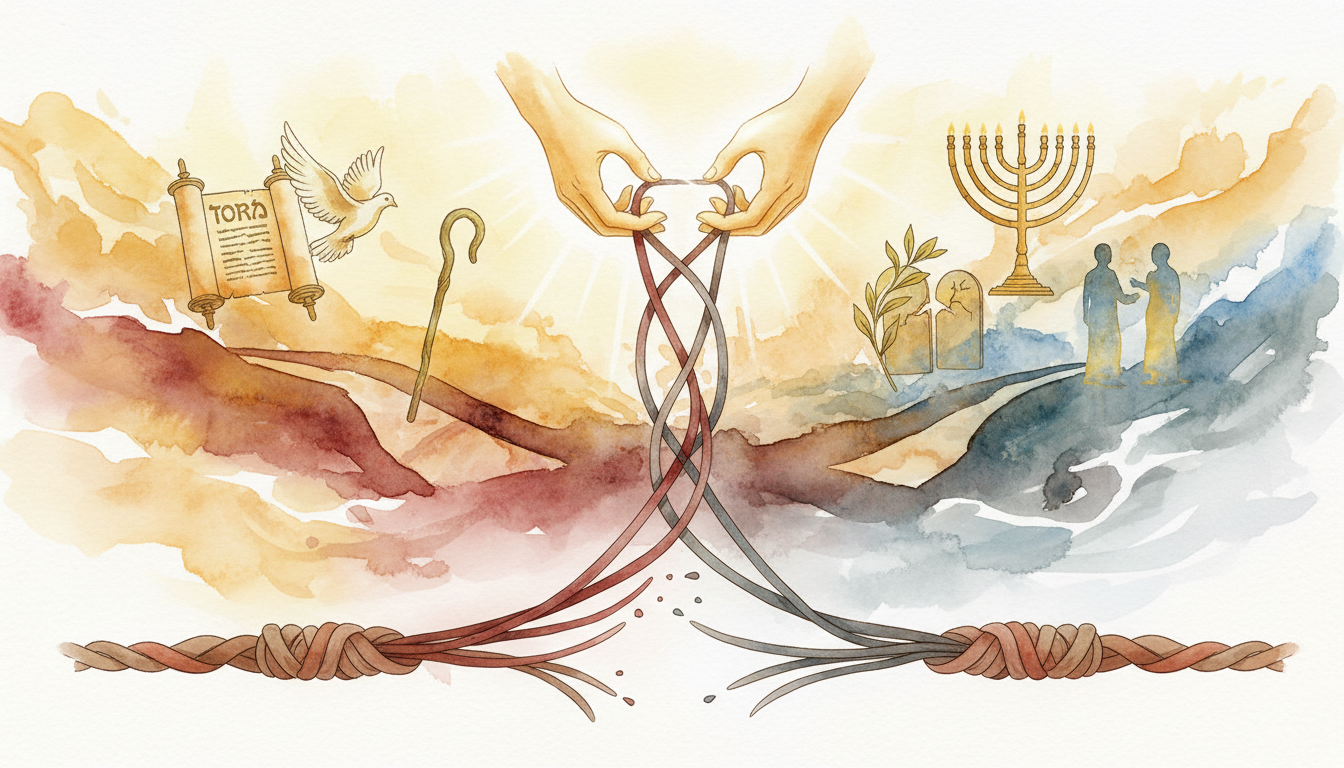
Divorce in the Bible: A Covenant and Compassion Reading
This course uncovers what the original biblical text reveals about divorce—not as a permission-versus-prohibition binary, but as a communal covenant issue centered on pastoral mercy and protecting the vulnerable. Beginning with Deuteronomy 24's protective framework, we trace how Jesus reinterprets divorce in light of God's design for permanence, how Paul navigates real pastoral crises in the church, and what the ancient sources tell us about hardness of heart, covenant breaking, and grace. By grounding each chapter in the primary text and enriching it with historical, linguistic, and theological evidence, learners discover that the Bible's teaching on divorce is far more nuanced, compassionate, and theologically profound than common tradition suggests.
What you'll study
The Deuteronomy 24 Permission: God's Reluctant Concession to Human Weakness
Deuteronomy 24:1-4
Malachi's Prophetic Reframe: When Covenant-Breaking Grieves the Lord
Malachi 2:14-16
Jesus and the Exception Clause: Matthew 19 and the Restriction to Porneia
Matthew 19:1-12
The Synoptic Differences: Why Mark Omits the Exception and What This Teaches
Mark 10:1-12 with comparison to Matthew 19 and Luke 16:18
Paul's Pastoral Wisdom: The Believer-Unbeliever Marriage and the Pauline Privilege
1 Corinthians 7:10-16
The Larger Vision: Marriage as Covenant, Divorce as Communion Breaking, and Redemptive Grace
Ephesians 5:25-33 with Romans 7:1-3 and 1 Peter 3:1-7
Chapter 1 · Free to read
The Deuteronomy 24 Permission: God's Reluctant Concession to Human Weakness
Deuteronomy 24:1-4
The Text
Deuteronomy 24:1–4 (BSB): If a man marries a woman, but she becomes displeasing to him because he finds some indecency in her, he may write her a certificate of divorce, hand it to her, and send her away from his house. If, after leaving his house, she goes and becomes another man's wife, and the second man hates her, writes her a certificate of divorce, hands it to her, and sends her away from his house, or if he dies, then the husband who divorced her first may not remarry her after she has been defiled, for that is an abomination to the LORD. You must not bring sin upon the land that the LORD your God is giving you as an inheritance.
Deuteronomy 24:1–4 (Deuteronomy 24:1–4 (BSB): If a man marries a woman, but she becomes displeasing to him because he finds some indecency in her, he may write her a certificate of divorce, hand it to her, and send her away from his house. If, after leaving his house, she goes and becomes another man's wife, and the second man hates her, writes her a certificate of divorce, hands it to her, and sends her away from his house, or if he dies, then the husband who divorced her first may not remarry her after she has been defiled, for that is an abomination to the LORD. You must not bring sin upon the land that the LORD your God is giving you as an inheritance.)
Key Terms
- כִּֽי־מָצָ֥א בָ֖הּ עֶרְוַת־דָּבָ֑ר · ki-matsa bah ervat-davar
- because he finds some indecency/nakedness/shame in her (a matter/thing)
- סֵ֥פֶר כְּרִיתֻ֖ת · sefer keritut
- certificate of divorce; document of cutting/severing
- וַהֲשִׁלְחָ֥הּ מִבֵּיתֽוֹ · va-hashlakhah mi-beto
- and he sent her away from his house
- תוֹעֲבָ֣ה לַֽיהוָ֔ה · toavah laYHWH
- an abomination to the LORD
Historical Foundation
Late Bronze Age Law Code through Second Temple Judaism (1400–1 BCE, with focus on Second Temple interpretation, 516 BCE–70 CE)
In the ancient Near Eastern world, marriage was a covenantal transaction between households—a binding legal arrangement involving property, inheritance, and social status. Unlike modern Western marriage (rooted in romantic love and individual choice), ancient marriages were economic and social contracts. Divorce, where permitted, was typically a male prerogative but carried complex implications for the abandoned woman: she lost her household status, her economic security, and her social standing. The Mosaic law, by requiring a written certificate (ketubah), actually RESTRICTED divorce compared to surrounding cultures and protected the divorced woman by giving her legal proof of her changed status—crucial for her ability to remarry. By the Second Temple period, however, Jewish interpreters had begun to relax these protections. The House of Hillel allowed divorce for nearly any reason (burnt food, finding a more beautiful woman), while the House of Shammai maintained stricter standards (moral or sexual impropriety). Jesus entered this debate and moved in the opposite direction—toward the original intent of the law: permanence, with an exception only for sexual infidelity (porneia in Greek). This was shocking to his contemporaries and reveals that God's ORIGINAL design (Genesis 2:24, cited in Matthew 19:4–6) took priority over Mosaic permission. The permission was remedial, not ideal—a concession to human hardness of heart.
Cultural World
In the ancient Near Eastern world, marriage was fundamentally a property and status transaction between households. In Hittite law codes (e.g., the Hittite Code, c. 1650–1180 BCE), divorce was permitted but typically involved financial penalties or the return of bride-price. In Mesopotamian law (Code of Hammurabi, c. 1754 BCE), a man could divorce his wife for infertility or neglect, but he owed her compensation—though she had minimal recourse. Egyptian marriage contracts (papyri from the Middle and New Kingdom periods) similarly favored male privilege in dissolution. The Mosaic law in Deuteronomy 24 is notably RESTRICTIVE compared to these Near Eastern parallels: it requires WRITTEN documentation (not just verbal dismissal), names a cause ('some indecency,' not mere caprice), and implicitly requires provision for the divorced woman (she is not simply expelled). The requirement for a written certificate (ketubah) is distinctly protective—it gave the woman legal standing to remarry and protected her against false claims of ongoing marriage. The prohibition on remarriage to the same woman (Deuteronomy 24:4) is unique to Israelite law and reflects covenant theology: the bond between man and woman mirrors the bond between God and Israel. To dissolve and reconnect is to treat the covenant carelessly—an 'abomination.' The Mosaic law thus moves in a more protective direction than surrounding cultures, even while permitting divorce. Jesus, however, moved further still—appealing back to the original creation account (Genesis 2:24, 'one flesh') as the true norm and treating the Mosaic permission as a concession to human hardness of heart (Matthew 19:8).
What the Evidence Shows
Deuteronomy 24:1–4 is not a permission granted; it is a regulation imposed on a practice already in existence. The law opens with a conditional ('if a man divorces his wife'), presupposing that divorce occurred in Israel. Matthew Henry and John Gill both note that Jesus clarified this in Matthew 19:8: Moses 'suffered' or 'permitted' divorce because of the 'hardness of their hearts,' not because God commanded it. The original design, stated in Genesis 2:24 ('a man shall leave his father and mother and be united to his wife, and they will become one flesh'), points toward permanence and covenant union. The Deuteronomy passage regulates divorce with three protective safeguards: (1) A CAUSE must exist ('some indecency')—not mere whim or preference. (2) A WRITTEN CERTIFICATE must be issued—requiring deliberation, witness, and formality. (3) A CONSEQUENCE is named—the divorced woman gains the legal standing to remarry, but the original husband forfeits the right to remarry her. By the First Temple period, the law had been established. By the Second Temple period (516 BCE–70 CE), however, interpretation had fractured. The House of Shammai (following the stricter reading of Shammai, c. 50 BCE–30 CE) held that 'indecency' meant serious sexual or moral fault—approaching the House of Shammai's stricter interpretation. The House of Hillel (following Hillel the Elder, c. 110 BCE–10 CE) loosened the standard dramatically: any grounds sufficed, including burnt food, an unbearable voice, or simply finding a more beautiful woman. This escalation away from the original protective intent is exactly what Jesus condemned in Matthew 19:3–9. Jesus appealed back to GENESIS—not Deuteronomy—as the true standard, calling remarriage after divorce 'adultery' (except in cases of porneia, sexual infidelity). In doing so, Jesus revealed that the Mosaic permission was remedial, not ideal. The law protected women from worse outcomes (abandonment without legal status, forced harsh treatment) but never endorsed divorce itself. God's reluctant concession was designed to prevent greater evil in a world of human hardness; it was not His blessing on the dissolution of covenant bonds. The cross-reference to Isaiah 50:1 ('Where is the certificate of your mother's divorce') and Jeremiah 3:1 ('If a man divorces his wife and she leaves him and marries another man, should he return to her?') confirm that even during the prophetic period, God viewed divorce as contrary to His heart. Jeremiah uses divorce imagery to describe Israel's unfaithfulness to God—showing that the covenant bond between God and His people transcends even the marital covenant. The law in Deuteronomy 24, then, is God's way of saying: 'I do not want this. But if hardness of heart leads you there, here are the rules that will least harm the vulnerable woman.'
Scholarly Witness
Henry emphasizes that Moses did not COMMAND divorce but only PERMITTED it due to the hardness of human hearts. The law's three protections (cause required, written form, consequence of permanent separation) all aim to restrict divorce and protect the divorced woman. Henry notes that by his time, the Jewish schools had erroneously expanded the grounds for divorce, and Christ corrected this by returning to the original design of permanent covenant union.
Gill carefully distinguishes 'indecency' (ervat davar) from adultery, which carried a death penalty. He chronicles the Jewish debate between Shammai and Hillel traditions, showing that the stricter interpretation (moral/sexual fault only) was initially preferred but later gave way to loosened standards (House of Hillel). Gill emphasizes that the law PROTECTS the divorced woman by giving her a written certificate—proof of her changed status and legal standing to remarry. This protection was radical in the ANE context.
JFB notes that Deuteronomy 24:5 immediately follows the divorce passage and stipulates that newly married men are exempt from military service for one year—'to bring joy to the wife he has married.' This juxtaposition suggests that the Torah's intent is to protect and sustain marriage, not enable its dissolution. The proximity of these laws reveals God's heart: first regulate divorce (if it happens), then strengthen marriage (the ideal).
Heiser argues that the Mosaic permission for divorce, when read against ANE legal codes (Hittite, Babylonian, Egyptian), was actually MORE RESTRICTIVE and MORE PROTECTIVE of women than surrounding cultures. The requirement for a written ketubah gave women legal standing and proof of status—unusual in the ancient world. This demonstrates that even the 'permissive' Mosaic law moved in a protective direction. However, by the Second Temple period, Jewish interpretation had drifted away from this protection, loosening grounds for divorce. Jesus's reinterpretation represents a return to the ORIGINAL protective intent and beyond—to the ideal of permanent covenant union rooted in Genesis 2:24.
Keener emphasizes that Jesus's teaching on divorce (Matthew 19:4–9) invokes Genesis 2:24 ('one flesh') as the original divine design and treats Mosaic permission as a concession to human weakness. Keener notes that in Matthew 19:7–8, the Pharisees cite Deuteronomy 24:1 as the basis for their permissive practice, but Jesus corrects them by pointing to the original creation account. This move—from Moses back to Genesis—reveals Jesus's hermeneutical principle: the original design takes priority over Mosaic regulations designed to mitigate harm in a fallen world.
Instone-Brewer's comparative study of Jewish divorce practice (first-century Pharisaic sources and rabbinic texts) demonstrates that the House of Hillel's permissive approach dominated Second Temple Judaism by Jesus's era. He shows that the language of Matthew 19:3 ('for any cause,' pasa aitia) directly addresses the Hillelite position. Jesus's response ('except for sexual immorality,' porneia) moves in the opposite direction—toward the House of Shammai's stricter interpretation but actually beyond it, appealing to Genesis as the true norm. This reveals that Jesus was not merely choosing one rabbinic school over another; he was transcending the entire debate by returning to creation theology.
Discovery Questions
1.Read Deuteronomy 24:1 carefully. What three PROCEDURAL requirements does the law impose on divorce? Why would each one matter in protecting the divorced woman in the ancient world?
The law requires: (1) a CAUSE ('some indecency')—not mere caprice; (2) a WRITTEN CERTIFICATE delivered by the husband—requiring deliberation and witness; (3) formal DISMISSAL from the household with, by implication, some provision for her future. In the ancient world, where women had minimal legal standing and no independent economic power, this was radical protection. The written certificate gave her proof of her changed status, enabling her to remarry without being falsely claimed as still-married. Compared to surrounding cultures (Hittite, Babylonian, Egyptian), where divorce was often informal and the woman had minimal recourse, Israel's law RESTRICTED and PROTECTED.
2.Matthew 19:7–9 records the Pharisees challenging Jesus with Deuteronomy 24. Why does Jesus respond by citing Genesis 2:24 instead of defending or reinterpreting Deuteronomy 24?
Jesus reveals that Deuteronomy 24 is NOT God's ideal; it is His REMEDIAL response to human hardness of heart. By citing Genesis 2:24 ('one flesh'), Jesus identifies the true design: permanent covenant union. The Mosaic permission was a concession, not a command or endorsement. Jesus's move—from Deuteronomy (the permission) back to Genesis (the design)—shows that the original creation theology takes priority over regulations designed to manage the fall. The Pharisees were using Deuteronomy to justify a practice; Jesus uses it to expose how far they had drifted from God's heart. This is hermeneutical: the law that looks permissive actually reveals God's reluctance and sorrow.
3.Look at the progression from Deuteronomy 24 to Matthew 19 to 1 Corinthians 7:10–16. How does Paul's teaching on divorce expand on Jesus's exception clause, and what does Ephesians 5:25–32 add by invoking 'one flesh' language in the context of Christ and the church?
Paul extends Jesus's teaching to new pastoral situations (what happens if an unbelieving spouse abandons the marriage?) while maintaining the same principle: permanence is the goal, but pastoral mercy is available when hardship is unavoidable. Ephesians 5:25–32 elevates the entire conversation by revealing that human marriage is a TYPE or IMAGE of Christ's covenant with the church. 'One flesh' (Genesis 2:24) is quoted in Ephesians 5:31 in this context—showing that the marriage covenant participates in the mystery of divine covenant-keeping. This canonical development shows that the law of Deuteronomy 24, Jesus's reinterpretation, and Paul's pastoral application all flow from the same theology: marriage is covenantal, permanent, and reflects God's character as a faithful covenant-keeper.
4.Bring together Jeremiah 3:1 (God speaks of Himself as a divorced husband who cannot remarry Israel) and Deuteronomy 24:4 (the prohibition on remarriage). What does this connection reveal about God's view of divorce and covenant-breaking?
The Jeremiah passage shows that even the prophet, living under the Mosaic law that permitted divorce, understood divorce as contrary to God's character. By using Himself as the example of a faithful covenant-keeper who CANNOT remarry the unfaithful partner, God reveals that the law of Deuteronomy 24 was never intended to normalize or endorse divorce. Rather, it was a regulation for a world broken by sin. The law's language of 'abomination' (Deuteronomy 24:4) and the prophet's use of divorce as a metaphor for unfaithfulness both point to the same truth: God views the breaking of covenant bonds as contrary to His nature and design. The law permits it (to prevent worse harm) but never approves of it. God is the faithful covenant-keeper; the law demands that His people imitate His faithfulness, not His tolerance of human failure.
Connected Passages
- Genesis 2:24 — The original design: 'a man shall leave his father and mother and be united to his wife, and they will become one flesh.' This is Jesus's appeal in Matthew 19:4–6, establishing permanence and covenant union as God's ideal, of which Deuteronomy 24's permission is only a regulation.
- Matthew 19:3–9 — The Pharisees invoke Deuteronomy 24:1 to justify divorce 'for any cause.' Jesus corrects them by citing Genesis 2:24 and revealing that Moses 'permitted' divorce only because of hardness of hearts. Jesus's exception ('except for sexual immorality') is the only ground for divorce—showing a move toward permanence, not away from it.
- Mark 10:2–12 — Mark's parallel account adds the principle of covenant equality: the teaching applies to women divorcing men as well. This reveals that Deuteronomy 24's regulation of male-initiated divorce is being transcended by a kingdom ethic where both spouses are bound by the same covenant obligation.
- 1 Corinthians 7:10–16 — Paul extends Jesus's teaching to new pastoral situations (mixed marriages, unbelieving spouses). While affirming the ideal of permanence ('a wife must not separate from her husband'), Paul offers pastoral mercy when an unbeliever abandons the marriage. This shows the canonical principle: permanence is the goal, but love and mercy meet human weakness.
- Ephesians 5:25–32 — The marriage covenant is revealed as a type of Christ's covenant with the church. The language of 'one flesh' (Genesis 2:24) is quoted here in the context of Christ's sacrificial faithfulness and headship. This elevates the entire conversation: human marriage covenants participate in and reflect divine covenant-keeping. Permanence is not merely a legal obligation but a participation in Christ's character.
- Jeremiah 3:1 — The prophet uses Deuteronomy 24:4 language to depict God as a faithful covenant-keeper who cannot simply remarry Israel because 'she has been defiled.' This shows that even under the law permitting divorce, the prophets understood it as contrary to God's character and design.
- Isaiah 50:1 — God speaks of His covenant with Israel in divorce language: 'Where is your mother's certificate of divorce?' This rhetorical question affirms God's faithfulness—He has NOT divorced Israel, despite her unfaithfulness. The passage reveals God's heart: covenant-keeping is His character, not His burden.
- Malachi 2:10–16 — The prophet criticizes Israel for 'breaking faith' with the wives of their youth and calls marriage 'a covenant before the Lord.' This reiterates the covenantal nature of marriage and God's hatred of 'covering your garment with violence'—a metaphor for the injustice of arbitrary divorce. Shows OT concern for vulnerable women.
Takeaways
- The law of Deuteronomy 24 is God's REGULATION of divorce, not His endorsement of it. Moses 'permitted' divorce because of human hardness of hearts, but the original design (Genesis 2:24) points to permanence. The law's three protections—requiring a cause, written form, and formal dismissal—all aim to restrict divorce and protect the vulnerable woman. This reveals God's reluctant concession: 'I do not want this, but if it happens, here are the rules that will least harm the innocent partner.'
- The Mosaic law actually RESTRICTED divorce compared to surrounding Ancient Near Eastern cultures. Hittite, Babylonian, and Egyptian law codes allowed divorce more freely and offered women less protection. Israel's requirement for a written certificate (ketubah) was radical: it gave the divorced woman legal proof of her status, enabling her to remarry and protecting her from false claims. What looks 'permissive' to modern readers was actually PROTECTIVE in its original context. This shows that even the law's accommodation to human weakness included God's care for the vulnerable.
- By the Second Temple period (1st century BCE–1st century CE), Jewish interpretation had drifted from the law's original protective intent. The House of Hillel allowed divorce for trivial causes (burnt food, finding a more beautiful woman), making the law serve caprice rather than justice. Jesus's reinterpretation corrects this drift by appealing back to Genesis and the creation theology of covenant permanence. He moves in the opposite direction from his contemporaries—toward an even stricter standard. This reveals Jesus's hermeneutical principle: the original design always takes priority over accommodations made necessary by human failure.
- The language of Deuteronomy 24:4—'an abomination to the LORD'—uses covenant-breaking terminology. This language, combined with the prophetic use of divorce imagery (Jeremiah 3, Isaiah 50, Malachi 2) to describe God's heartbreak over Israel's unfaithfulness, shows that the entire OT tradition viewed divorce as contrary to God's character. The permission was remedial (to prevent worse harm in a fallen world), but the ideal remains permanence and covenant-keeping. God does not divorce; His people are called to image His faithfulness.
- The New Testament extends this by connecting human marriage covenants to Christ's covenant with the church (Ephesians 5:25–32). The 'one flesh' language of Genesis 2:24 is quoted in the context of Christ's sacrificial headship and the church's submission. This reveals that permanence in marriage is not merely legal obligation; it is participation in Christ's character as the faithful covenant-keeper. Paul's pastoral guidance in 1 Corinthians 7 affirms this ideal while extending mercy to situations (like mixed marriages) that were not directly addressed in Jesus's teaching. The principle remains: permanence is the goal, but love and mercy meet human weakness without abandoning the covenant ideal.
Application
If you are married: Reflect on your covenant vows as a mirror of God's faithfulness. Deuteronomy 24's reluctant permission reveals that marriage is a serious covenant before God, not merely a contract terminable at convenience. Where have you drifted from the original design of 'one flesh' permanence? What would it mean to renew your commitment to image God's covenant-keeping, not merely your tolerance? If your marriage is struggling, seek counsel and prayer before considering any dissolution. If you are divorced or in a remarried situation: Know that this study is not an indictment of you but a recovery of God's original heart. If divorce happened before you understood its gravity, or in a situation involving infidelity, abandonment, or abuse, God's mercy extends to you. The law's protections for the vulnerable woman reflect God's compassion. Do not hear condemnation; hear God's call to steadfastness moving forward. If you are single or considering marriage: Understand that marriage, as designed in Genesis and regulated by God's law, is a covenantal bond—more serious than contemporary culture suggests. Do not enter this covenant lightly. Seek a partner committed to permanence and to imaging Christ's faithfulness. If you are a pastor or counselor: This passage calls you to protect the vulnerable, especially women trapped in dissolving marriages. The Mosaic law, despite permitting divorce, was designed to guard the abandoned woman's dignity and standing. Your role is to hold together both truths: the ideal of permanence and the pastoral reality of human weakness. Advocate for the vulnerable, guard against casual dissolution, and extend mercy to those who have experienced the pain of marital breakdown.
Continue the course — 5 more chapters
Malachi's Prophetic Reframe: When Covenant-Breaking Grieves the Lord
Malachi 2:14-16
What does Malachi reveal about God's true stance on divorce, and how does this prophetic word set up Jesus's teaching on permanence and hardness of heart?
Jesus and the Exception Clause: Matthew 19 and the Restriction to Porneia
Matthew 19:1-12
Why does Jesus restrict divorce to porneia (sexual unfaithfulness), and what does His appeal to creation order tell us about the original design God intended for marriage as covenant?
The Synoptic Differences: Why Mark Omits the Exception and What This Teaches
Mark 10:1-12 with comparison to Matthew 19 and Luke 16:18
How do the Gospel accounts differ in their reporting of Jesus's divorce teaching, and what does this variation reveal about the early church's pastoral wrestling with Jesus's radical principle?
Paul's Pastoral Wisdom: The Believer-Unbeliever Marriage and the Pauline Privilege
1 Corinthians 7:10-16
How does Paul apply Jesus's teaching to the concrete crisis of mixed marriages in Corinth, and what does his allowance for separation reveal about pastoral mercy meeting gospel principle?
The Larger Vision: Marriage as Covenant, Divorce as Communion Breaking, and Redemptive Grace
Ephesians 5:25-33 with Romans 7:1-3 and 1 Peter 3:1-7
What does the New Testament's theology of marriage as an unbreakable covenant—and its grounding in Christ's love—teach about both the permanence God desires and the hope available to the broken and divorced in Christ's redemption?
No credit card required
Sources Used
Every insight traces to a named source. 0 AI-generated interpretations.
Related courses
What Does the Bible Say About Tithing? A Covenant-Based System Revealed
This course traces the biblical teaching on tithes from Abraham through the early church, uncovering how tithing functioned not as a simple percentage but as a multifaceted covenant practice tied to priestly support, festival celebration, and care for the poor. We discover that the original text reveals something richer than the simplified 10% rule: a system rooted in relationship with God and community care. The course culminates in understanding how Jesus and the apostles transformed this practice into grace-motivated voluntary generosity, enriching rather than abandoning the principle of faithful giving.
5 chapters
What Does the Bible Say About Faith? Recovering Covenant Trust, Embodied Obedience, and Communal Faithfulness
This course deepens understanding of biblical faith (emunah/pistis) beyond modern definitions of belief to recover the original semantic and relational richness of the texts. Through careful study of key passages across the canon, learners will discover that biblical faith operates as covenant trust, finds expression in embodied obedience, and exists within communal faithfulness. Rather than an internal conviction alone, faith in Scripture is a dynamic trust-in-action directed toward God, rooted in His promises, and demonstrated through practical loyalty. This course traces faith from Abraham through the incarnation, showing how the concept develops while maintaining its core relational character, and invites learners to experience their own faith deepened rather than dismantled.
5 chapters
What Does the Bible Say About Marriage? A Biblical Foundation for Covenant, Creation, and Kingdom
This five-chapter course explores the Bible's teaching on marriage as a covenantal union rooted in creation, embodied in household life, revealing Christ's relationship to the Church, and extending into God's renewed creation. Rather than settling for reductive views (companionship-only or dualistic denial of embodied life), we return to the original biblical text to discover marriage's richer theological significance: it is simultaneously a creation mandate, a covenant bond, a sexual and relational union, and a sign of Christ's redemptive love. Each chapter is anchored in a key passage and progressively deepens our understanding through textual, theological, cultural, and historical evidence.
5 chapters
Overcoming Fear: Biblical Reverence and the Covenant Presence of God
A five-chapter exploration of how the Bible redefines fear—not as anxiety to be conquered through willpower, but as reverent alignment with God's reality and presence. This course traces the original meaning of yirah (fear) from the Old Testament through the apostolic church, showing how faith in God's covenant faithfulness, not self-generated courage, is the true antidote to human anxiety and threat. Each chapter is anchored in a key biblical passage and enriched by historical, textual, and theological evidence.
5 chapters
What Does Scripture Teach About Money? A Covenantal Vision Beyond Personal Virtue
This six-chapter course recovers the Bible's richest teaching on money as a covenantal and structural force, not merely a tool for individual moral performance. Beginning with the foundational text that distinguishes the love of money from money itself, the course traces how Hebrew economic law embedded justice into community structures, how Jesus named money as a rival power (mammon), and how apostolic practice revealed economics as a cosmic realignment. Each chapter starts with primary Scripture and shows how cultural, historical, and theological context deepens—not replaces—what the text already says. Learners will discover that biblical money teaching is far more concerned with concrete justice NOW in covenant community than with afterlife reward, and that wealth functions as a theological force requiring both personal AND corporate transformation. This is enrichment and recovery: the biblical text proves richer than inherited tradition suggested.
6 chapters
What Does the Bible Reveal About Anger as a Relational Response?
A five-chapter biblical exploration of anger as neither inherently sinful nor a mere emotion to suppress, but a morally complex relational response. This course traces how Scripture distinguishes between destructive and righteous anger, reveals anger and love coexisting in God's character, and shows how Christ's incarnation reframes human anger within redemptive justice. Learners will discover that the biblical text on anger is far richer than common tradition suggests—anger itself is morally neutral; the object, motive, and expression determine its ethical weight.
5 chapters
Create your own Bible studies — free.
Ask any question. Get evidence from named scholars and curated datasets in minutes.
Get Started Free