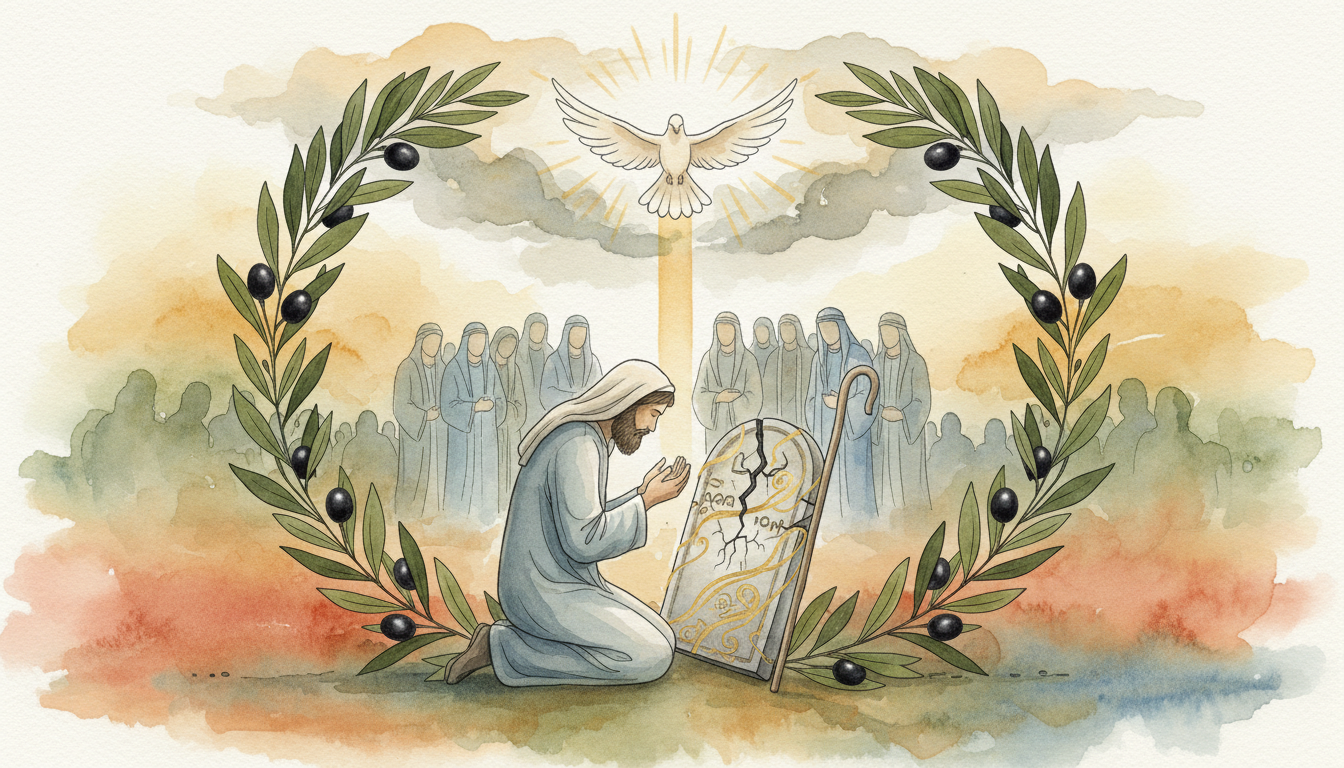
Jesus's Forgiveness Theology: Repentance, Community, and Covenantal Restoration
A 5-chapter biblical course exploring Jesus's teaching on forgiveness as fundamentally relational, community-restoring, and conditioned on repentance—far richer than the 'forgive everything always' simplification. We begin with Jesus's own words on limits and conditions, move through his modeling and the early church's embodiment, and conclude by recovering the full theological weight of forgiveness as covenantal restoration, not mere individual sentiment. Each chapter anchors in canonical text, enriched by cultural context, to deepen faith in both the radicality and the specificity of Christ's demand on disciples.
What you'll study
The Repentance-Condition: Matthew 18:21–35 and the Parable's Relational Logic
Then Peter came to him and said, 'Lord, if my brother sins against me, how often should I forgive him? As many as seven times?' Jesus said to him, 'Not seven times, but, I tell you, seventy-seven times. For this reason the kingdom of heaven may be compared to a king who wished to settle accounts with his slaves. When he began the reckoning, one who owed him ten thousand talents was brought to him; and, as he could not pay, his lord ordered him to be sold, together with his wife and children and all his possessions, and payment to be made. So the slave fell on his knees, saying,
The Prerequisite of Metanoia: Luke 17:3–4 and the Grammar of Forgiveness
Be on your guard! If another disciple sins, you must rebuke the offender, and if there is repentance, you must forgive; and if the same person sins against you seven times a day and turns back to you seven times and says, 'I repent,' you must forgive.
The Covenantal Weight: Matthew 6:9–13, Mark 11:25–26, and the Reciprocal Link Between Divine and Human Forgiveness
Our Father in heaven, hallowed be your name. Your kingdom come. Your will be done, on earth as it is in heaven. Give us this day our daily bread. And forgive us our debts, as we also have forgiven our debtors. And do not bring us to the time of trial, but rescue us from the evil one. (Matthew 6:9–13) Whenever you stand praying, forgive, if you have anything against anyone; so that your Father in heaven may also forgive you your trespasses. (Mark 11:25–26)
The Costly Model: Luke 23:34, John 20:21–23, and Forgiveness as Cruciform Discipleship
Then Jesus said, 'Father, forgive them; for they do not know what they are doing.' (Luke 23:34) Jesus said to them again, 'Peace be with you. As the Father has sent me, so I send you.' When he had said this, he breathed on them and said to them, 'Receive the Holy Spirit. If you forgive the sins of any, they are forgiven them; if you retain the sins of any, they are retained.' (John 20:21–23)
The Corporate Practice: Matthew 18:15–20, Romans 12:14–21, Colossians 3:12–14, and the Ecclesial Embodiment of Jesus's Forgiveness
If another member of the church sins against you, go and point out the fault when the two of you are alone. If the member listens to you, you have regained that one. But if you are not listened to, take one or two others along with you, so that every word may be confirmed by the evidence of two or three witnesses. If the member refuses to listen to them, tell it to the church; and if the offender refuses to listen even to the church, let such a one be to you as a Gentile and a tax collector. Truly I tell you, whatever you bind on earth will be bound in heaven, and whatever you loose on earth will be loosed in heaven. Again, truly I tell you, if two of you agree on earth about anything you ask, it will be done for you by my Father in heaven. For where two or three are gathered in my name, I am there among them. (Matthew 18:15–20) Bless those who persecute you; bless and do not curse them. Rejoice with those who rejoice, weep with those who weep. Live in harmony with one another; do not be haughty, but associate with the humble; do not claim to be wiser than you are. Repay no one evil for evil, but take thought for what is noble in the sight of all. If it is possible, so far as it depends on you, live peaceably with all. Beloved, never avenge yourselves, but leave room for the wrath of God; for it is written, 'Vengeance is mine, I will repay, says the Lord.' No, 'if your enemies are hungry, feed them; if they are thirsty, give them something to drink; for by doing this you will heap coals of fire on their heads.' Do not be overcome by evil, but overcome evil with good. (Romans 12:14–21)
Chapter 1 · Free to read
The Repentance-Condition: Matthew 18:21–35 and the Parable's Relational Logic
Then Peter came to him and said, 'Lord, if my brother sins against me, how often should I forgive him? As many as seven times?' Jesus said to him, 'Not seven times, but, I tell you, seventy-seven times. For this reason the kingdom of heaven may be compared to a king who wished to settle accounts with his slaves. When he began the reckoning, one who owed him ten thousand talents was brought to him; and, as he could not pay, his lord ordered him to be sold, together with his wife and children and all his possessions, and payment to be made. So the slave fell on his knees, saying,
The Text
Then Peter came to him and said, 'Lord, if my brother sins against me, how often should I forgive him? As many as seven times?' Jesus said to him, 'Not seven times, but, I tell you, seventy-seven times. For this reason the kingdom of heaven may be compared to a king who wished to settle accounts with his slaves. When he began the reckoning, one who owed him ten thousand talents was brought to him; and, as he could not pay, his lord ordered him to be sold, together with his wife and children and all his possessions, and payment to be made. So the slave fell on his knees, saying, 'Have patience with me, and I will pay you everything.' Moved by pity, the lord of that slave released him and forgave him the debt. But that same slave, as he went out, came upon one of his fellow slaves who owed him a hundred denarii; and seizing him by the throat, he said, 'Pay what you owe.' Then his fellow slave fell down and pleaded with him, 'Have patience with me, and I will pay you.' But he refused; then he had him thrown into prison until he should pay the debt. When the other slaves saw what had happened, they were greatly distressed, and they went and reported to their lord all that had taken place. Then his lord summoned him and said, 'You wicked slave! I forgave you all that debt because you pleaded with me. Should not you have had mercy on your fellow slave, as I had mercy on you?' And in anger his lord handed him over to the torturers until he should pay his entire debt. So my heavenly Father will also do to every one of you, if you do not forgive your brother or sister from your heart.' (Matthew 18:21–35, NRSV)
Matthew 18:21–35 (The passage appears in all major Greek manuscript families (Codex Sinaiticus, Codex Vaticanus, Codex Alexandrinus, and later Byzantine manuscripts). The NRSV translation above reflects the oldest attestable form. Key terms retain their force in translation: 'forgive' (aphiemi in Greek—literally 'to send away' or 'release'), 'slave' (doulos—servile status, not hired labor), 'talent' and 'denarius' (specific monetary units), and 'from your heart' (ek tou perisseumatos tēs kardias—from the abundance or fullness of the heart, suggesting a comprehensive, internal transformation, not mere external compliance).)
Key Terms
- ἀφίημι (aphiemi) · af-ee'-ay-mee
- To send away, release, dismiss, or forgive. In this passage, used twice: first of the king's release of the slave's debt (Matt 18:27), and second of the expected forgiveness between disciples (18:35). The word carries the sense of a complete, irreversible release—not merely overlooking or suspending judgment.
- δοῦλος (doulos) · doo'-los
- Slave; one in servile status with no rights and subject to the absolute authority of a master (kyrios). In the parable, both the unforgiving servant and the one he attacks are douloi—indicating their shared vulnerability and mutual dependence on their master's mercy.
- τάλαντον (talanton) · tal'-an-ton
- A talent; the heaviest unit of precious metal weight and value in the ancient Mediterranean world. One talent of silver weighed roughly 33 kilograms and represented the annual income of a skilled laborer multiplied by thousands (roughly 6,000 denarii). The ten-thousand-talent debt is astronomically, impossibly large—beyond any individual's ability to repay.
- ἐκ τοῦ περισσεύματος τῆς καρδίας (ek tou perisseumatos tēs kardias) · ek too per-is-syoo'-mat-os tace kar-dee'-as
- From the abundance or fullness of the heart. In Matthew 12:34, Jesus uses the same phrase: 'Out of the abundance of the heart the mouth speaks.' Here it means forgiveness rooted in internal transformation, not external performance. The parable's judgment falls on the servant precisely because his actions did not flow from renewed interiority.
- μετανοέω (metanoeō) [implicit in context] · met-an-o-eh'-o
- To turn around, change one's mind, repent. While the term does not appear in Matthew 18:21–35 itself, it is central to the parable's logic: the servant's plea 'Have patience with me, and I will pay you everything' signals attempted repentance. The king's response (releasing the debt) is predicated on the servant's posture of repentance, yet the servant himself never undergoes the internal transformation (metanoia) the parable assumes.
- ἀπό (apo) [in relation to forgiveness dynamics] · ap-o'
- From, away from. Used in the phrase 'forgive from your heart' (aphiemi apo kardias), it denotes the source from which forgiveness flows. The preposition emphasizes that forgiveness originates in the renovated interior—not from external compulsion or calculation.
Historical Foundation
Second Temple Judaism and Early Christian Movement
Second Temple Jewish society was stratified by wealth, religious authority, and social status. The Pharisaic movement emphasized detailed legal interpretation (halakha) of Torah, particularly around righteousness, purity, and relational ethics. Debt slavery was a live social reality—those unable to pay creditors faced sale into servitude, often affecting entire families under Roman and Jewish law. Forgiveness traditions in Judaism centered on repentance (teshuvah) and reconciliation, but limits existed: rabbinic teaching generally allowed for limited forgiveness cycles. The early Jerusalem church, comprised of Jews, grappled with how to live out Jesus's radical teaching on forgiveness within communities where economic vulnerability and relational wounds ran deep. This parable emerges in that crucible—not as abstract theology but as a response to Peter's real, practical question about relationship repair and communal boundaries.
Cultural World
The parable operates within the assumed world of Greco-Roman debt slavery and patronage (Latin: patronus-cliens relationship). In the ancient Mediterranean, debt was a binding obligation. A creditor could seize a debtor and his family, selling them into servitude to recover payment. This is not incidental to the parable but central: the king's authority to order sale (including of the slave's wife and children) reflects actual legal practice. However, the parable inverts typical ANE and Greco-Roman assumptions. In the Code of Hammurabi (Babylonian, c. 1750 BCE), debt slavery lasted a fixed term (generally three years; see laws 116–119). A master's mercy was legally possible but optional and culturally praised only if it benefited the master's reputation. The biblical parable, by contrast, presents mercy not as optional courtesy but as the defining mark of kingdom membership. The king's forgiveness is absolute (complete release, not suspension), immediate, and motivated by the servant's plea—not self-interest. The servant's failure to extend this kingdom-logic to a peer reveals that he has fundamentally misunderstood the nature of grace. The household (oikos) is the pedagogical unit: the king as pater familias (household head) establishes the moral order. All who dwell in his household—whether slave or free—are subject to his authority and example. In Matthew's Jewish context, this resonates with rabbinic teaching on the patriarch as moral exemplar (the father's mercy should shape children's character), but Jesus radicalizes it: not merely family members but all disciples are reordered by the king-father's radical mercy.
What the Evidence Shows
Matthew 18:21–35 presents Jesus's response to Peter's question about forgiveness limits as a parable that utterly destabilizes conventional moral accounting. Peter, reasoning from Jewish precedent, proposes 'seven times'—a culturally generous offer that would signal virtue in rabbinic estimation (seven symbolizing completeness in Hebrew thought). Jesus's counter—'seventy-seven times' (or in some manuscripts, 'seventy times seven,' equaling 490)—is not a higher number but a refusal of numerical limitation itself. The parable then explains why through dramatic inversion. The servant, facing ruinous debt (10,000 talents—an impossible sum meant to represent the totality of human sin before God), receives not punishment but complete release. His plea ('Have patience with me, and I will pay you everything') triggers the king's compassion (splagchnizomai—moved in his bowels, his deepest emotional and moral center). The release is total, unconditional, and absolute. Yet the same servant, encountering a peer in minor debt (100 denarii—roughly 1/600,000th of his own former obligation), chooses violent coercion over mercy. He refuses the identical plea that moved the king. The parable's pivot is decisive: the king's other servants witness this injustice and report it. The king then reverses his mercy, reinstating the debt and handing the servant to torturers (basanistais) until full payment—an impossible condition that renders him perpetually enslaved. Jesus's final application ('So my heavenly Father will also do to every one of you, if you do not forgive your brother or sister from your heart') does not soften this judgment but grounds it: forgiveness is not optional or provisional for kingdom members; it is the constitutive mark of those who have received kingdom mercy. The parable's logic is relational and covenantal: those who experience radical grace are obligated—not by external law but by transformed identity—to extend that same grace. Failure to do so is not a separate sin but a repudiation of the grace that constituted you. The parable punishes the unforgiving servant not because Jesus revokes mercy but because the servant has fundamentally rejected the mercy that would have transformed him. His enslavement is the consequence of his refusal to enter the king's household order.
Scholarly Witness
In his Homilies on Matthew, Chrysostom emphasizes that the parable teaches not merely the command to forgive but the necessity of transformative mercy. He argues that the king's forgiveness aims to reshape the servant's character, and the servant's failure reveals a hardened soul resistant to grace. For Chrysostom, the parable is pastoral—it addresses the actual condition of disciples who hear but do not internalize Jesus's teaching. The punishment is not vindictive but inevitable: a soul that refuses grace cannot be saved by grace.
Henry's Commentary emphasizes the 'infinite disproportion' between the servant's debt and the fellow slave's debt, using this to illustrate the incommensurable difference between human sin against God and inter-personal wrongs. He teaches that Jesus's parable establishes the principle: those who have experienced unlimited forgiveness from God are bound by conscience and gratitude to extend limited (yet generous) forgiveness to others. Henry sees the parable as a call not merely to forbearance but to a transformation of will that makes forgiveness natural and joyful, flowing from a renewed heart.
Luz argues that Matthew 18:21–35 is structured as a challenge to Peter's quantification of forgiveness. The parable inverts the arithmetic of justice: the king's mercy is not graduated (more for greater repentance) but absolute. The servant's subsequent hardness reveals that he has not undergone the metanoia (transformation) that grace intends. Luz emphasizes the parable's realism regarding debt slavery while stressing its radical theological move: forgiveness is not conflict resolution or mere letting-go but participation in the king's household order. The final judgment is not cruel punishment but the necessary outcome of refusing to be remade by grace.
Garland (Mark commentary, and in Matthew studies) stresses the parable's relational logic: forgiveness is not a solo act of individual virtue but a communal transformation initiated by grace. The king's mercy establishes a household order in which all members are bound to extend to one another the mercy they have received. The servant's failure is not merely personal sin but a breach of covenantal obligation. Garland connects this to Matthew's broader concern with community discipline and reconciliation (Matthew 18:15–20 precedes the parable), arguing that Jesus teaches forgiveness as the constitutive practice of the kingdom community.
Levine brings Jewish context to the parable, noting that Jesus's teaching on unlimited forgiveness ('seventy-seven times') deliberately exceeds rabbinic norms (Yoma 87a on three-fold forgiveness). She argues that the parable is not anti-Jewish but rather a radical intensification of Jewish covenantal theology: if God's mercy is unlimited (Psalm 103, Exodus 34:6–7), then disciples who have received that mercy must extend it without limit. Levine emphasizes that the parable's harshness toward the unforgiving servant is consonant with Jewish judgment theology—those who refuse covenant obligations face covenant consequences. The parable is not about whether God will forgive but about whether disciples will align themselves with God's character.
Gorman argues that Matthew 18:21–35 presents forgiveness as 'cruciform'—shaped by the cross. He connects the parable to Matthew's Christology: the king's radical mercy prefigures Christ's death for the ungodly (Romans 5:8). The servant's hardness reveals a heart not yet conformed to Christ's self-emptying love. Gorman stresses that forgiveness is not merely sentiment or leniency but the practice of kenotic (self-emptying) love that mirrors Christ's redemptive self-surrender. The parable teaches that refusing to forgive is, ultimately, refusing to be cruciform—refusing to be remade in the image of Christ.
Long emphasizes that the parable is not a threat but an invitation—the king offers the servant a new identity within the household. The servant's refusal to forgive the fellow slave is not a separate violation but a rejection of the identity the king has bestowed. Long argues that the parable's harsh ending is actually good news: it reveals that refusal of grace has real consequences, which means that acceptance of grace has real transformative power. For preachers and pastors, Long stresses that the parable calls the community to become the kind of people who forgive—not from duty but from recognition of what grace has done in us.
Discovery Questions
1.Peter proposes 'seven times' as a limit on forgiveness. Why would seven have seemed like a generous or even maximum number in his context, and what does Jesus's response ('seventy-seven times,' or 'seventy times seven') actually mean?
Jesus is not proposing a higher quota but a refusal of quantification itself. The parable then teaches why: grace is not transactional arithmetic but a reorientation of the entire person. The evidence shows that rabbinic ethics allowed for limits on forgiveness (Yoma 87a mentions three cycles of repentance), so Peter's 'seven' was not unreasonable—it was actually generous by standard interpretation. Jesus's counter abolishes the framework of counting. This reveals that he is not merely intensifying an existing command but teaching something fundamentally different: that those who have received boundless mercy are constituted as boundless forgivers, not by external quota but by internal transformation.
2.The servant's plea to the king ('Have patience with me, and I will pay you everything') is repeated almost word-for-word when the fellow slave pleads with the servant. Why does the parable repeat this language, and what does the servant's refusal of an identical plea reveal?
The repetition is not accidental but didactic—the parable is designed to make the reader feel the moral whiplash of the servant's hardness. The identical plea should trigger the servant's memory of his own desperation and the king's compassionate response. His refusal reveals that he has not been internally transformed by grace; he has merely received external release from debt. The evidence shows that genuine forgiveness (according to Matthew 18:35) must flow 'from your heart'—from the abundance of a transformed interior. The servant's hardness of heart proves that he never underwent the metanoia (internal reorientation) that grace should produce. This illuminates the parable's logic: forgiveness is not a transaction but a transformation. Receiving mercy should make you merciful. Refusing mercy reveals that you never truly received it.
3.The parable's final judgment is severe: the king hands the unforgiving servant to 'torturers until he should pay his entire debt.' But the servant could never pay 10,000 talents. What does this impossible condition reveal about the nature of the judgment and its connection to the earlier forgiveness?
The judgment is not arbitrary cruelty but a revelatory consequence: the servant who refuses grace re-enters the state of bondage from which grace alone could liberate him. The evidence from Romans 6:1–14 and 2 Peter 2:20–22 shows this is a consistent NT pattern—grace is offered as transformation, not as amnesty that leaves character untouched. The servant's enslavement becomes perpetual because he has rejected the grace that would have freed him internally. The parable's logic is covenantal: grace is not a one-time transaction but an ongoing offer of transformation. When the servant encounters a peer in need, the parable gives him a chance to internalize the mercy he received—to let it reshape him. His refusal means he has ultimately said no to grace itself. The reinstatement of the debt is not revocation of mercy but the necessary consequence of rejecting it. This is not punitive but relational: a person who refuses to be remade by grace cannot be saved by grace.
4.Jesus concludes: 'So my heavenly Father will also do to every one of you, if you do not forgive your brother or sister from your heart.' How does this final application transform the parable from a warning into a call to transformation, and what does it mean for the early church community hearing this?
The evidence shows that Jesus is not threatening external punishment but revealing an internal truth: those who belong to God's household are being remade in God's image. If God's character is merciful (Exodus 34:6–7, Psalm 103), then those who have received God's mercy are being transformed into merciful people. To refuse this transformation is to refuse God's kingdom itself. The phrase 'from your heart' connects this to Matthew 12:34 ('out of the abundance of the heart the mouth speaks') and forward to Romans 6:17 ('you have become obedient from the heart'). The early church, hearing this, would understand that forgiveness is not optional virtue but the foundational practice by which disciples prove they have been genuinely transformed by grace. The application reaches back to Matthew 6:12, 14–15 (the Lord's Prayer: 'forgive us as we forgive others') and forward to Colossians 3:13 ('bearing with one another and forgiving each other, just as the Lord forgave you'). The parable becomes a call: become who grace has made you. Refuse, and you reveal you never truly received it.
5.In what specific ways does the parable use economic language and imagery (talents, denarii, debt, slavery, payment) to teach a spiritual reality about God's kingdom, and why would this concrete, material language resonate with Matthew's audience?
The evidence shows that Jesus is not speaking in abstraction but in terms his audience understood viscerally. The Code of Hammurabi and Greco-Roman legal documents show that debt slavery was a genuine social crisis—entire families could be sold for default. By setting the parable in this world, Jesus makes the point concrete: the mercy you have received from God is as real and as transformative as the liberation from impossible debt. The economic disparity (10,000 talents vs. 100 denarii) is not arbitrary but pedagogical—it teaches that the difference between our sin and interpersonal wrongs is immeasurable, yet God forgives the immeasurable debt. The servant's refusal to extend even a tiny mercy to a peer becomes morally monstrous when understood against this backdrop. For Matthew's community—which included both wealthy individuals and those living on the edge of poverty—the parable speaks to real relational wounds and real economic pressure. It teaches that kingdom economics are different: grace, not force; mercy, not leverage. The evidence from Matthew 6:11–12 ('give us this day our daily bread' alongside 'forgive us our debts') shows that Matthew connects material provision with relational forgiveness—both are expressions of God's household order.
Connected Passages
- Matthew 6:12, 14–15 (The Lord's Prayer) — Establishes the foundational principle that discipleship requires forgiving others as God forgives us. 'Forgive us our debts, as we also forgive our debtors...for if you do not forgive others, neither will your Father forgive your trespasses.' This is the seed teaching that Matthew 18:21–35 expands and illustrates.
- Matthew 5:38–42 (Teaching on retaliation) — Jesus teaches 'turn the other cheek' and 'go the second mile'—concrete practices that embody the merciful, non-retaliatory character that the parable assumes. The servant in Matthew 18 violates this entire ethos by seizing the fellow slave 'by the throat.'
- Matthew 18:15–20 (Discipline and reconciliation protocol) — Immediately precedes the parable. Establishes a process for addressing sin within the community: direct confrontation, witness, and church discipline. The parable then teaches the spirit in which this process must occur—with a view toward restoration and forgiveness, not punishment. Without Matthew 18:15–20, the harshness of 18:21–35's judgment might seem to endorse cruelty; with it, the parable clarifies that discipline aims at transformation and reconciliation.
- Luke 17:3–4 (Parallel teaching on forgiveness) — Luke's version of the 'seven times' teaching reads: 'If there is repentance, you must forgive; and if the same person sins against you seven times a day and turns back to you seven times saying,
- Colossians 3:13 — Applies the parable's logic to early church practice: 'Bear with one another and, if anyone has a complaint against another, forgive each other; just as the Lord has forgiven you, so you also must forgive.' The phrase 'just as the Lord has forgiven you' echoes the parable's fundamental structure: you have received boundless mercy; therefore, extend it without limit.
- Ephesians 4:32 (Forgiveness as imitation of Christ) — Reinforces the parable's relational logic: 'Be kind to one another, tenderhearted, forgiving one another, as God in Christ has forgiven you.' The phrase 'as God in Christ has forgiven' grounds forgiveness in Christ's death—the ultimate expression of unlimited mercy. The parable becomes an invitation to participate in Christ's own self-giving.
- Romans 6:1–14 (Grace and transformation) — Paul's theological framework explains the parable's logic: grace is not amnesty that leaves character unchanged but a transformative power that dies to sin and is raised to newness of life. The servant who refuses to forgive reveals that he has not undergone the transformation that grace intends. The parable is a narrative illustration of Paul's pastoral concern: 'Shall we go on sinning so that grace may increase? By no means!'
- 1 John 3:16–18 (Love as self-sacrifice) — John extends the parable's logic: 'We know love by this, that he laid down his life for us—and we ought to lay down our lives for one another.' The servant in Matthew 18 is called to the sacrificial love that Christ exemplified. His refusal is not merely personal sin but a refusal of Christ's own pattern.
- 2 Peter 2:20–22 (Warning against rejecting grace) — Peter warns against receiving grace while refusing transformation: 'If they have escaped the defilements of the world through the knowledge of our Lord and Savior Jesus Christ, they are again entangled in them and overpowered, the last state has become worse than the first.' This parallels the parable's judgment: the servant who receives mercy but hardens his heart re-enters a worse condition than before.
Takeaways
- Jesus teaches that forgiveness is not quantifiable virtue (a limit to be reached) but a relational transformation rooted in identity. Peter's question—'how often should I forgive?'—assumes arithmetic; Jesus's response—'seventy-seven times'—abolishes the framework of counting. The evidence shows that the parable's logic is covenantal: those who have received God's boundless mercy are being remade in God's image. Forgiveness flows from transformed interiority, not external duty. This is recovery of the original context: Jesus is not imposing a harder law but inviting disciples into participation in God's character.
- The parable's central inversion—servant forgiven an impossible debt (10,000 talents) refuses mercy to a peer in minor debt (100 denarii)—reveals that receiving grace is not enough; grace must transform you. The evidence from Matthew 12:34 ('out of the abundance of the heart') and Matthew 18:35 ('from your heart') shows that genuine forgiveness is not transactional settlement but evidence of renovated interiority. The servant's hardness proves he never truly received the king's mercy; he was merely released from external obligation. This teaches that grace is not amnesty but transformation. Refusal to be transformed is, ultimately, refusal of grace itself.
- The parable's final judgment—reinstatement of the impossible debt, enslavement to torturers—is not arbitrary punishment but a revelatory consequence. The evidence from Romans 6:1–14 and 2 Peter 2:20–22 shows this is a consistent NT pattern: those who receive grace but refuse to be transformed by it enter a worse condition than before. The reinstatement is not revocation of mercy but the necessary outcome of rejecting it. For the early church and for us, this teaches that grace is an ongoing offer of transformation, not a one-time transaction. Refusal to extend mercy to others is refusal to participate in the grace that constitutes kingdom membership.
- The parable punishes the unforgiving servant not because Jesus has revoked mercy but because the servant has fundamentally rejected the mercy-shaped identity that grace offers. The evidence shows that the king does not change—his character remains merciful. The servant changes: he refuses the transformation that should flow from forgiveness. Jesus's application ('So my heavenly Father will also do') is not a threat of external punishment but a revelation of internal truth: those who align themselves with God's mercy experience liberation; those who refuse alignment experience enslavement. For disciples, this means that the call to forgive is not burdensome law but an invitation to become who grace is making us. The parable is therefore not fundamentally about judgment but about joy—the joy of a transformed heart that freely extends the mercy it has received.
- The parable operates in concrete, material terms—talents, denarii, slavery, debt—because Jesus is speaking to real people in a world of real economic vulnerability and relational wounding. The evidence shows that debt slavery was a live crisis in the first-century Mediterranean world. By grounding his teaching in this concrete reality, Jesus makes the point visceral: the mercy you have received from God is as real, as transformative, and as binding as liberation from impossible debt. The parable calls the early church (and us) to become a community whose economics are different from the world's: a community of grace, not leverage; mercy, not force. This is the kingdom's alternative to the world's systems of power and control.
- Jesus teaches that forgiveness has a relational condition: it must flow 'from your heart' and must result in a transformed character that extends mercy as freely as it has received mercy. The evidence is explicit in Matthew 18:35: 'if you do not forgive your brother or sister from your heart.' This is not arbitrary conditionality but covenantal logic—you cannot be remade in God's image while refusing to image God's mercy to others. The parable reveals that the condition is not punitive but relational: refusal to forgive is refusal to enter or remain in the transformed state that grace offers. For us today, this means that forgiveness is not optional sentiment but the foundational practice by which we prove that grace has genuinely transformed us. To withhold mercy is to declare yourself outside the kingdom's household order.
Application
Reflect honestly on a current relational wound—a time when someone wronged you, or when you have withheld forgiveness from someone who wronged another. Ask yourself: (1) What impossible debt has God forgiven in me? (2) Am I allowing that forgiveness to transform my heart, or am I receiving it as mere release from external obligation? (3) The person I refuse to forgive—what debt am I demanding that they pay? Is that debt, in proportion to the mercy I have received, comparable to 100 denarii against 10,000 talents? (4) What would it look like to forgive 'from my heart'—not as external obedience but as evidence of internal transformation? Most challengingly: (5) If I refuse to extend mercy now, am I willing to accept that I am choosing to re-enter the enslavement from which grace alone can free me? The parable invites you not to become more dutiful but to become more transformed—to let God's mercy remake you into a person who freely extends mercy, because mercy has become your nature.
Continue the course — 4 more chapters
The Prerequisite of Metanoia: Luke 17:3–4 and the Grammar of Forgiveness
Be on your guard! If another disciple sins, you must rebuke the offender, and if there is repentance, you must forgive; and if the same person sins against you seven times a day and turns back to you seven times and says, 'I repent,' you must forgive.
How does Luke's parallel teaching explicitly bind forgiveness to the offender's turning and confession, and what does this reveal about Jesus's vision of forgiveness as relational restoration rather than unilateral transaction?
The Covenantal Weight: Matthew 6:9–13, Mark 11:25–26, and the Reciprocal Link Between Divine and Human Forgiveness
Our Father in heaven, hallowed be your name. Your kingdom come. Your will be done, on earth as it is in heaven. Give us this day our daily bread. And forgive us our debts, as we also have forgiven our debtors. And do not bring us to the time of trial, but rescue us from the evil one. (Matthew 6:9–13) Whenever you stand praying, forgive, if you have anything against anyone; so that your Father in heaven may also forgive you your trespasses. (Mark 11:25–26)
How does Jesus establish forgiveness as a covenantal bond where human forgiveness and divine forgiveness are reciprocally linked, making disciples' forgiveness not optional virtue but the measure of their own standing before God?
The Costly Model: Luke 23:34, John 20:21–23, and Forgiveness as Cruciform Discipleship
Then Jesus said, 'Father, forgive them; for they do not know what they are doing.' (Luke 23:34) Jesus said to them again, 'Peace be with you. As the Father has sent me, so I send you.' When he had said this, he breathed on them and said to them, 'Receive the Holy Spirit. If you forgive the sins of any, they are forgiven them; if you retain the sins of any, they are retained.' (John 20:21–23)
How does Jesus's own forgiveness at the cross—and his commission to disciples to exercise forgiveness as apostolic authority—ground forgiveness not in sentiment but in the costly self-gift of Christ, and what does this demand of those who follow?
The Corporate Practice: Matthew 18:15–20, Romans 12:14–21, Colossians 3:12–14, and the Ecclesial Embodiment of Jesus's Forgiveness
If another member of the church sins against you, go and point out the fault when the two of you are alone. If the member listens to you, you have regained that one. But if you are not listened to, take one or two others along with you, so that every word may be confirmed by the evidence of two or three witnesses. If the member refuses to listen to them, tell it to the church; and if the offender refuses to listen even to the church, let such a one be to you as a Gentile and a tax collector. Truly I tell you, whatever you bind on earth will be bound in heaven, and whatever you loose on earth will be loosed in heaven. Again, truly I tell you, if two of you agree on earth about anything you ask, it will be done for you by my Father in heaven. For where two or three are gathered in my name, I am there among them. (Matthew 18:15–20) Bless those who persecute you; bless and do not curse them. Rejoice with those who rejoice, weep with those who weep. Live in harmony with one another; do not be haughty, but associate with the humble; do not claim to be wiser than you are. Repay no one evil for evil, but take thought for what is noble in the sight of all. If it is possible, so far as it depends on you, live peaceably with all. Beloved, never avenge yourselves, but leave room for the wrath of God; for it is written, 'Vengeance is mine, I will repay, says the Lord.' No, 'if your enemies are hungry, feed them; if they are thirsty, give them something to drink; for by doing this you will heap coals of fire on their heads.' Do not be overcome by evil, but overcome evil with good. (Romans 12:14–21)
How does the apostolic tradition recover Jesus's teaching as a structured, communal practice requiring discernment, witness, and graduated intervention, rather than a privatized virtue—and what does this corporate ecclesiology reveal about the depth of Jesus's demand?
No credit card required
Sources Used
Every insight traces to a named source. 0 AI-generated interpretations.
Related courses
What Does Scripture Teach About Money? A Covenantal Vision Beyond Personal Virtue
This six-chapter course recovers the Bible's richest teaching on money as a covenantal and structural force, not merely a tool for individual moral performance. Beginning with the foundational text that distinguishes the love of money from money itself, the course traces how Hebrew economic law embedded justice into community structures, how Jesus named money as a rival power (mammon), and how apostolic practice revealed economics as a cosmic realignment. Each chapter starts with primary Scripture and shows how cultural, historical, and theological context deepens—not replaces—what the text already says. Learners will discover that biblical money teaching is far more concerned with concrete justice NOW in covenant community than with afterlife reward, and that wealth functions as a theological force requiring both personal AND corporate transformation. This is enrichment and recovery: the biblical text proves richer than inherited tradition suggested.
6 chapters
Arminian Theology and Assemblies of God Doctrine: A Biblical Foundation
This course examines how Arminian theology influences Assemblies of God doctrine on salvation, sanctification, and the Holy Spirit by anchoring each major theological claim in Scripture. Rather than beginning with denominational positions, we start with what the biblical text itself teaches about divine sovereignty, human choice, Spirit empowerment, and Christian transformation. Each chapter investigates a key passage that illuminates this intersection, progressively building a biblical framework that explains why both Arminianism and Pentecostalism emphasize human response to God's gracious initiative. By the course's end, learners will understand how the Pentecostal movement inherited and developed distinctively Arminian answers to the deepest questions about salvation and the Spirit.
5 chapters
Toxic Relationships: A Biblical Path Through Restoration, Boundaries, and Spiritual Power
This course explores how Christians should engage persistently harmful relationships by studying the biblical sequence of restoration, confrontation, and wise withdrawal. Rather than viewing separation as the primary solution, we discover that Scripture emphasizes redemptive engagement first—confrontation, prayer, and multiple opportunities for repentance—before considering relational boundaries. The course deepens the learner's understanding of toxicity beyond individual psychology to include spiritual warfare, shows how Jesus and Paul modeled engagement with sinners while maintaining spiritual authority, and reveals that Christians are called not primarily to escape harm but to overcome evil through God's power. Each chapter is anchored in a key biblical passage and progressively builds a comprehensive framework for navigating relationships that wound us.
5 chapters
The Sermon on the Mount: Jesus's Vision for Kingdom Righteousness
A comprehensive Bible course exploring the Sermon on the Mount (Matthew 5:1-7:29) as the cornerstone of Jesus's ethical and spiritual teaching. This course examines the major themes, the foundational Beatitudes, the relationship between Jesus's teachings and the Old Testament Law, practical applications for Christian living, the theological meaning of righteousness, and the pneumatological dimensions of living out these teachings from an Assemblies of God perspective. Through careful textual analysis, historical contextualization, and theological commentary, learners will understand how Jesus reinterpreted Jewish piety for His kingdom community.
6 chapters
Research: Who is Jesus? Understanding His Identity and Significance
Evidence dossier for: Who is Jesus?
5 chapters
Baptism in the New Testament: Incorporation into Christ and God's Covenant Community
A five-chapter study exploring how baptism in the New Testament incorporates believers into Christ and God's covenant community, transforming the whole person into resurrection life. This course moves from Jesus's own baptism as the foundational pattern, through the early church's practice and theology, to Paul's vision of baptism as death-and-resurrection union with Christ, and finally to baptism's role in both individual transformation and corporate belonging. Each chapter is anchored in primary biblical texts and enriched by historical, cultural, and theological insight.
5 chapters
Create your own Bible studies — free.
Ask any question. Get evidence from named scholars and curated datasets in minutes.
Get Started Free