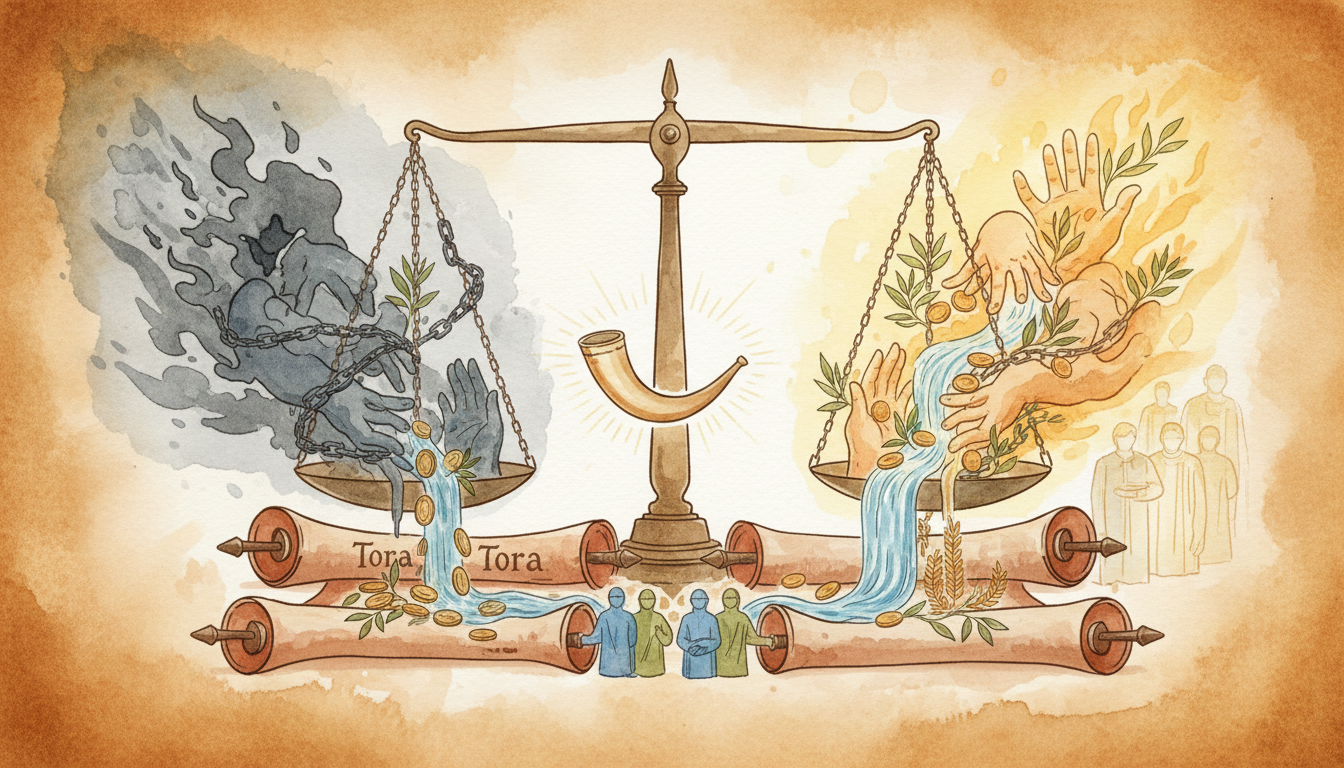
What Does Scripture Teach About Money? A Covenantal Vision Beyond Personal Virtue
This six-chapter course recovers the Bible's richest teaching on money as a covenantal and structural force, not merely a tool for individual moral performance. Beginning with the foundational text that distinguishes the love of money from money itself, the course traces how Hebrew economic law embedded justice into community structures, how Jesus named money as a rival power (mammon), and how apostolic practice revealed economics as a cosmic realignment. Each chapter starts with primary Scripture and shows how cultural, historical, and theological context deepens—not replaces—what the text already says. Learners will discover that biblical money teaching is far more concerned with concrete justice NOW in covenant community than with afterlife reward, and that wealth functions as a theological force requiring both personal AND corporate transformation. This is enrichment and recovery: the biblical text proves richer than inherited tradition suggested.
What you'll study
The Love of Money vs. Money Itself: Establishing the Foundation (1 Timothy 6:10)
1 Timothy 6:10 - 'For the love of money is a root of all kinds of evil. Some people, eager for money, have wandered from the faith and pierced themselves with many griefs.'
The Cosmic Rival: Money as Personified Power (Matthew 6:24 and Luke 16:9)
Matthew 6:24 - 'No one can serve two masters. Either you will hate the one and love the other, or you will be devoted to the one and despise the other. You cannot serve both God and money.' Luke 16:9 - 'I tell you, use worldly wealth to gain friends for yourselves, so that when it is gone, you will be welcomed into eternal dwellings.'
Divine Blessing and Covenantal Stewardship: Wealth in the Hebrew Narrative (Proverbs 10:22, Genesis 13, Job 42)
Proverbs 10:22 - 'The blessing of the Lord brings wealth, without painful toil for it.' Genesis 13:2 (Abraham's wealth as divine blessing); Job 42:12-17 (Job's restoration as covenant faithfulness).
Justice Embedded in Law: Hebrew Economic Structures as Covenant Expression (Deuteronomy 15:1-11 and Leviticus 25)
Deuteronomy 15:1-11 - The sabbatical year canceling debts and freeing slaves; Leviticus 25 - The Jubilee Year restoring land and redistributing wealth every fifty years. Proverbs 22:7 - 'The borrower is servant to the lender.'
Jesus Confronts Wealth as Discipleship Cost: The Rich Young Ruler and Radical Redistribution (Mark 10:17-31, Luke 12:15-21)
Mark 10:17-31 - Jesus and the rich young ruler: 'Go, sell everything you have and give to the poor...then come, follow me.' Luke 12:15-21 - The Parable of the Rich Fool: 'A man's life does not consist in the abundance of his possessions.'
Apostolic Practice and Cosmic Redemption: Economics as Grace-Powered Realignment (2 Corinthians 8-9, Acts 2:44-45, 1 Peter 1:18-19)
2 Corinthians 8-9 - Paul's teaching on grace-motivated giving and economic equality among churches; Acts 2:44-45 - Early church selling possessions and distributing to all who had need; 1 Peter 1:18-19 - 'You were redeemed...not with perishable things like silver or gold, but with the precious blood of Christ.'
Chapter 1 · Free to read
The Love of Money vs. Money Itself: Establishing the Foundation (1 Timothy 6:10)
1 Timothy 6:10 - 'For the love of money is a root of all kinds of evil. Some people, eager for money, have wandered from the faith and pierced themselves with many griefs.'
The Text
For the love of money is a root of all kinds of evil. Some people, eager for money, have wandered from the faith and pierced themselves with many griefs.
1 Timothy 6:10 (NIV) (The Greek reads: 'hē philarguria gar rhiza pantōn tōn kakōn estin. Hōn tines oregomenoi aperplanēthēsan apo tēs pisteōs kai heautous periepeiran odunais pollais.' A more literal rendering: 'For the love of money is a root of all kinds of evil. Some, having desired it, have wandered away from the faith and pierced themselves with many sorrows.' The phrase 'root of all kinds of evil' is crucial: not 'the root' (implying money is the sole cause of all evil) but 'a root' (one of several sources). Money-love is parasitic on other vices—pride, envy, dishonesty, idolatry.)
Key Terms
- φιλαργυρία (philarguria) · phil-ar-GYOO-ree-ah
- Love of money, avarice, greed. Literally 'silver-love' (philos = love, argyros = silver). Not mere possession of wealth, but the emotional orientation toward acquiring it.
- ρίζα (rhiza) · HREE-zah
- Root, foundation, origin. Metaphorically, the source or cause from which something grows or spreads.
- ὀρέγομαι (oregomai) · or-EG-om-ahee
- To stretch out toward, to desire, to long for, to reach after. Implies active aspiration or yearning.
- πλανάω (planaō) · plan-AH-oh
- To wander, to go astray, to deceive or be deceived. In passive or middle voice: to be led astray, to lose one's way.
Historical Foundation
Second Temple Judaism and Early Roman Imperial Period
The Roman Empire in the mid-first century was extracting wealth through taxation, creating severe economic disparity. Palestine experienced double taxation—both temple tax (half-shekel annually per adult male, Exodus 30:11-16) and Roman tribute. Wealthy merchants and landowners accumulated capital while peasant farmers faced debt slavery and land seizure. In urban centers like Ephesus (where 1 Timothy was likely written), patron-client relationships structured society; wealthy patrons bankrolled civic projects and religious life while clients repaid through loyalty and labor. Jewish law, by contrast, built in mechanisms to prevent permanent wealth accumulation: the Sabbath year (debt forgiveness every seven years) and the Jubilee (property return every fifty years). Jesus emerged from and critiqued this system. Paul wrote to churches embedded in both Jewish ethical memory and Greco-Roman economic realities. First Timothy addresses wealthy patrons (1 Timothy 6:17-19) directly—a sign the church was stratified by wealth. Paul's distinction between money and the love of money cuts to the heart of this tension: wealth itself is morally neutral; the desire to acquire it without limit is destructive.
Cultural World
WELL-GROUNDED: Ancient Near Eastern and Greco-Roman economies were fundamentally relational and patronal. In Mesopotamia, wealth was concentrated among temple, palace, and landed elites. The Code of Hammurabi (c. 1750 BCE) protected creditors' rights and allowed debt slavery—a system that generated moral anxiety in wisdom literature. Proverbs 22:7 ('the borrower is servant to the lender') reflects this reality. In the Greco-Roman world of Paul's day, the patron-client system was the primary economic engine. A wealthy patron (patronus) provided loans, protection, and patronage to clients who repaid through service, loyalty, and public honor. Inscriptions from Ephesus, Corinth, and Rome document these relationships. The cult of Fortune (Tyche) and Plutus (wealth) was widespread—money was spiritualized as a gift of the gods or as destiny itself. Jewish law, by contrast, explicitly resisted wealth accumulation. Leviticus 25:23-24 establishes that God, not landowners, is the true proprietor: 'The land is mine. You are but foreigners and my tenants.' The Sabbath year (Deuteronomy 15:1-11) mandated debt forgiveness, preventing the permanent underclass that patron-client systems created. This tension—Jewish redistribution ethics vs. Greco-Roman accumulation ethics—frames Paul's teaching.
What the Evidence Shows
[1] Paul's command in 1 Timothy 6:10 hinges on a grammatical distinction that English often obscures: money itself (chrēma, chremata) is not evil, but the love of money (philarguria) is a root of evil. [2] This distinction was already rooted in Jewish law. Deuteronomy 15:1-11 presumes people will have money, lend money, and accumulate debts—but mandates forgiveness every seven years to prevent money-love from hardening into structural oppression. The law recognizes that wealth is necessary for survival but that the emotional attachment to it (the desire to hoard, to dominate through debt, to secure oneself through accumulation) corrupts the covenant community. [3] In the Greco-Roman world where Timothy's church existed, this was countercultural. Wealthy patrons in Ephesus were expected to display their wealth, use it for civic honor, and build client networks through strategic giving. A first-century inscription from Ephesus honoring a wealthy benefactor reads: 'She spent her own money for the beautification of the city and the glory of the gods.' The implicit spirituality is that wealth is a sign of divine favor and proper use means self-aggrandizement through public display. [4] Paul inverts this entirely. In 1 Timothy 6:17-19, he addresses the wealthy: 'Command those who are rich in this present world not to be arrogant nor to put their hope in wealth... but to put their hope in God.' The phrase 'put their hope in wealth' (elpizō epi ploutos) means to trust wealth as the ultimate security and source of meaning—precisely the spiritualization of money that patron culture demands. [5] The consequence Paul names in 6:10—'wandering from the faith and piercing themselves with many griefs'—is not an external punishment but an internal disintegration. The Greek word for 'pierced' (peripeiraō) appears nowhere else in the New Testament and likely derives from the image of a sword piercing the soul. It evokes the anguish described in Proverbs 23:4-5: the person who pursues wealth endlessly experiences the torment of never having enough, never being secure, never resting in trust. [6] Historically, this teaching emerged in the early church as congregations became economically stratified. Acts 2:44-45 and 4:34-35 describe the Jerusalem church selling property and sharing goods—not as mandatory communism but as a voluntary, Spirit-prompted response to the presence of risen Christ and the conviction that money-love had no place in the new community. By Paul's time (late 50s CE), churches were more diverse economically. First Corinthians 11:17-34 reveals that wealthy members were eating before poor members at the Lord's Supper, creating shame. First Timothy 6 addresses this head-on: wealth is a moral test of whether one's loyalty has remained with Christ or drifted toward security in money.
Scholarly Witness
Gill emphasized that 'the love of money' is distinct from money itself: 'Money is not evil, but the love of it is; a covetous affection to it is the root of evils.' He rooted this in the Ten Commandments' prohibition of covetousness and noted that the phrase 'root of all kinds of evil' means money-love generates multiple vices—murder, theft, dishonesty—without being the sole source of all evil.
Henry stressed that 'the love of money' creates a spiritual misdirection: it sets the affections on a perishable good instead of on God. He noted that wealthy believers are not condemned but are tested—will they trust God or their riches? His pastoral application was to urge rich church members toward generosity and contentment.
Moo analyzes the grammatical nuance of 'a root' (not 'the root') and demonstrates that Paul is not claiming money-love is the sole source of evil but a major generative source. He contextualizes 1 Timothy 6:10 within the broader structure of wealth warnings in 1 Timothy 6:6-19, showing that Paul's solution is not renunciation but reorientation: contentment in Christ, not in accumulation.
Kibbe situates 1 Timothy 6:10 within the trajectory of biblical economics, tracing the tension between ancient Near Eastern patronage systems (which Paul's audience inhabited) and the Levitical redistribution model. He argues that Paul's teaching on money reflects a deliberate inversion of Greco-Roman values: not honor through accumulation but character through generosity.
The Assemblies of God Statement of Fundamental Truths (#9, Sanctification, and #10, Church and Mission) emphasizes that sanctification includes separation 'from that which is evil' and a dedicated pursuit of holiness. The church's mission includes 'demonstrating God's love and compassion for all the world' and providing 'ministries of love and compassion,' which the Assemblies tradition has interpreted to include economic justice, opposition to greed, and faithful stewardship. This aligns with Paul's teaching: money-love is a 'separation from holiness' and denies the Spirit's empowerment for generous living.
Discovery Questions
1.Read 1 Timothy 6:10 and Proverbs 23:4-5 side by side. What specific image does Paul use ('pierced themselves'), and what does the Proverb say happens to the person who pursues wealth obsessively ('sprout wings and fly off')? What do both passages teach about the internal experience of money-love?
Both texts describe money-love as self-inflicted harm, not as God's external punishment. Proverbs 23:5 shows the futility and frustration of endless wealth-seeking. Paul's image of 'piercing' oneself shows that wandering from faith wounds one's own soul. The evidence reveals that the deepest consequence of greed is not loss of external things but disintegration of inner peace and spiritual security. This shifts the concern from 'Will God punish me?' to 'Am I destroying my own peace with God?'
2.Paul says the love of money is 'a root' (not 'the root') of all kinds of evil. If money-love is one root among others, what other roots does Scripture identify? (Hint: Look at 1 Timothy 6:4, where false teaching arises from 'conceit'; also James 4:1-3 on warfare from desires.) Why does Paul use the word 'kinds' of evil rather than saying all evil comes from money?
Paul is making a precise theological claim: money-love is one major generative source of spiritual and moral corruption, but not the only one. The Bible teaches that pride, idolatry, sexual immorality, and other desires also generate evil. By saying 'a root,' Paul shows that money-love is neither trivial (it's truly destructive) nor totalizing (it's not the cause of all problems). This matters for pastoral application: addressing money-love will not solve all moral problems in the church, but it addresses one major source of wandering from faith. The phrase 'kinds of evil' (pantos tou kakou) suggests money-love spawns multiple vices—theft, lying, murder, discord—because it reorganizes priorities around an inferior good.
3.In 1 Timothy 6:17-19, Paul addresses the wealthy directly, commanding them not to 'put their hope in wealth, which is so uncertain' but to 'put their hope in God' and to 'be generous and willing to share.' How does this command directly address the Greco-Roman patron culture that expected wealthy people to display wealth and seek honor? What alternative does Paul offer?
Paul inverts the entire patronage system. Instead of wealthy people seeking earthly honor through public display and client relationships, Paul redirects them toward God's honor and eternal reward. First Timothy 6:19 says to 'lay up treasure for themselves as a firm foundation for the coming age, so they may take hold of the life that is truly life.' This is not worldly detachment but a reorientation of loyalty: you are wealthy? Good. Use it generously, trust God (not money), and build eternal treasure. The evidence shows Paul is not calling the wealthy to poverty but to freedom from money-love's spiritual tyranny. By abandoning the love of money, the wealthy are liberated to use money justly and generously. This connects directly to the Assemblies of God emphasis on demonstrating God's compassion through economic justice and care for the needy.
4.Paul teaches in 1 Timothy 6:6, 'Godliness with contentment is great gain.' He uses the word 'gain' (perisseia, surplus) when discussing spiritual profit, mirroring business language. But earlier he said money-love produces only loss ('wandered from faith, pierced with griefs'). What is Paul claiming about two different kinds of 'gain'—economic gain vs. spiritual gain? How does this resolve the tension between valuing money and rejecting the love of money?
Paul is teaching a profound inversion of values. Economic gain (accumulation of wealth) pursued without contentment in God produces loss—spiritual disorientation, anxiety, moral corruption. But spiritual gain (godliness combined with freedom from the need for more) produces true profit: peace, integrity, faith, and genuine security. This is not a call to poverty or renunciation but to a reordering of what counts as 'gain.' The wealthy can be wealthy, but if wealth is pursued as ultimate security or status rather than as a tool for generosity and justice, it produces only emptiness. The evidence from Scripture shows that money itself is neutral; the emotional and spiritual orientation toward it is everything. A person can be rich and spiritually free (like Abraham, Job in his restoration, or the wealthy believers Paul addresses in 1 Timothy 6:17-19) if their trust and identity rest in God, not in accumulation. This directly supports the Assemblies of God emphasis on sanctification—separation from the enslaving passions (including greed) and dedication to God's purposes through generous care for others.
Connected Passages
- Deuteronomy 15:1-11 (Sabbath year and debt forgiveness) — Establishes the biblical principle that wealth must be regulated by justice; money is for meeting human need, not for permanent stratification. The law assumes people will have money but mandates forgiveness to prevent money-love from hardening into oppression. Paul's teaching on money-love echoes this Levitical concern for justice.
- Luke 16:14 ('The Pharisees, who loved money') — Identifies money-love as a spiritual condition that blinds people to kingdom values. The Pharisees 'scoffed' at Jesus's teaching on wealth because they loved money—their emotional attachment to it prevented them from hearing the gospel. Parallel to Paul's claim that money-love causes people to 'wander from faith.'
- 1 Corinthians 11:17-34 (divisions at the Lord's Supper) — Reveals that wealth disparity in the church created spiritual division and shame; Paul's remedy is to challenge the wealthy to recognize the poor and to eat together. This concrete application shows that money-love (the refusal to share, the pride of the wealthy) produces exactly the kind of wandering from faith Paul warns about.
- Acts 2:44-45; 4:34-35 (Early church sharing of possessions) — Shows that the post-resurrection church voluntarily divested itself of money-love as a Spirit-enabled response to Christ's presence. This wasn't mandatory redistribution but a fruit of faith—believers recognized that money-love had no place in a community centered on the risen Christ. Paul's teaching assumes this same Spirit-empowerment.
- Proverbs 23:4-5 ('Do not wear yourself out to get rich') — Jewish wisdom tradition identifies wealth-pursuit as futile and emotionally exhausting ('cast a glance at riches, and they are gone'). Paul's image of self-piercing echoes the torment wisdom literature associates with money-love.
- Hebrews 13:5-6 ('Keep your lives free from the love of money... God has said, Never will I leave you') — Explicitly commands freedom from money-love (using the same word, philarguria) and grounds it in trust in God's presence and provision. The antidote to money-love is assurance of God's faithfulness—the same move Paul makes in 1 Timothy 6:17 ('put their hope in God').
- 1 Timothy 3:1-3 (Qualifications for overseer) — Lists 'not a lover of money' as essential for church leadership. This shows that Paul sees money-love as disqualifying for spiritual responsibility—further evidence that it's a fundamental spiritual danger, not a minor vice.
- Colossians 3:1-3 ('Set your hearts on things above, not on earthly things') — Frames the money-love problem as a matter of where the heart (kardia) is set—on heavenly or earthly security. Money-love is setting the heart on an earthly thing rather than on Christ. Paul's solution in both passages is to reorient spiritual affection toward God.
Takeaways
- The biblical distinction between money and the love of money is precise and consequential. Money itself is morally neutral—necessary for survival, useful for justice and generosity, and permissible for believers to have. But the emotional orientation toward acquiring money without limit, trusting it as ultimate security, and seeking status through it is spiritually lethal. Paul's wording 'a root of all kinds of evil' shows that money-love is not the sole cause of all corruption, but it is a major generative source that spawns multiple vices (theft, murder, dishonesty, pride). This matters because it means we cannot address money-love by abandoning money; we must address it by reorienting our hearts away from it and toward God.
- In the Greco-Roman patronage culture where Timothy's church existed, money was spiritualized—wealthy benefactors were expected to display wealth for honor, immortalize their names through public projects, and build client networks. Paul directly inverts this system: the wealthy are called not to display but to give generously, not to seek earthly honor but to trust God, and not to build human loyalty networks but to 'lay up treasure for themselves as a firm foundation for the coming age.' This was countercultural then and remains so. Paul teaches that using money justly and generously—emptied of the love for it—is the sign of someone whose affections have been reoriented toward God and God's kingdom.
- The internal consequence of money-love is not external judgment but spiritual disintegration. When believers 'wander from faith' due to the love of money, they 'pierce themselves with many griefs.' The damage is self-inflicted: endless pursuit produces anxiety, never enough produces frustration, and trust in money produces the fear that accompanies any object that can be lost. Jewish wisdom (Proverbs 23:4-5) and Stoic philosophy agreed: chasing wealth is torment. Paul's claim is that contentment in Christ (not from getting more, but from resting in God's provision and presence) produces the opposite: peace, integrity, and spiritual security. This is not mere sentiment; it's psychological and spiritual truth confirmed across traditions.
- The Assemblies of God tradition, grounded in the Statement of Fundamental Truths, emphasizes sanctification as 'separation from that which is evil' and the church's mission to 'demonstrate God's love and compassion for all the world' through 'ministries of love and compassion.' Money-love is precisely the kind of evil from which sanctification separates us. The Spirit-filled life is characterized not by accumulation and status-seeking but by generosity, justice, and care for the poor. Paul's teaching in 1 Timothy 6 directly supports this: freedom from the love of money is enabled by the Holy Spirit's power and is evidenced by willingness to share and to put hope in God rather than in riches. This connects corporate Pentecostal practice (prayer for the poor, ministries of healing and relief) to personal spiritual formation: freed from money-love, believers become channels of God's compassion.
- Money-love is a spiritual test that reveals where ultimate loyalty resides. Every believer faces a choice: Will I trust God or money? Will I seek security in accumulation or in faith? Will I use wealth for self-aggrandizement or for justice? Paul teaches that there is no neutral position; money either serves God or becomes a rival god. The wealthy (1 Timothy 6:17-19) are not condemned but are explicitly tested: Will you remain humble, trust God, be generous, and build eternal treasure? This applies to all economic stations. Even those with little can ask: Am I anxious about money because I've set my hope in it, or am I resting in God's provision? The evidence shows that money-love is the sign of a wandering faith, and freedom from it is the sign of faith restored.
Application
Reflect on your own relationship with money. What role does trust in financial security play in your daily decisions, worries, and identity? Ask yourself: Do I make choices (career, spending, giving) primarily to increase wealth and status, or primarily to follow Christ and serve others? Identify one area where the love of money may be drawing you away from faith (perhaps hoarding, anxiety, status-seeking, or refusing to give). Then ask: What would change if I fully trusted God to provide, if I sought His honor rather than earthly honor, and if I used money as a tool for justice and generosity rather than as a measure of success? Consider fasting from one financial anxiety (e.g., checking your balance obsessively, worrying about retirement, comparing yourself to wealthier peers) for one week and instead offering that mental energy to prayer, trust, and notice how your peace shifts. Finally, identify someone in need and ask the Spirit to empower you toward specific, sacrificial generosity—not as a work to earn favor, but as evidence that your heart has been reoriented away from money-love and toward God's values.
Continue the course — 5 more chapters
The Cosmic Rival: Money as Personified Power (Matthew 6:24 and Luke 16:9)
Matthew 6:24 - 'No one can serve two masters. Either you will hate the one and love the other, or you will be devoted to the one and despise the other. You cannot serve both God and money.' Luke 16:9 - 'I tell you, use worldly wealth to gain friends for yourselves, so that when it is gone, you will be welcomed into eternal dwellings.'
Why does Jesus use the Aramaic word 'mammon' and frame money as a master/principality rather than a neutral resource, and what does this reveal about money as a structural spiritual power requiring corporate realignment?
Divine Blessing and Covenantal Stewardship: Wealth in the Hebrew Narrative (Proverbs 10:22, Genesis 13, Job 42)
Proverbs 10:22 - 'The blessing of the Lord brings wealth, without painful toil for it.' Genesis 13:2 (Abraham's wealth as divine blessing); Job 42:12-17 (Job's restoration as covenant faithfulness).
How does the Hebrew Bible present wealth as a sign of divine blessing AND as a covenantal trust, and why is this richer than both 'prosperity gospel' interpretations and ascetic rejection of wealth?
Justice Embedded in Law: Hebrew Economic Structures as Covenant Expression (Deuteronomy 15:1-11 and Leviticus 25)
Deuteronomy 15:1-11 - The sabbatical year canceling debts and freeing slaves; Leviticus 25 - The Jubilee Year restoring land and redistributing wealth every fifty years. Proverbs 22:7 - 'The borrower is servant to the lender.'
What do the Jubilee and sabbatical systems reveal about God's covenantal design for economic justice, and why is this STRUCTURAL justice (not merely charitable giving) central to biblical theology in ways Western tradition has often overlooked?
Jesus Confronts Wealth as Discipleship Cost: The Rich Young Ruler and Radical Redistribution (Mark 10:17-31, Luke 12:15-21)
Mark 10:17-31 - Jesus and the rich young ruler: 'Go, sell everything you have and give to the poor...then come, follow me.' Luke 12:15-21 - The Parable of the Rich Fool: 'A man's life does not consist in the abundance of his possessions.'
Does Jesus teach personal detachment from wealth as individual spiritual virtue, or does he reveal wealth-accumulation as fundamentally incompatible with covenant allegiance and the kingdom's redistribution logic—and how do his words about 'mammon' support the latter?
Apostolic Practice and Cosmic Redemption: Economics as Grace-Powered Realignment (2 Corinthians 8-9, Acts 2:44-45, 1 Peter 1:18-19)
2 Corinthians 8-9 - Paul's teaching on grace-motivated giving and economic equality among churches; Acts 2:44-45 - Early church selling possessions and distributing to all who had need; 1 Peter 1:18-19 - 'You were redeemed...not with perishable things like silver or gold, but with the precious blood of Christ.'
How do the apostles practice economics as a visible sign of redemption and cosmic realignment, and what does the early church's witness reveal about money ethics as fundamentally relational and covenantal rather than merely individualistic?
No credit card required
Sources Used
Every insight traces to a named source. 0 AI-generated interpretations.
Related courses
What Does the Bible Teach About Death, Resurrection, and Renewed Creation?
A six-chapter biblical exploration of death from Genesis through Revelation, showing how Hebrew holism (nephesh) and bodily resurrection hope enrich our understanding beyond Greek dualism. Each chapter anchors in primary texts and builds evidence progressively to reveal that biblical hope is MORE concrete and physical than disembodied existence—a recovery of the church's deepest tradition.
6 chapters
What Does the Bible Reveal About Anger as a Relational Response?
A five-chapter biblical exploration of anger as neither inherently sinful nor a mere emotion to suppress, but a morally complex relational response. This course traces how Scripture distinguishes between destructive and righteous anger, reveals anger and love coexisting in God's character, and shows how Christ's incarnation reframes human anger within redemptive justice. Learners will discover that the biblical text on anger is far richer than common tradition suggests—anger itself is morally neutral; the object, motive, and expression determine its ethical weight.
5 chapters
What Does the Bible Say About Tithing? A Covenant-Based System Revealed
This course traces the biblical teaching on tithes from Abraham through the early church, uncovering how tithing functioned not as a simple percentage but as a multifaceted covenant practice tied to priestly support, festival celebration, and care for the poor. We discover that the original text reveals something richer than the simplified 10% rule: a system rooted in relationship with God and community care. The course culminates in understanding how Jesus and the apostles transformed this practice into grace-motivated voluntary generosity, enriching rather than abandoning the principle of faithful giving.
5 chapters
What Does the Bible Say About the Holy Spirit?
A six-chapter course exploring the identity, roles, and work of the Holy Spirit across Scripture. Beginning with the Spirit's presence at creation and moving through Old Testament promises, Jesus's teaching, Pentecost, and the apostolic letters, this course builds a comprehensive biblical understanding of the Holy Spirit's personhood, functions in salvation and sanctification, and gifting of the church. Each chapter is anchored in a key passage and progresses from textual observation through historical context to theological synthesis, designed to deepen the learner's wonder at Scripture's revelation.
6 chapters
What Does the Bible Say About Anxiety? A Whole-Person Spiritual Practice
This five-chapter course explores biblical teaching on anxiety as an integrated concern involving spiritual trust, physical provision, communal belonging, and embodied rest. Beginning with Jesus' foundational teaching in Matthew 6, we trace how Hebrew wisdom, the Psalms, and Paul's letters present anxiety not as an isolated internal state to manage, but as a whole-person invitation to deeper trust in God's care. Through careful attention to biblical vocabulary, we discover how ancient authors understood the connection between body, spirit, community, and peace—offering a richer vision than modern tradition often recognizes.
5 chapters
What Does the Bible Say About Faith? Recovering Covenant Trust, Embodied Obedience, and Communal Faithfulness
This course deepens understanding of biblical faith (emunah/pistis) beyond modern definitions of belief to recover the original semantic and relational richness of the texts. Through careful study of key passages across the canon, learners will discover that biblical faith operates as covenant trust, finds expression in embodied obedience, and exists within communal faithfulness. Rather than an internal conviction alone, faith in Scripture is a dynamic trust-in-action directed toward God, rooted in His promises, and demonstrated through practical loyalty. This course traces faith from Abraham through the incarnation, showing how the concept develops while maintaining its core relational character, and invites learners to experience their own faith deepened rather than dismantled.
5 chapters
Create your own Bible studies — free.
Ask any question. Get evidence from named scholars and curated datasets in minutes.
Get Started Free