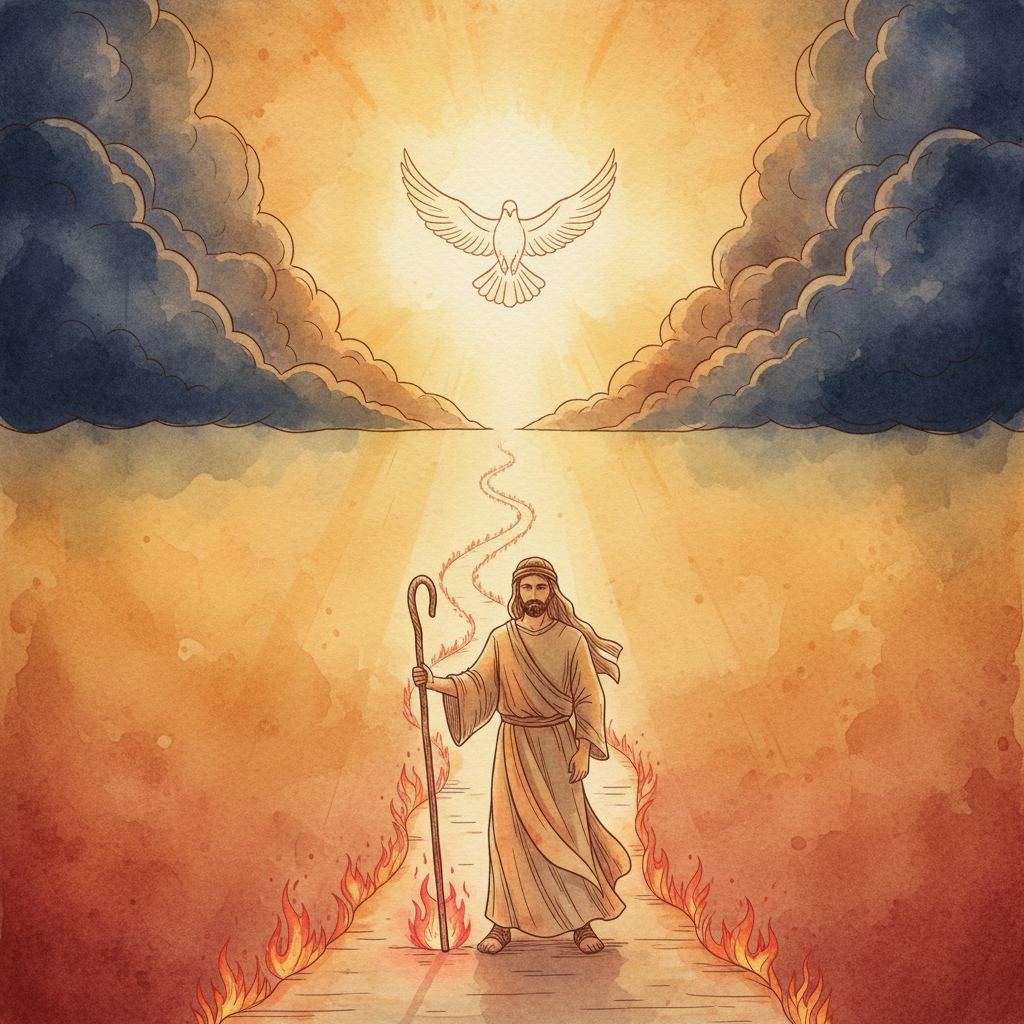
Overcoming Fear: Biblical Reverence and the Covenant Presence of God
A five-chapter exploration of how the Bible redefines fear—not as anxiety to be conquered through willpower, but as reverent alignment with God's reality and presence. This course traces the original meaning of yirah (fear) from the Old Testament through the apostolic church, showing how faith in God's covenant faithfulness, not self-generated courage, is the true antidote to human anxiety and threat. Each chapter is anchored in a key biblical passage and enriched by historical, textual, and theological evidence.
What you'll study
The Fear of the Lord: Reverent Awe as the Foundation (Proverbs 1:7 and Psalm 111:10)
Proverbs 1:7 (The fear of the LORD is the beginning of knowledge); Psalm 111:10 (The fear of the LORD is the beginning of wisdom)
God's Covenant Presence Against Human Fear: The Repeated Pattern of 'Do Not Fear' (Isaiah 41:10 and Joshua 1:9)
Isaiah 41:10 (Fear not, for I am with you; be not dismayed, for I am your God. I will strengthen you, yes, I will help you, I will uphold you with My righteous right hand); Joshua 1:9 (Have I not commanded you? Be strong and courageous. Do not be terrified; do not be discouraged, for the LORD your God will be with you wherever you go)
Faith Over Fear: When Belief Meets Threat (Mark 4:35-41 and Luke 8:49-56)
Mark 4:35-41 (The disciples in the storm: 'Why are you so afraid? Do you still have no faith?'); Luke 8:49-56 (Jesus to Jairus: 'Do not be afraid; only believe, and she will be made well')
Perfect Love Casts Out Fear: Relational Transformation in 1 John 4:18 and 2 Timothy 1:7
1 John 4:18 (There is no fear in love. But perfect love drives out fear, because fear has to do with punishment. The one who fears is not made perfect in love); 2 Timothy 1:7 (For God has not given us a spirit of fear, but of power, love and of a sound mind)
From Anxiety to Peace: The Apostolic Pattern of Presence, Prayer, and Trust (Philippians 4:6-7 and 1 Peter 3:14-15)
Philippians 4:6-7 (Do not be anxious about anything, but in every situation, by prayer and petition, with thanksgiving, present your requests to God. And the peace of God, which transcends all understanding, will guard your hearts and your minds in Christ Jesus); 1 Peter 3:14-15 (But even if you should suffer for what is right, you are blessed. Do not fear their threats; do not be frightened. But in your hearts revere Christ as Lord. Always be prepared to give an answer to everyone who asks you to give the reason for the hope that you have)
Chapter 1 · Free to read
The Fear of the Lord: Reverent Awe as the Foundation (Proverbs 1:7 and Psalm 111:10)
Proverbs 1:7 (The fear of the LORD is the beginning of knowledge); Psalm 111:10 (The fear of the LORD is the beginning of wisdom)
The Text
Proverbs 1:7 — 'The fear of the LORD is the beginning of knowledge; fools despise wisdom and instruction.' Psalm 111:10 — 'The fear of the LORD is the beginning of wisdom; all those who practice it have a good understanding.'
Proverbs 1:7; Psalm 111:10 (Both passages use the Hebrew term yirah (יִרְאָה), typically rendered 'fear,' paired with the divine name YHWH (יְהוָה), the covenant name of God. The parallel structure—'fear of the LORD is the beginning of [knowledge/wisdom]'—establishes a foundational equivalence: reverent awe toward God is not peripheral to understanding; it is the starting point, the prerequisite, the ground floor of all true knowledge and wisdom. 'Beginning' (reshit, ראשׁית) means both 'first' (in sequence) and 'chief' (in importance)—it is the alpha and omega, the primary principle.)
Key Terms
- יִרְאָה (yirah) · yirah
- Fear, reverence, awe—the instinctive response of creaturely recognition before the divine. Not phobic terror, but the profound respect that arises when one encounters transcendent power and holiness. In Hebrew thought, it encompasses emotional response (awe), volitional response (obedience), and intellectual response (submission to God's wisdom).
- יְהוָה (YHWH) · YHWH / Adonai (in reading)
- The covenant name of God revealed to Moses at the burning bush (Exodus 3:14-15)—'I AM that I AM.' This name emphasizes God's self-existence, eternality, and faithful covenant-keeping. It is the name that binds God to His people. 'Fear of the LORD' is not fear of an abstract deity but fear of the God who has entered covenant, who has promised, who has made Himself known.
- ראשׁית (reshit) · reshit
- Beginning, first, chief, principal. It denotes both temporal precedence (the first thing) and hierarchical priority (the most important thing). In Genesis 1:1, 'In the beginning [reshit] God created...' establishes that God's creative word is the foundational reality of existence.
- חָכְמָה (chokmah) / דַּעַת (da'at) · chokmah / da'at
- Chokmah (wisdom) is practical skill, discernment, the ability to live rightly and make sound decisions. Da'at (knowledge) is understanding, the ability to recognize truth and reality. Together, they represent the complete intellectual and moral capacity to navigate life in alignment with God's order.
Historical Foundation
Post-exilic wisdom tradition and First-century apostolic church
The Jewish people, returned from exile, rebuilt their identity around Torah obedience and wisdom literature that taught reverence for God as the foundation of all knowledge. In the first century, Jesus of Nazareth embodied this reverence—calling disciples to follow Him with trust that replaced fear-based anxiety with love-based devotion. The apostolic church, empowered by the Holy Spirit at Pentecost, experienced a radical transformation: what had been commanded duty ('fear the Lord') became intimate relationship ('Abba, Father'). This shift did not erase reverence; it deepened it. The fear of the Lord became not servile dread but filial awe—the awestruck response of a child who knows they are loved by an all-powerful parent. The Assemblies of God tradition, rooted in early Pentecostal recovery of Acts 2 experience, emphasizes that the baptism in the Holy Spirit brings 'a deepened reverence for God' (Acts 2:43; Hebrews 12:28)—not fear that drives away, but reverence that draws near.
Cultural World
In ancient Near Eastern wisdom literature (Egyptian Instructions of Ptahhotep, Mesopotamian wisdom texts), the concept of 'fear of the gods' or 'reverence for divine order' functioned as the authoritative foundation for ethical conduct and social stability. However, the biblical yirah differs significantly: it is not fear of arbitrary divine judgment but reverence for a God who has revealed His character through covenant. Egyptian wisdom taught fear as submission to cosmic order; Hebrew wisdom taught fear as submission to a personal, covenantal God. The Mesopotamian apkallu (sages) sought to discern divine will through observation and interpretation; Hebrew sages knew God's will through Torah and relational obedience. The biblical reversal is profound: knowledge and wisdom do not begin with human observation or rational deduction—they begin with acknowledging dependence on the God who reveals Himself. This is well-grounded in the Proverbs corpus (1:7, 9:10, 15:33) where the fear of the Lord appears as the condition for all legitimate wisdom, not merely one element among others.
What the Evidence Shows
The biblical texts establish that the fear of the Lord is not an emotional liability or a psychological obstacle to overcome, but the foundational orientation toward reality itself. Proverbs and Psalms, products of post-exilic wisdom reflection, teach that all legitimate knowledge—intellectual, moral, practical, relational—begins with the recognition that God is supreme, trustworthy, and worthy of reverent obedience. This is not fear in the sense of phobic anxiety (which the New Testament explicitly rejects: 1 John 4:18, 'perfect love casts out fear'). Rather, it is the awestruck recognition of God's transcendence coupled with trust in His covenantal faithfulness. The First Testament establishes this as a constant refrain: 'Fear not, I am with you' (Isaiah 41:10) is not a contradiction but a clarification. God commands His people to cease anxious dread (the fear that paralyzes) and to embrace reverent awe (the fear that orients). The New Testament intensifies this paradox. Jesus teaches His disciples to fear God—'fear him who can destroy both soul and body in hell' (Matthew 10:28)—yet in the same breath He assures them of the Father's intimate care: 'Are not two sparrows sold for a penny? Yet not one of them will fall to the ground apart from the knowledge of your Father' (Matthew 10:29-30). The apostles, empowered by the Holy Spirit at Pentecost, experienced a transformation: the disciples who cowered 'for fear of the Jews' (John 20:19) became bold proclaimers, and the text notes that 'all the believers were together and had everything in common. Every day they continued to meet together in the temple courts...all the believers were filled with awe [phobos, the same term]' (Acts 2:44-47). The Assemblies of God Statement of Fundamental Truths (Point 7) specifically identifies this: 'With the baptism in the Holy Spirit come such experiences as...a deepened reverence for God (Acts 2:43; Hebrews 12:28).' The fear of the Lord, in apostolic experience, is not diminished by the Holy Spirit—it is deepened, transformed, and integrated with love. As Hebrews 12:28 teaches: 'Therefore, since we are receiving a kingdom that cannot be shaken, let us be grateful and worship God in an acceptable way with reverence and awe [literally, fear and trembling].'
Scholarly Witness
Henry notes on Proverbs 1:7 that 'fear' here means 'a holy fear, a reverent awe of God, a godly fear and dread of His majesty and goodness.' He distinguishes this sharply from 'the fear of men' or 'the fear of misfortune,' emphasizing that the fear of the Lord is the only fear that produces wisdom. The fool, by contrast, 'despises wisdom and instruction'—not because he lacks capacity, but because he lacks reverent orientation. Henry anchors this in the covenantal character: the fear of God is the fear of One who has revealed Himself as merciful, faithful, and just.
Gill on Proverbs 1:7 emphasizes that 'the fear of the Lord' is the 'principle and foundation of all true knowledge and wisdom.' He notes the Hebrew construction emphasizes that this fear is not merely one virtue among many, but the 'beginning' in the sense of the 'chief' or 'principal' part. He also connects this to the apostolic witness: 'This is confirmed by the experience of the apostles; who, when filled with the Holy Ghost, were filled with reverence and godly fear (Acts 2:43).'
Kidner, in his commentary on Proverbs, argues that yirah is not the paralyzing fear of punishment but 'a relation of reverence, involving both awe and trust.' He notes that the parallelism between Proverbs 1:7 ('knowledge') and Psalm 111:10 ('wisdom') shows these are not separate concepts but intimately linked—knowledge is the intellectual and moral capacity that flows from reverent relationship with God. Kidner also emphasizes that the fear of the Lord in Proverbs is always generative: it produces practical wisdom, ethical discernment, and relational maturity.
Longman's commentary on Proverbs emphasizes that the fear of the Lord is 'the integrating principle' of the entire book. He argues that Proverbs 1:7 is a thesis statement: all the diverse teachings that follow (about speech, work, relationships, justice) flow from and circle back to reverent relationship with God. Longman also notes the 'relational' dimension: in a wisdom tradition, the student learns not merely abstract principles but learns to 'fear the Lord' by observing how reverent people navigate concrete situations.
Boa and Snyder argue that the fear of the Lord operates in the 'affective, cognitive, and volitional' dimensions of the person simultaneously. This is important for the Assemblies of God understanding: when believers are baptized in the Spirit, their 'reverence' for God is not intellectual assent but involves the whole person—the Spirit-filled heart stands in awe, the Spirit-filled mind comprehends God's truth, and the Spirit-filled will orients toward obedience.
The AGo Statement explicitly teaches that the baptism in the Holy Spirit produces 'a deepened reverence for God' (Acts 2:43; Hebrews 12:28). This is not portrayed as a fear that diminishes; rather, it is a reverence that matures and intensifies as one experiences the presence and power of the Spirit. The fear of the Lord, in this tradition, is integrated with love, power, and boldness—a living experience of standing before the holy God, known as Father, empowered by the Spirit, secured in Christ.
Discovery Questions
1.In Proverbs 1:7 and Psalm 111:10, the 'fear of the Lord' is described as the 'beginning' of knowledge and wisdom. But what does 'beginning' mean here—is it the starting point (like the first chapter of a book) or the foundation (like the bedrock of a building)? What difference does that make to how we understand fear?
The Hebrew reshit means both 'first' and 'chief'—it's not merely sequential but supremely important. This reveals that the fear of the Lord is not optional preparation; it is the integrating principle that orders all legitimate understanding. As Matthew Henry notes, the fool does not lack intellectual capacity; he lacks the reverent orientation that would allow him to receive instruction. The evidence shows that knowledge without fear of God is distorted, misdirected, and ultimately destructive.
2.Jesus in Matthew 10:28 tells His disciples, 'Fear the one who can destroy both soul and body in hell,' yet immediately after (verses 29-31) He assures them that God cares for them personally—down to knowing the number of hairs on their heads. How do these two statements coexist? What does this reveal about the biblical definition of fear?
The evidence shows that biblical fear is not the absence of comfort but the proper prioritization of God. The disciples are called to 'fear' God—to honor His authority and judgment—while simultaneously trusting His intimate care. This is not psychological contradiction; it is relational maturity. The Assemblies of God tradition understands this through the Spirit's work: the Holy Spirit produces both boldness (Acts 4:31) and reverence (Acts 2:43) simultaneously. Fear of God drives us toward dependence on Him; trust in God's character transforms that fear from dread into awe.
3.In Acts 2:43, after the disciples are baptized in the Holy Spirit and begin speaking in tongues and performing miracles, the text says 'everyone was filled with awe.' Is the 'awe' (phobos—the Greek word for fear) a response to the miracles, or is it a deepened reverence for God? What changes when fear is Spirit-produced rather than self-generated?
The evidence reveals that the Spirit transforms the object and source of fear. Before Pentecost, the disciples' fear is human-centered (fear of the authorities). After Pentecost, their awe is God-centered, produced by the Spirit's presence and power. This is well-grounded in the canonical pattern: when Israel encounters God's power at the Red Sea, they are 'filled with awe' (Exodus 15:11, using the same root yirah), and this awe integrates trust, praise, and obedience. The Assemblies of God emphasizes this: Spirit-baptism brings 'deepened reverence'—not diminished courage but courage rooted in reverence.
4.If the 'fear of the Lord is the beginning of knowledge' (Proverbs 1:7), and if Jesus came to teach us to address God as 'Abba, Father' (Romans 8:15, Galatians 4:6), has fear been replaced by intimacy? Or are both necessary? What does your own experience as a believer teach you about how these relate?
The evidence shows that love and fear are not opposites in biblical thought—they are integrated. 1 John 4:18 teaches that 'perfect love drives out fear,' but the fear being expelled is the fear of judgment and rejection, not reverent awe. Hebrews 12:28 calls us to worship 'with reverence and awe' at the same time we approach God with confidence (Hebrews 4:16). This synthesis is the birthright of the Spirit-filled believer: we know God's love so intimately (through the Spirit's witness, Romans 8:16) that our reverence is no longer self-protective dread but loving submission. The Assemblies of God tradition teaches that the Spirit baptism intensifies both: more boldness because more security, more reverence because more intimacy. Fear of the Lord becomes the joyful orientation of a beloved child toward a holy Father.
Connected Passages
- Genesis 22:12 ('Now I know that you fear God, because you have not withheld from me your son, your only son') — Abraham's willingness to offer Isaac becomes the paradigmatic act of fear-of-God. Fear is not measured by words but by willingness—the alignment of the whole person toward obedience. This shows fear as active submission to God's will, not emotional response.
- Exodus 20:20 ('Moses said to the people, 'Do not be afraid. God has come to test you, so that the fear of God will be with you to keep you from sinning'') — Here, Moses distinguishes paralyzing fear (of the thundering mountain) from the fear of the Lord (reverent obedience). The test is meant to produce not terror but reverent alignment with God's will. This is a watershed text showing the biblical inversion: fear God precisely so that you will not sin through fearing other things.
- Job 28:28 ('And he said to the human race, 'The fear of the Lord—that is wisdom; and to shun evil is understanding'') — Job's wisdom tradition confirms Proverbs: the fear of the Lord is not intellectual knowledge but practical wisdom that manifests in moral action ('shun evil'). Fear of God produces ethical discernment and conduct.
- Luke 1:46-55 (Mary's Magnificat, especially verse 50: 'His mercy extends to those who fear him') — Mary, chosen to bear Jesus, is described in the Gospel of Luke as one 'favored' by God—and her fear of the Lord is inseparable from her experience of mercy. This bridges Old Testament reverence and New Testament grace: the God who demands fear is the God whose mercy is boundless.
- Revelation 19:5 ('A voice came from the throne, saying: 'Praise our God, all you his servants, you who fear him, both great and small'') — The final vision of heaven shows the redeemed 'fearing' God in worship—this is not elimination of fear but its perfection. In the eschaton, reverence for God is the integrating principle of eternal praise.
- 1 Peter 1:17-19 ('Since you call on a Father who judges each person's work impartially, live out your time as foreigners here in reverent fear...knowing that it was not with perishable things such as silver or gold that you were redeemed...but with the precious blood of Christ') — Peter teaches that the fear of God—lived out as 'reverent fear'—is the appropriate response to redemption. Having been bought at the price of Christ's blood, believers orient their entire lives in reverent submission. Fear is integrated with gratitude for grace.
- Acts 9:31 ('Then the church throughout Judea, Galilee and Samaria enjoyed a time of peace and was strengthened. Living in the fear of the Lord and encouraged by the Holy Spirit, it increased in numbers') — Luke explicitly shows that the fear of the Lord and encouragement by the Holy Spirit are complementary, not contradictory. The church grows in both reverence and boldness simultaneously. This is the evidence base for the Assemblies of God understanding of Spirit-baptism.
Takeaways
- The fear of the Lord is not phobic anxiety or paralyzing dread—it is reverent awe, the instinctive recognition of God's transcendence and trustworthiness. The biblical texts consistently distinguish this from the fear that cripples. Jesus commands His disciples to 'fear God' while assuring them of His intimate care; the apostles, filled with the Spirit, speak with boldness while standing in awe. This is the classical biblical paradox: the more deeply you know God's faithfulness, the more profound your reverence becomes.
- The fear of the Lord is foundational to all legitimate knowledge and wisdom. Proverbs 1:7 and Psalm 111:10 are not making a pious suggestion; they are making an epistemological claim. Without reverent orientation toward God, all other knowledge is distorted. This means that a believer's pursuit of understanding—whether in work, relationships, theology, or ethics—must begin with humble submission to God's authority. The fool is not one who lacks intelligence but one who lacks the reverent framework that would direct intelligence rightly.
- In the apostolic church, the baptism in the Holy Spirit deepened reverence, not eliminated it. Acts 2:43 explicitly says the disciples, after Pentecost, were 'filled with awe.' The Assemblies of God tradition, rooted in recovery of apostolic experience, teaches that the Spirit's empowerment brings not confidence-without-reverence but reverence-without-fear—bold proclamation integrated with holy awe. This is why the Statement of Fundamental Truths (Point 7) identifies 'deepened reverence for God' as one of the marks of Spirit-baptism.
- The fear of the Lord integrates with love, not against it. First John 4:18 removes the fear that isolates ('fear has to do with punishment'), but Hebrews 12:28 affirms the fear that unites us to God ('reverence and awe'). A Spirit-filled believer approaches God as Father (Galatians 4:6, 'Abba, Father') while standing in reverent awe. This is the mature posture: the security of being loved like a child and the reverence of being known by the holy God. The fear of the Lord becomes the joyful orientation of one who loves God and is loved by God.
- Fear of the Lord produces ethical and relational transformation. It is not merely an emotion or an intellectual position—it manifests in obedience, humble submission, and loving conduct. Proverbs teaches that fear of the Lord leads to departure from evil (8:13), proper speech (15:1), and humble relationships (22:4). Hebrews 12:28 links reverence to gratitude and worship. This means that your fear of God is tested not in your private feelings but in your public life: Do you submit to God's authority? Do you keep covenant? Do you honor His image in others? A deepened reverence for God should deepen your faithfulness in marriage, your integrity at work, your love for the poor, your patience with the difficult.
Application
This week, identify one area of your life—work, relationships, finances, speech, or service—where you are not yet operating from reverent submission to God. What would it mean to 'fear the Lord' in that specific situation? What would change if you began there, with the recognition that God sees, judges, and cares? Ask the Holy Spirit to deepen your reverence in that area. Then act: make one concrete decision this week that reflects 'fear of the Lord'—a decision that costs you something but aligns you with God's authority and character. After you do it, notice: Does that act increase your joy or diminish it? Does it produce peace or anxiety? The evidence of true fear of the Lord is that it produces life, not death—freedom, not bondage. If your 'fear' produces paralysis, you are experiencing shame or dread, not the fear of the Lord. Repent and ask the Spirit to reorient your reverence toward the God who loves you.
Continue the course — 4 more chapters
God's Covenant Presence Against Human Fear: The Repeated Pattern of 'Do Not Fear' (Isaiah 41:10 and Joshua 1:9)
Isaiah 41:10 (Fear not, for I am with you; be not dismayed, for I am your God. I will strengthen you, yes, I will help you, I will uphold you with My righteous right hand); Joshua 1:9 (Have I not commanded you? Be strong and courageous. Do not be terrified; do not be discouraged, for the LORD your God will be with you wherever you go)
Why does God repeat 'Do not fear' throughout Scripture when commanding covenant obedience, and what is the actual ground of fearlessness in these passages?
Faith Over Fear: When Belief Meets Threat (Mark 4:35-41 and Luke 8:49-56)
Mark 4:35-41 (The disciples in the storm: 'Why are you so afraid? Do you still have no faith?'); Luke 8:49-56 (Jesus to Jairus: 'Do not be afraid; only believe, and she will be made well')
How does Jesus distinguish between faith and fear in moments of crisis, and what does this reveal about the nature of spiritual fear versus natural emotion?
Perfect Love Casts Out Fear: Relational Transformation in 1 John 4:18 and 2 Timothy 1:7
1 John 4:18 (There is no fear in love. But perfect love drives out fear, because fear has to do with punishment. The one who fears is not made perfect in love); 2 Timothy 1:7 (For God has not given us a spirit of fear, but of power, love and of a sound mind)
What does it mean that love—not willpower or positive thinking—is the antidote to fear? How do these passages reframe fear as a relational problem rather than an emotional one?
From Anxiety to Peace: The Apostolic Pattern of Presence, Prayer, and Trust (Philippians 4:6-7 and 1 Peter 3:14-15)
Philippians 4:6-7 (Do not be anxious about anything, but in every situation, by prayer and petition, with thanksgiving, present your requests to God. And the peace of God, which transcends all understanding, will guard your hearts and your minds in Christ Jesus); 1 Peter 3:14-15 (But even if you should suffer for what is right, you are blessed. Do not fear their threats; do not be frightened. But in your hearts revere Christ as Lord. Always be prepared to give an answer to everyone who asks you to give the reason for the hope that you have)
How does the apostolic church move beyond 'do not fear' commands to a lived, embodied practice of anxiety transformation, and what role does the Spirit's presence play in this?
No credit card required
Sources Used
Every insight traces to a named source. 0 AI-generated interpretations.
Related courses
What Does the Bible Say About Tithing? A Covenant-Based System Revealed
This course traces the biblical teaching on tithes from Abraham through the early church, uncovering how tithing functioned not as a simple percentage but as a multifaceted covenant practice tied to priestly support, festival celebration, and care for the poor. We discover that the original text reveals something richer than the simplified 10% rule: a system rooted in relationship with God and community care. The course culminates in understanding how Jesus and the apostles transformed this practice into grace-motivated voluntary generosity, enriching rather than abandoning the principle of faithful giving.
5 chapters
What Does the Bible Say About Faith? Recovering Covenant Trust, Embodied Obedience, and Communal Faithfulness
This course deepens understanding of biblical faith (emunah/pistis) beyond modern definitions of belief to recover the original semantic and relational richness of the texts. Through careful study of key passages across the canon, learners will discover that biblical faith operates as covenant trust, finds expression in embodied obedience, and exists within communal faithfulness. Rather than an internal conviction alone, faith in Scripture is a dynamic trust-in-action directed toward God, rooted in His promises, and demonstrated through practical loyalty. This course traces faith from Abraham through the incarnation, showing how the concept develops while maintaining its core relational character, and invites learners to experience their own faith deepened rather than dismantled.
5 chapters
Divorce in the Bible: A Covenant and Compassion Reading
This course uncovers what the original biblical text reveals about divorce—not as a permission-versus-prohibition binary, but as a communal covenant issue centered on pastoral mercy and protecting the vulnerable. Beginning with Deuteronomy 24's protective framework, we trace how Jesus reinterprets divorce in light of God's design for permanence, how Paul navigates real pastoral crises in the church, and what the ancient sources tell us about hardness of heart, covenant breaking, and grace. By grounding each chapter in the primary text and enriching it with historical, linguistic, and theological evidence, learners discover that the Bible's teaching on divorce is far more nuanced, compassionate, and theologically profound than common tradition suggests.
6 chapters
What Does the Bible Say About Marriage? A Biblical Foundation for Covenant, Creation, and Kingdom
This five-chapter course explores the Bible's teaching on marriage as a covenantal union rooted in creation, embodied in household life, revealing Christ's relationship to the Church, and extending into God's renewed creation. Rather than settling for reductive views (companionship-only or dualistic denial of embodied life), we return to the original biblical text to discover marriage's richer theological significance: it is simultaneously a creation mandate, a covenant bond, a sexual and relational union, and a sign of Christ's redemptive love. Each chapter is anchored in a key passage and progressively deepens our understanding through textual, theological, cultural, and historical evidence.
5 chapters
What Does Scripture Teach About Money? A Covenantal Vision Beyond Personal Virtue
This six-chapter course recovers the Bible's richest teaching on money as a covenantal and structural force, not merely a tool for individual moral performance. Beginning with the foundational text that distinguishes the love of money from money itself, the course traces how Hebrew economic law embedded justice into community structures, how Jesus named money as a rival power (mammon), and how apostolic practice revealed economics as a cosmic realignment. Each chapter starts with primary Scripture and shows how cultural, historical, and theological context deepens—not replaces—what the text already says. Learners will discover that biblical money teaching is far more concerned with concrete justice NOW in covenant community than with afterlife reward, and that wealth functions as a theological force requiring both personal AND corporate transformation. This is enrichment and recovery: the biblical text proves richer than inherited tradition suggested.
6 chapters
What Does the Bible Reveal About Anger as a Relational Response?
A five-chapter biblical exploration of anger as neither inherently sinful nor a mere emotion to suppress, but a morally complex relational response. This course traces how Scripture distinguishes between destructive and righteous anger, reveals anger and love coexisting in God's character, and shows how Christ's incarnation reframes human anger within redemptive justice. Learners will discover that the biblical text on anger is far richer than common tradition suggests—anger itself is morally neutral; the object, motive, and expression determine its ethical weight.
5 chapters
Create your own Bible studies — free.
Ask any question. Get evidence from named scholars and curated datasets in minutes.
Get Started Free