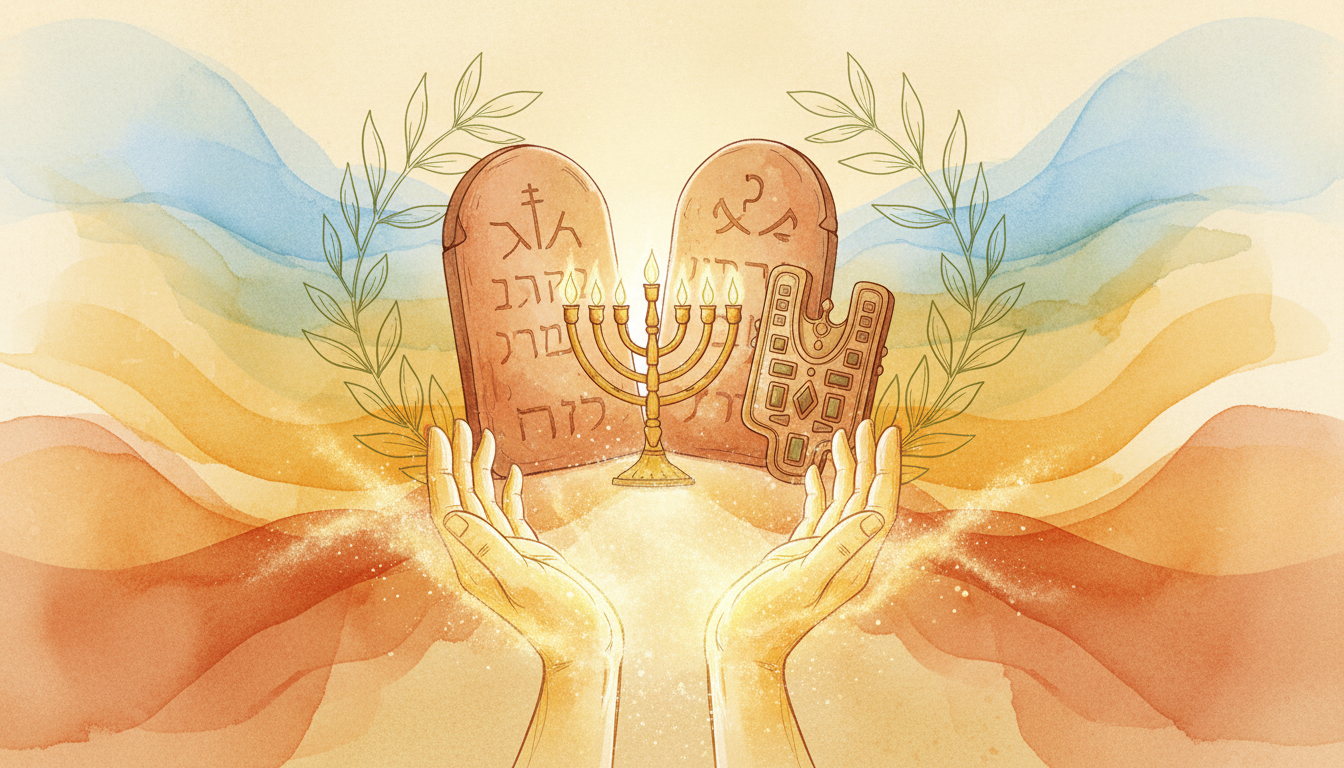
What Does the Bible Say About Tithing? A Covenant-Based System Revealed
This course traces the biblical teaching on tithes from Abraham through the early church, uncovering how tithing functioned not as a simple percentage but as a multifaceted covenant practice tied to priestly support, festival celebration, and care for the poor. We discover that the original text reveals something richer than the simplified 10% rule: a system rooted in relationship with God and community care. The course culminates in understanding how Jesus and the apostles transformed this practice into grace-motivated voluntary generosity, enriching rather than abandoning the principle of faithful giving.
What you'll study
Before the Law: Abraham's Tithe to Melchizedek—Tithing as Voluntary Honor
Genesis 14:18-20
The Mosaic Foundation: What Is a Tithe and Who Receives It?
Leviticus 27:30-33 and Numbers 18:20-32
A System of Care: The Multiple Tithes and Their Social Function
Deuteronomy 12:5-19 and Deuteronomy 14:22-29
Jesus and the Pharisees: Affirming Justice While Reframing Priorities
Matthew 23:23 and Luke 18:9-14
From Law to Grace: The Apostolic Reframing of Generous Giving
2 Corinthians 9:6-15, 1 Corinthians 9:1-14, Hebrews 7:1-10, and Acts 2:44-45
Chapter 1 · Free to read
Before the Law: Abraham's Tithe to Melchizedek—Tithing as Voluntary Honor
Genesis 14:18-20
The Text
Then Melchizedek king of Salem brought out bread and wine—since he was priest of God Most High—and he blessed Abram and said: 'Blessed be Abram by God Most High, Creator of heaven and earth, and blessed be God Most High, who has delivered your enemies into your hand.' Then Abram gave Melchizedek a tenth of everything. (Genesis 14:18–20, BSB)
Genesis 14:18–20 (The Hebrew reads: וַיּוֹצִא מֶלְכִּי־צֶדֶק מֶלֶךְ שָׁלֵם לֶחֶם וָיָיִן וְהוּא כֹהֵן לְאֵל עֶלְיוֹן (Melchizedek, king of Salem, brought forth bread and wine; and he was priest of God Most High). Then Abraham gives: וַיִּתֶּן־לוֹ מַעֲשֵׂר מִכֹּל (and he gave him a tenth from all).)
Key Terms
- מֶלְכִּי־צֶדֶק · Melkhi-Tsedeq
- Melchizedek; literally 'My King is Righteousness' (melkhi = 'my king'; tsedeq = 'righteousness'). This name encodes theological significance—a ruler whose kingship is founded on righteousness, not mere power.
- כֹהֵן · kohen
- Priest; one who mediates between God and humanity, performing sacred functions and blessings. In Melchizedek's case, he is explicitly identified as 'priest of God Most High' (kohen le-El Elyon), holding a formal mediatory role that predates the Levitical priesthood.
- מַעֲשֵׂר · ma'aser
- A tenth; one part in ten. The term signifies proportional giving. The verb form 'aser means 'to tithe' or 'to set apart one-tenth.' This is the first use of this word in Scripture, establishing the semantic baseline for all later tithing law.
- אֵל עֶלְיוֹן · El Elyon
- God Most High; El (the generic Canaanite term for God) with Elyon (Most High, supreme). Together they denote the God who is transcendent over all other powers. This is the title Melchizedek uses and that Abraham affirms, showing theological alignment despite their different backgrounds.
Historical Foundation
The Patriarchal Age (Abraham's lifetime, c. 2000–1800 BCE) into the Iron Age II context where these narratives were documented and transmitted through Israel's history until the Second Temple period (537 BCE onward)
Abraham lived as a sojourner in the land of Canaan, existing outside the structures of the later Mosaic covenant. His world was one of nomadic herding, tribal confederacies, and small city-states locked in territorial disputes. The Kings' War (Genesis 14) reflects the volatile politics of the Levantine Bronze Age—petty kingdoms tributary to larger powers (Elam, Shinar) rebelled and were militarily subdued. Melchizedek appears as one of the few native rulers who retained faith in 'God Most High' (El Elyon), suggesting a pre-Abrahamic religiosity in the land. Abraham's actions—raising a militia from his household, pursuing Chedorlaomer, refusing spoils from the king of Sodom, and tithing to Melchizedek—all occur in this context of covenant-obligation and personal honor, not yet within the structures of the Mosaic Law (which would not be given for another 400+ years). This tithe is an act of voluntary devotion and recognition of priestly mediation before any law commanded it.
Cultural World
The Ancient Near Eastern context of Genesis 14 involves several overlapping systems. First, the political landscape reflects tributary vassalage—smaller kingdoms submitting to imperial powers (here, the five kings of the Jordan Valley under Elam/Persia for 12 years, then rebelling in year 13). This mirrors the suzerainty pattern common in Hittite treaties and Akkadian inscriptions: a powerful overlord demands tribute from subordinate kings, who may rebel but face military reconquest. Second, the institution of the 'tithe' or 'tenth' was known in Mesopotamian and Egyptian administrative systems as a tax or offering to temples and kings. The Code of Hammurabi (18th century BCE, training-assisted) contains provisions for tithes as temple dues. Egyptian temple records from the Ramesside period (13th century BCE, training-assisted) document systematic tithes to the god Amun-Re. Third, the figure of a priest-king mediating between the human and divine realms appears in various ANE contexts—the Egyptian pharaoh as high priest, Mesopotamian kings performing ritual functions. Melchizedek exemplifies this dual role: king of a city-state and priest of El Elyon. Fourth, the practice of blessing in ANE culture was a formal, binding pronouncement—not merely well-wishes but the transfer of divine favor (seen in Akkadian and Hittite blessing formulas, training-assisted). When Melchizedek blesses Abram, he exercises priestly prerogative. Fifth, gift-giving and tribute after military victory was a means of acknowledging divine favor and securing future blessing—a reciprocal, covenantal act. Abram's tithe fits this pattern: he acknowledges that God delivered victory, and he honors the priest of God Most High by dedicating a tenth of the spoils.
What the Evidence Shows
Genesis 14 presents Abraham's tithe not as a response to law but as a voluntary act of honor and devotion. The narrative sequence is crucial: (1) Abram learns his nephew Lot has been captured; (2) he musters his household and pursues Chedorlaomer, routing him by night near Damascus; (3) he recovers all the goods and people; (4) on his return, Melchizedek, king of Salem and priest of God Most High, meets him, brings bread and wine (provisions and priestly sustenance), and pronounces a formal blessing, acknowledging God's victory; (5) Abram responds by giving Melchizedek a tenth of everything. The text does not command this tithe—it flows from Abram's recognition of the priest's mediatory role and God's deliverance. The commentators Matthew Henry and John Gill both underscore that Abram's tithe is 'an evidence of his piety, as well as of his valor'—a voluntary expression of faith and gratitude before any Mosaic law. Easton's Bible Dictionary confirms: 'The dedication of a tenth to God was recognized as a duty before the time of Moses. Abraham paid tithes to Melchizedek.' The evidence shows that tithing predates the Mosaic covenant by centuries and arises from a personal conviction of gratitude, not legal obligation. This first tithe is directed to a priest (Melchizedek) whose legitimacy comes not from Levitical descent (which did not yet exist) but from his role as priest of God Most High and his recognition by the patriarch Abraham himself. Later, Hebrews 7:6 (training-assisted) will reference this moment as proof that Abraham honored Melchizedek—a priest superior to the Levitical order—suggesting that the author of Hebrews saw in Abraham's tithe a pattern of honoring priestly mediation rooted in faith rather than law. The implication is profound: the fundamental motive for tithing is not legal compulsion but covenantal honor and the recognition that God is the true provider of victory and blessing.
Scholarly Witness
Abram's tithe is 'an evidence of his piety, as well as of his valor; for it was to a priest or official mediator between God and him that Abram gave a tenth of the.' Henry emphasizes that the tithe flows from piety—faith recognition—not legal requirement. He also identifies Melchizedek as 'a type of the Saviour' (Hebrews 7), reading the patriarchal tithe as prefiguring the honor due to Christ's priesthood.
Gill discusses Melchizedek's identity and priesthood at length, noting that he was 'one of the few native princes, if not the only one, who knew and worshipped the most high God.' Gill emphasizes that Melchizedek's priesthood is legitimate by recognition and divine sanction, not by genealogy, and that Abraham's honoring him with a tithe demonstrates faith in the priest's mediatory role.
The commentators stress that Melchizedek's blessing was 'a pious acknowledgment which we should imitate on succeeding in any lawful enterprise.' They frame the tithe as part of a larger pattern: after victory in battle, the pious acknowledgment of God's hand through an offering to God's priest. This establishes tithing as a spiritual principle, not a legal one.
Easton notes that 'the dedication of a tenth to God was recognized as a duty before the time of Moses. Abraham paid tithes to Melchizedek.' This entry positions patriarchal tithing as a custom rooted in faith, prior to and independent of the Mosaic tithe laws.
Bruce argues that Hebrews 7:1–10 uses Abraham's tithe to Melchizedek as scriptural proof that the Melchizedekian priesthood (Christ's order) transcends and supersedes the Levitical priesthood. The tithe becomes evidence that even the patriarch Abraham recognized a priest-king whose order was superior to that of his own descendants. Bruce frames the tithe as Abraham's implicit confession of faith in a priesthood that would outlast the law.
Heiser emphasizes that Melchizedek represents a remnant of pre-Abrahamic monotheism in Canaan—someone who retained knowledge of 'God Most High' (El Elyon) outside the patriarchal line. Heiser argues that Abraham's tithe to Melchizedek acknowledges this priesthood not as foreign but as aligned with the true God. Heiser connects this to the ANE pattern of priest-kings mediating divine blessing and uses it to argue that tithing in the biblical world was fundamentally about honoring priestly mediation and recognizing God's sovereignty, not about economic redistribution.
Joines's broader work on religious syncretism and adaptation in the ANE suggests that Melchizedek's appearance and Abraham's recognition of him reflect a pattern of religious accommodation—not compromise, but the principle that God worked with existing religious frameworks (El Elyon as the Canaanite high god) to reveal himself. Abraham's tithe is his affirmation that the God he serves is the true El Elyon, validating Melchizedek's priesthood by subordinating it to the covenant promise.
Discovery Questions
1.Read Genesis 14:18–20 carefully. What does the text tell us about WHO initiates the blessing and the tithe? Does Melchizedek command Abram to tithe, or does Abram give it voluntarily?
The text presents the tithe as ABRAM'S RESPONSE to Melchizedek's blessing, not as a command. Melchizedek blesses first (a priestly function), and then Abram gives. This sequence reveals that tithing here is voluntary devotion, not legal obligation. The tithe is Abram's way of saying, 'I honor the priest of the God who gave me victory.' This establishes the MOTIVE for tithing long before the Mosaic Law—not compulsion, but gratitude and honor.
2.Compare Genesis 14:20 ('Then Abram gave Melchizedek a tenth of everything') with Leviticus 27:30 and Numbers 18:21 (the later Mosaic tithe laws). What is different about WHAT is tithed and WHY? Is Abraham tithing the same thing the law requires?
Abraham tithes SPOILS OF WAR (goods, animals, captives from battle)—not agricultural produce. The Mosaic tithe later focuses on the produce of the land (crops and livestock). This reveals that TITHING AS A PRINCIPLE (giving a tenth in recognition of God's blessing) predates the Mosaic Law's SPECIFIC FORM (the agricultural tithe). Abraham's tithe is a voluntary gesture from the heart; the law's tithe is a structured requirement tied to settled life in the land. Both flow from the principle of honoring God and his priests, but the patriarchal tithe is more flexible, more personal—it's Abram saying, 'Out of what God has given me, I give to his priest.'
3.Look at Hebrews 7:1–10 (cross-referenced in your BSB). The New Testament author connects Genesis 14:20 to a larger argument about Christ as a priest 'in the order of Melchizedek' (Psalm 110:4). Why would Abraham's tithe to Melchizedek matter to an argument about Jesus? What does it prove?
Hebrews uses Genesis 14:20 as SCRIPTURAL EVIDENCE that Abraham himself—the ancestor and model of faith—recognized and honored a priesthood that was NOT Levitical. By tithing to Melchizedek, Abraham implicitly confesses that this priest-king's order transcends the later Levitical system (of which Abraham's descendant Levi was a part). This turns the patriarchal tithe into a prophetic act: Abraham honors the very priesthood that Christ would embody. The evidence shows that tithing in Scripture is ultimately about recognizing and honoring TRUE PRIESTLY MEDIATION—first Melchizedek's, then the Levites', finally Christ's. The tithe is not merely a tax; it's a confession of faith in God's mediatory system.
4.Given that Abraham's tithe was voluntary (not commanded), given that it predates the Mosaic Law by centuries, and given that the New Testament connects it to Christ's priesthood (not the Levitical one), what does this tell you about the PURPOSE of tithing in Scripture? Is tithing primarily a legal obligation, or is it a spiritual principle that takes different forms?
The evidence reveals that TITHING IS A SPIRITUAL PRINCIPLE—the practice of acknowledging God's sovereignty and honoring his mediatory system by dedicating a portion of what He has given. The FORM changes (spoils → agricultural produce → spiritual honor), but the MOTIVE remains: gratitude, faith, and recognition that all belongs to God and flows through his appointed channels. This reading helps bridge the patriarchal, Mosaic, and Christian periods. It also helps explain why the early church didn't simply demand tithes as the law did—the principle (honor God and his servants) remained binding, but the FORM (the tenth of the land) was no longer mandated under grace. The New Testament, however, never dismisses tithing; it reframes it as flowing from love and grace, not from legal coercion. Abraham's tithe stands as the model: a free heart responding to God's blessing through honor to God's priest.
Connected Passages
- Leviticus 27:30–32 and Numbers 18:21–24 — The Mosaic tithe law. Compares the SPECIFIC FORM (one-tenth of crops and animals from the land) and PURPOSE (support of the Levitical priesthood) with Abraham's patriarchal tithe. Shows that the PRINCIPLE of tithing predates the law, but the law FORMALIZED and SYSTEMATIZED it. This establishes a continuity of principle across different covenantal periods.
- Malachi 3:8–10 — Addresses Israel's failure to tithe during the post-exilic period, calling it 'robbing God.' Malachi treats the tithe as a binding obligation (not merely a principle), showing that by the Second Temple period, tithing was understood as a legal duty rooted in the Mosaic covenant. But the motive Malachi stresses—'Bring the whole tithe into the storehouse'—echoes Abraham's voluntary recognition: honor the priest's ministry and trust God's blessing.
- Hebrews 5–7 (esp. 7:1–10) — The New Testament's definitive commentary on Genesis 14:18–20. Uses Abraham's tithe to argue that Melchizedek's priesthood is superior to the Levitical order and that Christ belongs to Melchizedek's line. This elevates the patriarchal tithe from a historical curiosity into a PROPHETIC ACT—Abraham's recognition of the priesthood that Christ would embody. Shows that early Christians understood the tithe through a Christological lens.
- 1 Corinthians 9:13–14 and 2 Corinthians 9:6–7 — Paul addresses giving and support of ministry in the New Testament church. In 1 Cor. 9, Paul appeals to the priestly principle (those who serve the altar share in its benefits), echoing the Mosaic tithe's purpose. In 2 Cor. 9, Paul stresses voluntary, cheerful giving—'God loves a cheerful giver'—returning to the SPIRIT of Abraham's tithe (free-will devotion) while releasing the LETTER of the law (the mandatory tenth). Shows the New Testament's reorientation: the PRINCIPLE (support God's servants; give from a grateful heart) remains; the FORM (the tenth) is transformed by grace.
- Proverbs 3:9–10 and Proverbs 22:9 — Wisdom literature's affirmation of generosity and giving 'the firstfruits of your crops' to the Lord. Echoes the principle that honoring God through material giving is an act of faith and wisdom. These passages, predating the Mosaic Law's codification, reflect the patriarchal mindset (of which Abraham is the exemplar): giving to God as a recognition of his provision.
- Luke 11:42 and Matthew 23:23 (Jesus on tithing) — Jesus affirms tithing as part of 'the more important matters of the law'—justice, mercy, faithfulness—but subordinates it. This shows that by the 1st century, the tithe had become formalized and even burdensome (tithing mint and herbs). Jesus redirects attention to the HEART behind the tithe. His words echo the patriarchal pattern: tithing is valid, but only when rooted in mercy and justice, not in legalistic precision. Abraham's free-will tithe exemplifies the right spirit.
Takeaways
- TITHING PREDATES THE LAW AND FLOWS FROM GRACE: Abraham's tithe to Melchizedek occurs centuries before the Mosaic covenant and is entirely voluntary—a response to God's deliverance and a recognition of priestly mediation. This establishes tithing as a PRINCIPLE of faith, not a legal obligation. The principle is: 'Acknowledge God's sovereignty by honoring his appointed mediators with a portion of what He has given.' This grounds all later forms of tithing (Mosaic and Christian) in a spiritual reality, not in legal compulsion.
- TITHING HONORS THE PRIEST'S ROLE AS MEDIATOR: Melchizedek blesses Abram in God's name, and Abram responds by tithing to him. The tithe is Abram's affirmation that this priest stands between him and God Most High. The New Testament later uses this patriarchal act to argue that Christ is the ultimate priest-mediator (Hebrews 7)—the tithe becomes a way of confessing who mediates God's blessing. In the Christian era, giving honors those who serve the gospel and mediate Christ's ministry.
- THE FORM OF TITHING CHANGES; THE PRINCIPLE REMAINS CONSTANT: Abraham tithes spoils of war; Moses codifies a tithe of the land; the New Testament reframes giving as voluntary and grace-motivated. What changes is the FORM (what you give and how much); what remains is the MOTIVE (gratitude, faith, and honor). This helps believers understand why the church does not mandate the 10% agricultural tithe—the FORM was tied to Mosaic law and Israel's agrarian settlement. But the PRINCIPLE (give generously and joyfully to support God's work and workers) remains eternally valid.
- MELCHIZEDEK'S PRIESTHOOD FORESHADOWS CHRIST'S: Abraham's tithe to a priest-king outside the Levitical line is interpreted by Hebrews as a prophetic gesture—a confession that this priesthood is greater. The early church saw in Melchizedek a 'type' (prefigurement) of Christ, who is both King of Righteousness and Priest. For believers today, honoring Christ with our resources (through the local church, ministry support, and generosity) parallels Abraham's tithe—it is an acknowledgment that Jesus mediates our access to God and deserves our devotion.
- TITHING IS NOT FIRST ABOUT ECONOMICS; IT'S ABOUT THEOLOGY: The patriarchal tithe in Genesis 14 is not primarily about funding a religious institution (there is none yet). It's about CONFESSION—Abram confessing his faith in God Most High and the legitimacy of Melchizedek's priesthood. Similarly, Christian giving is not primarily about keeping the church solvent (though that matters); it's about expressing faith, gratitude, and submission to Christ as Lord. When a believer tithes or gives generously, they are making a theological statement: 'God provides; I trust Him; I honor His appointed mediators (pastors, missionaries, the body of Christ).
Application
This week, examine your own giving practices and motivations. Ask yourself: (1) Do I give out of obedience to a rule, or out of gratitude and love? (2) Who are the 'mediators' I am honoring through my giving—local pastors, missionaries, poor saints? (3) If I think of my giving as a confession of faith (like Abraham's tithe confessed his faith in God Most High and Melchizedek's priesthood), how does that change the way I give? (4) The early church moved from a mandatory tithe to voluntary, grace-motivated giving—do I experience my giving as joyful, or as obligatory? Pray over your giving this week, and consider: Am I honoring Christ through my generosity, or am I giving merely to satisfy a rule? Abraham gave freely from a full heart. Can you?
Continue the course — 4 more chapters
The Mosaic Foundation: What Is a Tithe and Who Receives It?
Leviticus 27:30-33 and Numbers 18:20-32
How did God define the tithe under the Mosaic covenant, and what was its primary purpose in Israel's covenant structure?
A System of Care: The Multiple Tithes and Their Social Function
Deuteronomy 12:5-19 and Deuteronomy 14:22-29
Why did Israel have more than one tithe, and what does this reveal about God's design for worship, celebration, and care for the vulnerable?
Jesus and the Pharisees: Affirming Justice While Reframing Priorities
Matthew 23:23 and Luke 18:9-14
How did Jesus regard the tithing practice of His day, and what was His critique really about?
From Law to Grace: The Apostolic Reframing of Generous Giving
2 Corinthians 9:6-15, 1 Corinthians 9:1-14, Hebrews 7:1-10, and Acts 2:44-45
How did the early church and apostles transform the tithe principle from legal obligation into grace-motivated, voluntary generosity?
No credit card required
Sources Used
Every insight traces to a named source. 0 AI-generated interpretations.
Related courses
What Does the Bible Say About Faith? Recovering Covenant Trust, Embodied Obedience, and Communal Faithfulness
This course deepens understanding of biblical faith (emunah/pistis) beyond modern definitions of belief to recover the original semantic and relational richness of the texts. Through careful study of key passages across the canon, learners will discover that biblical faith operates as covenant trust, finds expression in embodied obedience, and exists within communal faithfulness. Rather than an internal conviction alone, faith in Scripture is a dynamic trust-in-action directed toward God, rooted in His promises, and demonstrated through practical loyalty. This course traces faith from Abraham through the incarnation, showing how the concept develops while maintaining its core relational character, and invites learners to experience their own faith deepened rather than dismantled.
5 chapters
Divorce in the Bible: A Covenant and Compassion Reading
This course uncovers what the original biblical text reveals about divorce—not as a permission-versus-prohibition binary, but as a communal covenant issue centered on pastoral mercy and protecting the vulnerable. Beginning with Deuteronomy 24's protective framework, we trace how Jesus reinterprets divorce in light of God's design for permanence, how Paul navigates real pastoral crises in the church, and what the ancient sources tell us about hardness of heart, covenant breaking, and grace. By grounding each chapter in the primary text and enriching it with historical, linguistic, and theological evidence, learners discover that the Bible's teaching on divorce is far more nuanced, compassionate, and theologically profound than common tradition suggests.
6 chapters
What Does the Bible Say About Marriage? A Biblical Foundation for Covenant, Creation, and Kingdom
This five-chapter course explores the Bible's teaching on marriage as a covenantal union rooted in creation, embodied in household life, revealing Christ's relationship to the Church, and extending into God's renewed creation. Rather than settling for reductive views (companionship-only or dualistic denial of embodied life), we return to the original biblical text to discover marriage's richer theological significance: it is simultaneously a creation mandate, a covenant bond, a sexual and relational union, and a sign of Christ's redemptive love. Each chapter is anchored in a key passage and progressively deepens our understanding through textual, theological, cultural, and historical evidence.
5 chapters
Overcoming Fear: Biblical Reverence and the Covenant Presence of God
A five-chapter exploration of how the Bible redefines fear—not as anxiety to be conquered through willpower, but as reverent alignment with God's reality and presence. This course traces the original meaning of yirah (fear) from the Old Testament through the apostolic church, showing how faith in God's covenant faithfulness, not self-generated courage, is the true antidote to human anxiety and threat. Each chapter is anchored in a key biblical passage and enriched by historical, textual, and theological evidence.
5 chapters
What Does Scripture Teach About Money? A Covenantal Vision Beyond Personal Virtue
This six-chapter course recovers the Bible's richest teaching on money as a covenantal and structural force, not merely a tool for individual moral performance. Beginning with the foundational text that distinguishes the love of money from money itself, the course traces how Hebrew economic law embedded justice into community structures, how Jesus named money as a rival power (mammon), and how apostolic practice revealed economics as a cosmic realignment. Each chapter starts with primary Scripture and shows how cultural, historical, and theological context deepens—not replaces—what the text already says. Learners will discover that biblical money teaching is far more concerned with concrete justice NOW in covenant community than with afterlife reward, and that wealth functions as a theological force requiring both personal AND corporate transformation. This is enrichment and recovery: the biblical text proves richer than inherited tradition suggested.
6 chapters
What Does the Bible Reveal About Anger as a Relational Response?
A five-chapter biblical exploration of anger as neither inherently sinful nor a mere emotion to suppress, but a morally complex relational response. This course traces how Scripture distinguishes between destructive and righteous anger, reveals anger and love coexisting in God's character, and shows how Christ's incarnation reframes human anger within redemptive justice. Learners will discover that the biblical text on anger is far richer than common tradition suggests—anger itself is morally neutral; the object, motive, and expression determine its ethical weight.
5 chapters
Create your own Bible studies — free.
Ask any question. Get evidence from named scholars and curated datasets in minutes.
Get Started Free