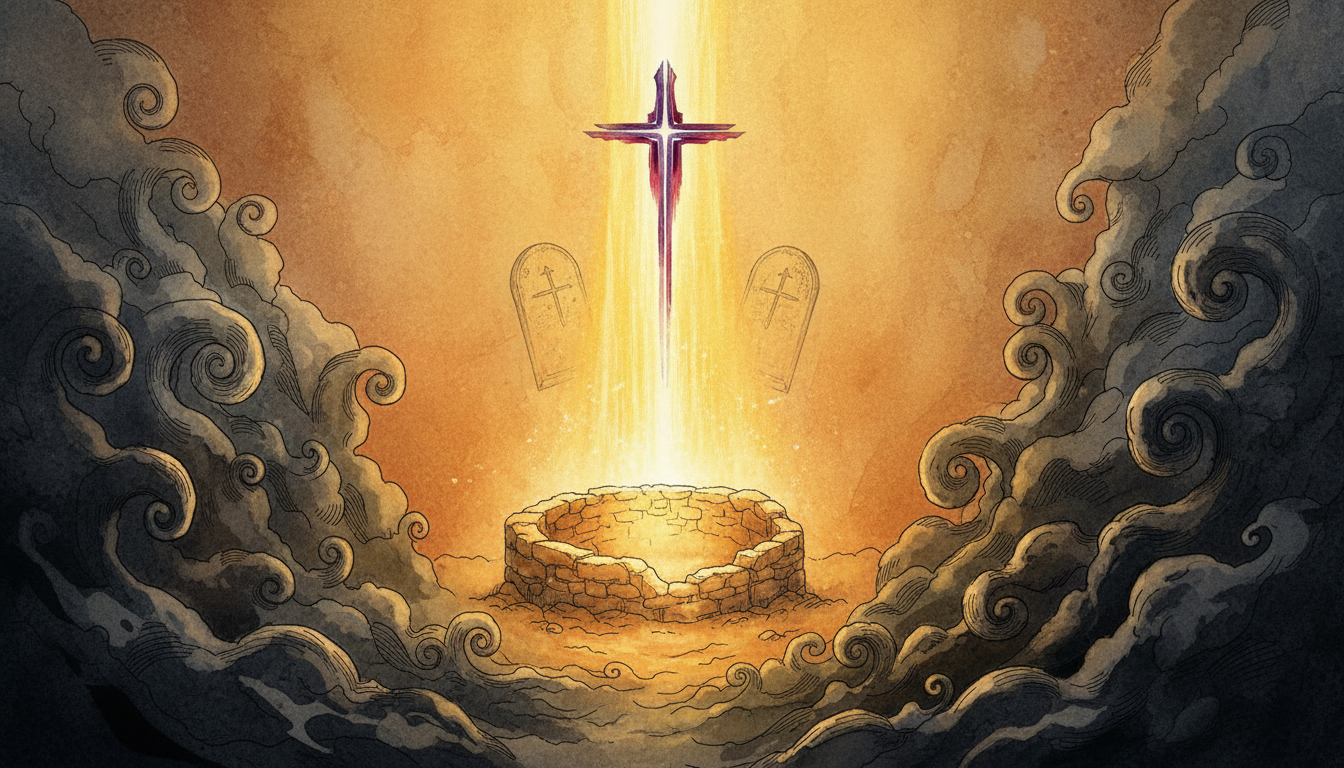
The Richer Biblical Cosmology of Spiritual Conflict and Divine Authority
This course deeply explores the biblical understanding of spiritual conflict, moving beyond modern interpretations to uncover a more nuanced and profound biblical cosmology. Through primary texts, historical context, and linguistic analysis, learners will discover the breadth of spiritual adversaries, the origins of evil, and the foundational authority of God and Christ over all spiritual realms. The aim is to deepen faith and cultivate a richer appreciation for the Bible's teaching on spiritual warfare, framing this exploration as an enrichment and recovery of ancient wisdom.
What you'll study
The Genesis of Opposition: First Glimpses of a Cosmic Battle
Genesis 3:1-15 & Genesis 6:1-4
The Divine Council and the Adversary: Unveiling Heavenly Politics
Job 1-2 & Psalm 82
Territorial Spirits and Cosmic Princes: The Unseen Battle for Nations
Daniel 10
Christ's Authority and the Demise of Darkness: Jesus' Ministry of Conquest
Mark 1:21-28, Mark 5:1-20, Luke 10:18-20
The Believer's Stand: Equipping for Battle and Securing Victory
Ephesians 6:10-18, Colossians 2:13-15, 2 Corinthians 10:3-5
Chapter 1 · Free to read
The Genesis of Opposition: First Glimpses of a Cosmic Battle
Genesis 3:1-15 & Genesis 6:1-4
The Text
Genesis 3:1-15 & Genesis 6:1-4 1 Now the serpentwas more crafty than any beast of the field that the LORD God had made. And he said to the woman, “Did God really say, ‘You must not eat from any tree in the garden?’” 2 The woman answered the serpent, “We may eat the fruit of the trees of the garden, 3 but about the fruit of the tree in the middle of the garden, God has said, ‘You must not eat of it or touch it, or you will die.’” 4 “You will not surely die,” the serpent told the woman. 5 “For God knows that in the day you eat of it, your eyes will be opened and you will be like God, knowing good and evil.” 6 When the woman saw that the tree was good for food and pleasing to the eyes, and that it was desirable for obtaining wisdom, she took the fruit and ate it. She also gave some to her husband who was with her, and he ate it. 7 And the eyes of both of them were opened, and they knew that they were naked; so they sewed together fig leaves and made coverings for themselves. 8 Then the man and his wife heard the voice of the LORD God walking in the garden in the breezeof the day, and they hid themselves from the presence of the LORD God among the trees of the garden. 9 But the LORD God called out to the man, “Where are you?” 10 “I heard Your voice in the garden,” he replied, “and I was afraid because I was naked; so I hid myself.” 11 “Who told you that you were naked?” asked the LORD God. “Have you eaten from the tree of which I commanded you not to eat?” 12 And the man answered, “The woman whom You gave me, she gave me fruit from the tree, and I ate it.” 13 Then the LORD God said to the woman, “What is this you have done?”“The serpent deceived me,” she replied, “and I ate.” 14 So the LORD God said to the serpent:“Because you have done this,cursed are you above all livestockand every beast of the field!On your belly will you go,and dust you will eat,all the days of your life. 15 And I will put enmity between you and the woman,and between your seed and her seed.He will crush your head,and you will strike his heel.” 16 To the woman He said:“I will sharply increase your pain in childbirth; in pain you will bring forth children. Your desire will be for your husband,and he will rule over you.” 17 And to Adam He said:“Because you have listened to the voice of your wifeand have eaten from the treeof which I commanded you not to eat,cursed is the ground because of you; through toil you will eat of itall the days of your life. 18 Both thorns and thistles it will yield for you,and you will eat the plants of the field. 19 By the sweat of your browyou will eat your bread, until you return to the ground—because out of it were you taken. For dust you are,and to dust you shall return.” 20 And Adam named his wife Eve,because she would be the mother of all the living. 21 And the LORD God made garments of skin for Adam and his wife, and He clothed them. 22 Then the LORD God said, “Behold, the man has become like one of Us, knowing good and evil. And now, lest he reach out his hand and take also from th
Genesis 3:1-15 & Genesis 6:1-4 (Berean Standard Bible (BSB))
Key Terms
- נָחָשׁ · nachash
- serpent
- בְּנֵי הָאֱלֹהִים · bene ha'elohim
- sons of God
- רָפָא · rapha'
- giant, Nephilim
Historical Foundation
Early Biblical Narratives, echoed in Second Temple and Greco-Roman Periods
In the earliest history, the biblical text depicts a perfect creation shattered by disobedience. In the Second Temple period, Jewish thinkers wrestled with the problem of evil and its origins, often expanding on the sparse details in Genesis 1-11. This period (roughly 500 BCE - 70 CE) saw the flourishing of texts like 1 Enoch and Jubilees, which provided further narrative and theological frameworks for understanding Genesis 6:1-4. During the Greco-Roman period (1st century CE onwards), early Christians, including New Testament authors, articulated their understanding of cosmic conflict within this rich interpretive tradition, emphasizing Christ's victory over these spiritual forces.
Cultural World
Ancient Near Eastern (ANE) cultures frequently grappled with the origins of evil and the presence of divine beings influencing human affairs. The biblical narrative of Genesis 1-11, while unique in its monotheistic framework, engages with and often reinterprets common ANE motifs. The concept of divine beings interacting with humanity, and even violating divine boundaries, was present in various mythologies. However, the biblical account consistently presents God as sovereign and distinct from the flawed pagan deities.
What the Evidence Shows
The Assemblies of God position paper on 'The Fall of Man' grounds humanity's separation from God in the voluntary transgression of Adam and Eve (Genesis 3:6). This event, instigated by 'the serpent,' introduced sin and spiritual death. The AG 'Spiritual Warfare and the Believer' paper explicitly links the devil's opposition to humanity's purpose back to Genesis 3:1-19, stating that 'From the fall into sin… the devil has opposed humanity’s fulfillment of God’s purpose.'
Building on this foundation, Genesis 6:1-4 reveals a further escalation of spiritual rebellion. The 'sons of God' (bene ha'elohim) are depicted as taking human wives, leading to the birth of the Nephilim. While traditional interpretations, particularly in pre-modern commentary like John Gill's, sometimes refer to these 'sons of God' as descendants of Seth, a growing consensus in modern scholarship, informed by ANE context and Second Temple literature, identifies them as divine beings. Dr. Michael Heiser highlights that 'nearly every Second Temple Jewish text that comments on human depravity attributes the proliferation of evil not to Adam but to the sin of the Watchers in Genesis 6:1-4.' This interpretation is further supported by the consistent use of 'sons of God' in other biblical texts (e.g., Job 1:6, 2:1) which denote divine, heavenly beings, not human lineage.
The 'nachash' (serpent) in Genesis 3 is identified in Revelation 12:9 as 'that ancient serpent, who is the devil, or Satan.' This clarifies that the initial temptation was not from a mere animal, but from a supernatural adversary. Heiser further notes the term 'nachash' has semantic ranges beyond 'snake,' including 'shining one,' suggesting a being of significant, perhaps divine, appearance. The Assemblies of God acknowledges this spiritual adversary, teaching that 'the Christ-follower is engaged in a conflict... with the devil,' and referencing Ephesians 6:12: 'our struggle is not against flesh and blood, but against the rulers, against the authorities, against the powers of this dark world and against the spiritual forces of evil in the heavenly realms.' These passages collectively establish two distinct, yet interconnected, foundational rebellions by divine beings: one leading to humanity's fall, and another escalating corruption on earth, both contributing to the broader cosmic conflict.
Scholarly Witness
Gill identifies the serpent in Genesis 3:1 as being possessed and used by Satan, arguing that it's irrational to assume human nature in its glory would be outwitted by a mere creature. He notes the serpent's speech and reason, concluding that the New Testament reveals the true identity of the tempter to be the devil. This interpretation aligns the Genesis account with later biblical revelations that Satan is the ultimate antagonist.
JFB commentary emphasizes Eve's distorted perception of God's prohibition and penalty, noting her omission of 'surely' from 'you shall surely die'. They highlight the tempter's strategy of promising impunity and a higher status ('your eyes shall be opened'), leading Eve to desire knowledge. They also describe the immediate effect of sin as shame, remorse, and fear, contrasting it with Adam and Eve's prior joyful interactions with God.
Heiser posits that the primeval history contains a series of supernatural rebellions by divine beings, beginning with the nachash (serpent) in Eden and escalating with the 'sons of God'/'Watchers' transgression in Genesis 6:1-4. He argues that the 'nachash' was a 'shining divine being' rather than a mere snake, and that the 'sons of God' were divine beings, not human, whose sin profoundly contributed to human depravity, a view widely held in Second Temple Judaism.
Discovery Questions
1.What words or phrases in Genesis 3:1-5 indicate that the 'serpent' is not just a typical animal, but something more sinister?
The text states the serpent was 'more crafty than any beast of the field.' It speaks directly to Eve, questioning God's command and sowing doubt. It also makes a theological claim, asserting that God knows eating the fruit will make them 'like God, knowing good and evil.' This goes beyond the capabilities of any mere animal, suggesting a profound intelligence and malevolence, which the New Testament (Revelation 12:9) confirms is Satan himself.
2.How do the 'sons of God' in Genesis 6:1-4 contribute to the escalation of spiritual opposition on earth, and how is this understood in light of other biblical texts?
The 'sons of God' (bene ha'elohim) are identified by canonical parallel passages (e.g., Job 1:6, 2:1) as members of God's divine council – divine or heavenly beings. Their act of taking human wives (Genesis 6:2) represents a crossing of divine boundaries, leading to an unprecedented level of corruption and violence (Genesis 6:5). This supernatural transgression is distinct from Adam's sin and introduces another layer of spiritual rebellion and opposition directly into the human realm, contributing to sin on a cosmic scale.
3.How do the events of Genesis 3 and Genesis 6 provide a foundational understanding for the Assemblies of God's teaching on 'Spiritual Warfare'?
The Assemblies of God 'Spiritual Warfare and the Believer' position paper explicitly traces the devil's opposition back to 'the fall into sin (Genesis 3:1–19).' The Eden narrative shows the direct engagement of a spiritual adversary (Satan via the serpent) against humanity, leading to sin and separation from God. The Genesis 6 narrative, depicting the 'sons of God' (divine beings) corrupting humanity, reveals a further dimension of spiritual forces actively working against God's creation. Together, these form the biblical bedrock for understanding that believers are engaged in ongoing conflict against 'spiritual forces of evil in the heavenly realms' (Ephesians 6:12), as articulated by the Assemblies of God.
4.How does the 'protoevangelium' in Genesis 3:15 offer hope and foreshadow Christ's victory amidst the genesis of spiritual opposition?
Despite the immediate judgment and the introduction of curses, God's promise in Genesis 3:15, where He says 'I will put enmity between you and the woman, and between your seed and her seed. He will crush your head, and you will strike his heel,' provides the very first glimpse of ultimate victory over the spiritual adversary. This 'protoevangelium' (first gospel) assures that the 'seed of the woman' (later understood to be Christ) will defeat the serpent (Satan), even though there will be suffering. This promise initiates the theme of cosmic battle with a clear declaration of God's victorious plan, setting the stage for all future spiritual warfare.
Connected Passages
- Revelation 12:9; 20:2 — These New Testament passages definitively identify the 'ancient serpent' from Genesis 3 as 'the devil, or Satan,' clarifying the true identity of the spiritual adversary behind the temptation of Eve. This shows how later Scripture interprets earlier Scripture.
- Jude 6; 2 Peter 2:4-5 — These New Testament passages refer to 'angels who did not stay within their own position of authority but left their proper dwelling' and are now 'kept in perpetual darkness, bound with chains until the judgment of the great Day.' Many scholars and early Jewish readers understood these passages to refer to the 'sons of God' or 'Watchers' transgression in Genesis 6:1-4, thereby confirming the supernatural nature of these beings and the severity of their rebellion.
- Ephesians 6:12 — Paul explicitly states that 'our struggle is not against flesh and blood, but against the rulers, against the authorities, against the powers of this dark world and against the spiritual forces of evil in the heavenly realms.' This verse directly informs the Assemblies of God position on spiritual warfare, showing that the opposition originates from invisible, spiritual entities, tracing back to the primordial rebellions in Genesis 3 and 6.
- Genesis 6:5-7 — Immediately following the account of the 'sons of God' and the Nephilim, God observes that 'every inclination of the thoughts of the human heart was only evil all the time' and decides to destroy humanity. This demonstrates the profound and pervasive corruption that resulted from this supernatural rebellion, linking the actions of the 'sons of God' directly to the flood narrative and the extreme evil on earth.
Takeaways
- The Genesis narrative establishes that spiritual opposition did not originate with humanity, but with a supernatural being—Satan, identified as the 'nachash' (serpent) in Genesis 3—who actively challenged God's word and sought to deceive humanity.
- Beyond the initial temptation, Genesis 6 reveals a further, deliberate transgression by 'sons of God' (divine beings) who crossed spiritual boundaries, leading to an escalation of evil and corruption that permeated the earth and ultimately led to the flood.
- The Assemblies of God's understanding of 'spiritual warfare' is deeply rooted in these foundational Genesis accounts, recognizing that believers are engaged in an ongoing conflict not solely against human wickedness, but against real, malevolent spiritual forces.
- Despite the devastating consequences of these primordial rebellions, God's promise in Genesis 3:15 (the protoevangelium) immediately foreshadows a future victory over the spiritual adversary, establishing the hope of redemption through the 'seed of the woman' (Christ).
- Understanding the supernatural origins of evil in Genesis 3 and 6 enriches our appreciation for the biblical worldview, where a cosmic battle unfolds, and highlights the sovereign power of God over all spiritual forces, both those that rebelled and those that remain faithful.
Application
Reflect on how your daily choices and perspectives are influenced by the unseen spiritual conflict revealed in Genesis. How can acknowledging the depth of this spiritual opposition, while clinging to the promise of ultimate victory in Christ, empower your prayer life and commitment to walk in obedience?
Continue the course — 4 more chapters
The Divine Council and the Adversary: Unveiling Heavenly Politics
Job 1-2 & Psalm 82
How do Old Testament narratives introduce 'ha-Satan' within the divine council, and what does this reveal about his agency and God's ultimate sovereignty?
Territorial Spirits and Cosmic Princes: The Unseen Battle for Nations
Daniel 10
What does the book of Daniel illustrate about spiritual warfare's territorial dimensions, involving angelic beings and national destinies?
Christ's Authority and the Demise of Darkness: Jesus' Ministry of Conquest
Mark 1:21-28, Mark 5:1-20, Luke 10:18-20
How does Jesus' ministry, particularly his exorcisms and teachings, demonstrate definitive authority over spiritual adversaries and illuminate their nature?
The Believer's Stand: Equipping for Battle and Securing Victory
Ephesians 6:10-18, Colossians 2:13-15, 2 Corinthians 10:3-5
What specific practices and theological truths does the New Testament prescribe for Christians engaging in spiritual warfare, and how does Christ's accomplished victory frame this engagement?
No credit card required
Sources Used
Every insight traces to a named source. 0 AI-generated interpretations.
Related courses
What Does the Bible Say About Anxiety? A Whole-Person Spiritual Practice
This five-chapter course explores biblical teaching on anxiety as an integrated concern involving spiritual trust, physical provision, communal belonging, and embodied rest. Beginning with Jesus' foundational teaching in Matthew 6, we trace how Hebrew wisdom, the Psalms, and Paul's letters present anxiety not as an isolated internal state to manage, but as a whole-person invitation to deeper trust in God's care. Through careful attention to biblical vocabulary, we discover how ancient authors understood the connection between body, spirit, community, and peace—offering a richer vision than modern tradition often recognizes.
5 chapters
The Book of Psalms: Divine Poetry, Human Faith, and Messianic Hope
A comprehensive exploration of the Psalms as a collection of prayers, praise, and meditations that reflect Israel's lived faith experience, reveal the character of God, anticipate Christ's redemptive work, and continue to shape worship and spiritual practice. This course traces the theological purpose and literary artistry of the Psalms while examining how they address the full range of human experience—from doubt and lament to exuberant praise—always anchored in trust in God's faithfulness.
6 chapters
Toxic Relationships: A Biblical Path Through Restoration, Boundaries, and Spiritual Power
This course explores how Christians should engage persistently harmful relationships by studying the biblical sequence of restoration, confrontation, and wise withdrawal. Rather than viewing separation as the primary solution, we discover that Scripture emphasizes redemptive engagement first—confrontation, prayer, and multiple opportunities for repentance—before considering relational boundaries. The course deepens the learner's understanding of toxicity beyond individual psychology to include spiritual warfare, shows how Jesus and Paul modeled engagement with sinners while maintaining spiritual authority, and reveals that Christians are called not primarily to escape harm but to overcome evil through God's power. Each chapter is anchored in a key biblical passage and progressively builds a comprehensive framework for navigating relationships that wound us.
5 chapters
Prayer in the Bible: A Journey into Divine Communication
This course explores the multifaceted nature of prayer as revealed in the biblical text, from its earliest forms in the Old Testament to its profound development in the teachings and example of Jesus and the early church. We will uncover the purpose, practice, and power of prayer through textual, historical, cultural, linguistic, and theological lenses, revealing how God invites humanity into intimate communion.
6 chapters
Unclean Spirits in the New Testament: A Deeper Biblical Cosmology
This course explores what unclean spirits truly are according to New Testament texts, moving beyond simplified notions of 'demons' to recover a richer biblical understanding of spiritual bondage and liberation. Through close reading of primary passages—from Jesus's first encounter with an unclean spirit to Paul's cosmic framework of spiritual warfare—we discover that the original texts reveal a more integrated, relational, and systemic spirituality than tradition often teaches. The biblical cosmology includes not only personal possession but also structural spiritual forces, not only contamination but also restoration of embodied wholeness. By grounding each chapter in canonical texts and enriching them with historical, linguistic, and theological insights, we will see that Scripture's teaching on unclean spirits is deeper, more comprehensive, and more liberating than we may have realized.
5 chapters
The Book of Philippians: A 4-Part Bible Study Guide
A comprehensive chapter-by-chapter study through Paul's Letter to the Philippians, exploring themes of joy in suffering, Christological depth, gospel freedom, and church unity.
4 chapters
Create your own Bible studies — free.
Ask any question. Get evidence from named scholars and curated datasets in minutes.
Get Started Free