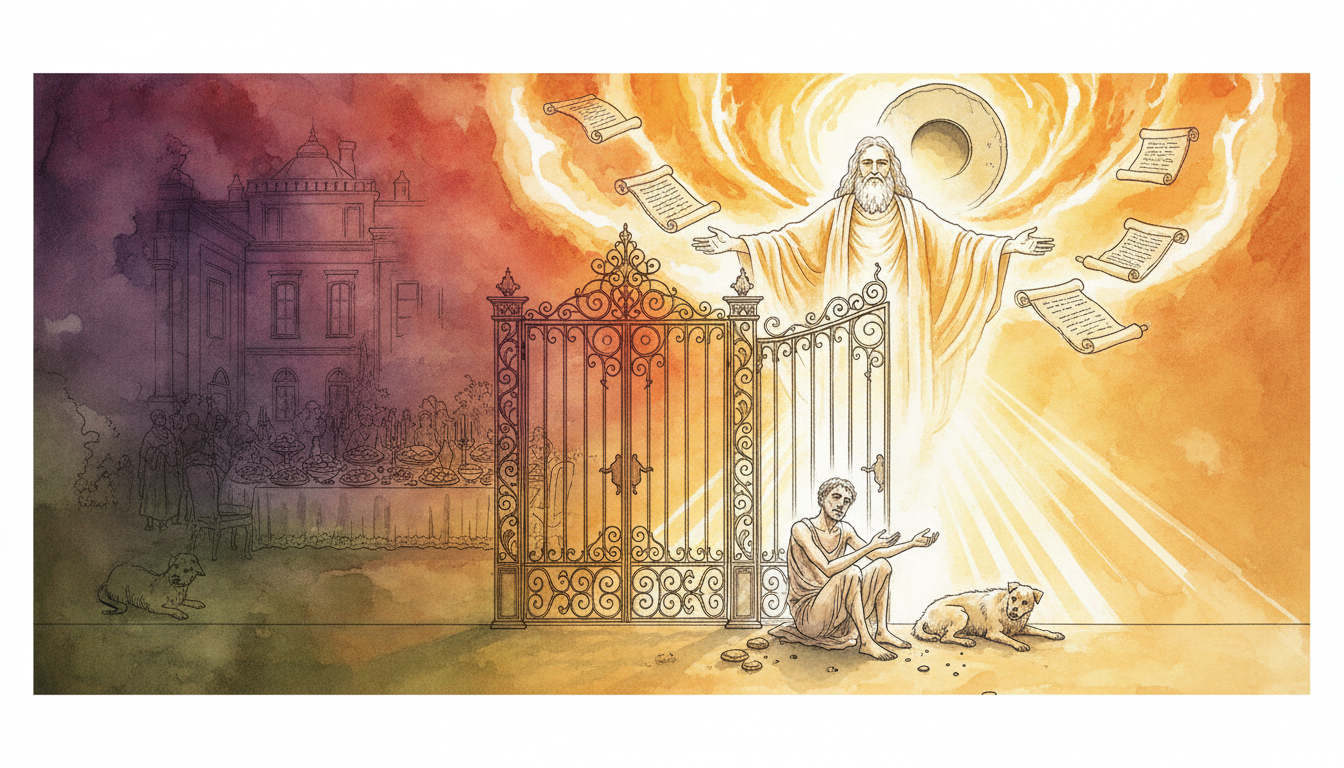
The Parable of Lazarus and the Rich Man: Mercy, Justice, and the Hope of Resurrection
This five-chapter course explores Luke 16:19-31 as a window into Jesus' teaching on wealth, divine mercy, economic justice, and the biblical hope of bodily resurrection. Rather than treating this parable as a simple cautionary tale about the afterlife, we recover its original richness by reading it carefully within Luke's Gospel, the testimony of Moses and the Prophets, and early Christian witness. Each chapter anchors in the biblical text itself, then enriches our understanding through historical, theological, and cultural evidence. You will discover that the parable teaches something far more transformative than inherited tradition often suggests—God's persistent mercy, the urgent call to justice, and the concrete hope of renewed creation.
What you'll study
Reading the Text Itself—Luke 16:19-31 and What Jesus Actually Says
Luke 16:19-31 (The Parable of Lazarus and the Rich Man; read the full parable in context within Jesus' teaching on wealth and stewardship in Luke 16)
The Gospel Context—Jesus' Programmatic Mission to the Poor and the Reversal of Fortune
Luke 4:18 (Jesus' mission statement) and Luke 6:20-26 (The Beatitudes and woes), read alongside Luke 16:19-31 to show the parable as the lived consequence of Jesus' kingdom proclamation
The Spiritual Danger of Wealth and the Idolatry of Comfort—Why the Rich Man Failed
1 Timothy 6:10 (The love of money is the root of all evil), James 2:1-13 (Favoritism and the law of love), and Luke 12:13-21 (The parable of the rich fool) read alongside the rich man's indifference to Lazarus at his gate
Moses and the Prophets—The Testimony That Calls Us to Justice and Transformation
Amos 6:1-7 (The OT prophetic witness against the wealthy who ignore the afflicted), Proverbs 19:17 (Generosity to the poor as service to God), and Hebrews 13:16 (Sharing as pleasing to God), with Luke 16:29-31 as the parable's own appeal to prophetic testimony
Bodily Resurrection and Final Judgment—The Hope Beyond the Intermediate State
Matthew 25:31-46 (The judgment of nations and the final separation of sheep and goats based on care for the vulnerable) read in dialogue with Luke 16:19-31 to show the parable's eschatological fullness
Chapter 1 · Free to read
Reading the Text Itself—Luke 16:19-31 and What Jesus Actually Says
Luke 16:19-31 (The Parable of Lazarus and the Rich Man; read the full parable in context within Jesus' teaching on wealth and stewardship in Luke 16)
The Text
Luke 16:19-31 (read in context from 16:1-18, which establishes the framework of stewardship, divided loyalty, and the Pharisees' rejection of Jesus' teaching on wealth): Verse 19: 'Now there was a rich man dressed in purple and fine linen, who lived each day in joyous splendor.' Verse 20-21: 'And a beggar named Lazarus lay at his gate, covered with sores and longing to be fed with the crumbs that fell from the rich man's table. Even the dogs came and licked his sores.' Verse 22: 'One day the beggar died and was carried by the angels to Abraham's side. And the rich man also died and was buried.' Verse 23: 'In Hades, where he was in torment, he looked up and saw Abraham from afar, with Lazarus by his side.' Verse 24: 'So he cried out, "Father Abraham, have mercy on me and send Lazarus to dip the tip of his finger in water and cool my tongue, because I am in agony in this flame."' Verse 25-26: 'But Abraham said, "Child, remember that in your lifetime you received your good things, while Lazarus received bad things. But now he is comforted here, while you are in agony. And besides all this, between us and you a great chasm has been set in place, so that those who want to go from here to you cannot, nor can anyone cross over from there to us."' Verse 27-28: 'He answered, "Then I beg you, father, send Lazarus to my father's house, for I have five brothers. Let him warn them so that they will not also come to this place of torment."' Verse 29-30: 'Abraham replied, "They have Moses and the Prophets; let them listen to them." He said, "No, father Abraham; but if someone from the dead goes to them, they will repent." But Abraham said to him, "If they do not listen to Moses and the Prophets, they will not be convinced even if someone rises from the dead."'
Luke 16:19-31 (BSB); read in immediate context of Luke 16:1-18 (The parable presents a stark reversal: a rich man clothed in luxury and living in daily splendor; a beggar Lazarus (a named individual, not generic) at his gate, diseased and longing for scraps. At death, Lazarus is borne by angels to Abraham's bosom (the seat of honor and comfort in Jewish eschatology), while the rich man finds himself in Hades in torment. The rich man begs Abraham to send Lazarus—even the condemned poor man can do what the living rich man would not. Abraham's response is the theological pivot: the rich man had Moses and the Prophets; the problem is not access to revelation but refusal to hear it. Even resurrection would not move those who reject the written Word.)
Key Terms
- πορφύρα (porphyra) · porphyra
- Purple dye/cloth, extracted from murex shells and worth its weight in silver; worn by royalty, the ultra-wealthy, and the Temple high priesthood. Herod the Great and his successors wore purple; only the wealthiest could afford garments dyed repeatedly to achieve deep royal purple.
- κόλπος Ἀβραάμ (kolpos Abraam) · kolpos Abraam / Abraham's bosom
- Abraham's side or lap; a Jewish euphemism for the privileged place at a banquet table (the seat of honor), and more broadly for the place of comfort and honor in the world to come. The image draws from Roman dining custom (reclining on cushioned couches) and Jewish eschatological expectation of messianic banqueting.
- ἄδης (hades) · hades
- The Greek term for the underworld, used in the LXX to translate Hebrew שְׁאוֹל (sheol)—the place of the dead, neither inherently blessed nor cursed in older OT thought, but by Second Temple Judaism increasingly differentiated into righteous and unrighteous compartments.
- χάσμα μέγα (chasma mega) · chasma mega / great chasm
- An impassable gulf or separation. The term appears in the Odyssey to describe geographic divides; here it signifies metaphysical partition between the righteous and unrighteous dead in the intermediate state.
Historical Foundation
Second Temple Judaism and Early Christianity
First-century Judea experienced acute wealth disparity—Roman taxation extracted up to 40% of agricultural surplus, landlessness was endemic, and the Temple economy created distinct classes (priestly elites, merchants, subsistence farmers, and day laborers). Jewish renewal movements competed for spiritual legitimacy: Pharisees emphasized oral Torah observance and resurrection hope, Sadducees controlled Temple economics and denied resurrection, and Jesus taught radical reorientation of wealth and status. Lazarus—a pauper with a known name (λάζαρος, from Eleazar, 'God helps')—represents the invisible poor who lay literally at the gates of wealth-holders. The parable emerges from a context where honor/shame, debt relationships, and hopes for divine reversal saturated daily discourse.
Cultural World
In the ancient Near Eastern household economy (oikos in Greek), the paterfamilias (household head) bore sacred responsibility for dependents—including slaves, hired workers, and the poor who gathered at the gates. Mesopotamian wisdom literature (Atra-Hasis, Enuma Elish) depicts the gods creating humans to relieve divine labor, yet human rebellion brings judgment. Similarly, Israelite and Jewish law grounded care for the poor in covenant theology: Deuteronomy 15:7-11 commands the Israelite to open his hand to the poor brother; Leviticus 25 institutes jubilee to redistribute land; Job 31 presents the righteous man's testimony that he never refused the poor or the widow. The Second Temple period saw escalation: wealthy elders often positioned themselves as patrons (patronage networks), dispensing alms to secure honor and followers. Yet prophetic tradition (Isaiah 1:10-17, 3:12-15; Amos 4:1-3; Malachi 3:5) relentlessly condemned the powerful who 'devour widow's houses' and forget the poor. Roman occupation intensified this: tax collectors (publicans) were despised not for greed alone but for collaboration with a pagan empire that drained Judea. The rich man in purple represents the intersection of temple-economy beneficiary, Roman-era wealth-holder, and someone embedded in patronage networks—yet one who has severed ties to prophetic obligation.
What the Evidence Shows
The parable of Lazarus and the rich man operates at multiple levels, all grounded in the immediate context of Luke 16:1-18. Jesus has just taught the Parable of the Unjust Steward (16:1-8), establishing that disciples are stewards—not owners—of wealth, and that the shrewd use of mammon (worldly wealth) should aim at securing future blessing, not hoarding present comfort. Verses 9-13 escalate: 'Use worldly wealth to make friends for yourselves so that when it is gone, they will welcome you into eternal dwellings' (16:9). Then, crucially, Luke inserts a historical note: 'The Pharisees, who were lovers of money, heard all of this and were scoffing at Jesus' (16:14). This is Jesus' audience—not the poor or the middling, but the wealthy who 'justify yourselves before men' yet whose hearts God knows (16:15). In that context, the parable addresses a specific failure: the refusal to hear Moses and the Prophets—not ignorance of them, but willful neglect. The rich man was not isolated; he lived near Lazarus, could see his condition, yet gave nothing. The parable presents five dimensions of his failure: (1) Blindness—he 'lived each day in joyous splendor' while Lazarus lay at his gate (v. 19-20). The rich man's daily comfort erased Lazarus from consciousness. This is not accidental; it is systematic indifference, the result of a gaze turned inward. (2) Refusal of mercy—Lazarus 'longed to be fed with the crumbs that fell from the rich man's table' (v. 21). Crumbs—not food, not wages, not redistribution, but scraps—would have kept Lazarus alive. The refusal is absolute. (3) Reversal—At death, the positions invert completely. Lazarus is carried by angels (a marker of honor and divine care) to Abraham's bosom; the rich man is buried (v. 22). Burial itself was a mercy in the ancient world (see 1 Kings 14:13), but it is followed by torment. (4) Continuity of knowledge—The rich man retains full consciousness and memory in Hades (v. 23-24). He recognizes Lazarus, calls to him by name ('Father Abraham'), and recalls his own wealth-earned comfort. This is deliberate: the parable does not permit the suggestion that the rich man was ignorant of his own behavior or its consequences. (5) Finality—Abraham's final word seals the judgment: 'If they do not listen to Moses and the Prophets, they will not be convinced even if someone rises from the dead' (v. 30). This is not merely about afterlife geography; it is about the present refusal to hear. The Pharisees (and any who follow the rich man's path) have had sufficient witness. Resurrection itself would not move them, because the problem is not information but will—the choice to justify oneself before others rather than before God (v. 15). The parable is thus a prophetic pronouncement: God's judgment on the wealthy who refuse the cry of the poor and the testimony of Scripture.
Scholarly Witness
Henry emphasizes that the parable's lesson is not to 'infer that any one can befriend us if we lie under the displeasure of our Lord, but that we must so lay out what we have in works of piety and charity as that we may meet it again with comfort on the other side death and the grave.' He roots the parable in the doctrine of stewardship established in verses 1-13: 'Whatever we have, the property of it is God's; we have only the use of it.' This frames the rich man's failure as a misunderstanding of the nature of possession itself.
JFB notes that the steward's shrewdness (16:8) is commended 'not for his injustice, but because he had done wisely'—he adapted means to ends with foresight. The parable's lesson inverts this: the rich man had all the means (wealth, proximity to Lazarus, Scripture) but adapted them to the wrong end (self-comfort). JFB emphasizes that 'the children of this world are more shrewd in dealing with their own kind than are the sons of light'—the rich man's indifference reveals not stupidity but a different priority: his generation, his comfort, his justification before others.
Jeremias argues that the parable's historical context is crucial: Jesus addresses Pharisees who are dismissing his teaching on wealth precisely because they are 'lovers of money.' Jeremias emphasizes that the parable does not teach general eschatology but specific condemnation of the refusal to hear the prophets—i.e., to respond to Jesus' own prophetic call. The final saying ('If they do not listen to Moses and the Prophets, they will not be convinced even if someone rises from the dead') alludes prophetically to Jesus' own resurrection and the Jewish leadership's refusal to believe.
Garland highlights that the parable is placed within Luke's larger narrative on property and possessions (Luke 12:13-21, 18:18-30, 19:1-10). The pattern is consistent: the rich either remain indifferent (the rich man in 16:19-31) or experience radical transformation (Zacchaeus in 19:1-10). Garland stresses that the parable is not primarily about afterlife geography but about present choices regarding wealth, mercy, and allegiance to Scripture. The chasm is not primarily a cosmological feature but a relational consequence.
Cole emphasizes that the rich man's failure is covenantal: in ancient Near Eastern household ethics, the paterfamilias bore sacred duty to the vulnerable. The refusal to feed Lazarus is not merely unkindness but a breach of covenant law. Cole notes that the Deuteronomic and Levitical tradition grounds care for the poor in the memory of Israel's own slavery ('Remember that you were slaves in Egypt,' Deuteronomy 5:15, 15:15). The rich man's indifference represents a forgetting of this foundational narrative.
Snodgrass argues that the parable's force lies in its moral inversion of honor/shame culture: the visible poor (Lazarus, shamed) is vindicated as honored in Abraham's presence; the visible rich (the man in purple, honored) is exposed as shamed in Hades. Snodgrass emphasizes that Jesus is not introducing otherworldly metaphysics but revealing what God's kingdom actually prioritizes—a reversal of values that the Pharisees (lovers of money and status) explicitly reject. The parable functions prophetically to expose hidden values.
Discovery Questions
1.Read Luke 16:19-21 carefully. What do we know about the rich man's awareness of Lazarus? What does the text tell us he did or did not do?
The text explicitly states that Lazarus lay 'at his gate'—not hidden away, but visible at the entrance of the rich man's household. The detail that Lazarus 'longed to be fed with the crumbs that fell from the rich man's table' suggests that food was discarded but Lazarus received nothing. The silence of the text—'the rich man' is not named; the rich man does nothing—is itself the evidence. The parable does not depict an ignorant rich man but an indifferent one. His failure is not information-based but choice-based.
2.According to the text itself (Luke 16:29-30), what does Abraham say the rich man and his brothers already have access to? What is the rich man's response, and what does that reveal about the problem Jesus diagnoses?
The parable reveals that the problem is not lack of revelation but refusal of it. The rich man (and the Pharisees he represents) have 'Moses and the Prophets'—the written Scripture. Yet the rich man suggests that the dead rising would be more persuasive. Abraham's final statement ('If they do not listen to Moses and the Prophets, they will not be convinced even if someone rises from the dead') indicates that the barrier is not intellectual but volitional. The rich man and his cohort are choosing not to hear what they already have. This is revolutionary: Jesus is not offering more information but exposing a refusal to obey information already given.
3.What is the sequence of events in Luke 16:22-26? Who is comforted? Who is in torment? What creates the separation between them?
The text presents not arbitrary judgment but consequence: Abraham says to the rich man, 'Child, remember that in your lifetime you received your good things, while Lazarus received bad things. But now he is comforted here, while you are in agony.' The chasm exists because of how the rich man lived. His indifference to Lazarus during life created a separation that is now revealed as permanent. The parable teaches that choices about wealth, mercy, and obedience to Scripture are not spiritually neutral—they establish the trajectory of one's eternal state. The rich man's present refusal to hear Moses and the Prophets (v. 29) is continuous with his lifetime refusal to act on what Moses and the Prophets demanded.
4.How does the parable of Lazarus and the rich man fit into Jesus' larger teaching in Luke 16:1-18 about wealth, stewardship, and loyalty? What is Jesus calling his listeners (especially the Pharisees in v. 14) to do?
The parable is the prophetic culmination of a sustained teaching on divided loyalty. The earlier parables and sayings establish that: (1) Disciples are stewards, not owners, and must account for their use of wealth (16:1-8). (2) The shrewd use of wealth should secure relationships that outlast material possession—friends who will welcome you into 'eternal dwellings' (16:9). (3) Faithfulness in small things (including the use of 'mammon of unrighteousness'—wealth itself) determines what greater trust one receives (16:10-12). (4) Fundamental loyalty is singular: 'You cannot serve both God and money' (16:13). The Pharisees reject this because they 'love money' (v. 14). The parable of Lazarus and the rich man is Jesus' prophetic verdict on that choice: the rich man exemplifies exactly what Jesus warns against—the use of wealth for self-comfort rather than mercy, the refusal to hear Scripture (Moses and the Prophets) when it demands sacrifice on behalf of the poor. The call is urgent: Repent of this loyalty to mammon, use what you have to make friends for eternity, obey the prophetic word that demands justice for the vulnerable. The final judgment will reveal which loyalty you have actually chosen.
Connected Passages
- Deuteronomy 15:7-11 (Obligation to the poor) — 'If there is a poor person among your brothers... you must not harden your heart or shut your hand against him. Rather, you must open your hand to him and freely lend him enough for whatever need he has... For the poor will never cease to exist in the land. That is why I am commanding you: You must freely open your hand to your brother, to the needy, and to the poor in your land.' This is Torah—the law the rich man claimed to have. The parable shows that having the law is not the same as hearing it (doing it).
- Isaiah 1:10-17 (Prophetic critique of the wealthy who neglect the poor) — 'Wash yourselves. Make yourselves clean. Remove the evil of your deeds from my sight. Stop doing evil. Learn to do what is good. Pursue justice. Correct the oppressor. Defend the rights of the fatherless. Plead the case of the widow... Come now, let us reason together, says the Lord. Though your sins are like scarlet, they will be white as snow.' The rich man 'heard' Isaiah's call but did not obey. The parable shows the consequence of this refusal.
- Proverbs 19:17 (Divine solidarity with the poor) — 'Whoever is kind to the poor lends to the Lord, and the Lord will repay him for his deeds.' In the parable, Lazarus is vindicated and honored; the rich man's refusal to 'lend' (give) to Lazarus becomes a refusal to honor the Lord. The parable teaches that treatment of the poor is treatment of God.
- Luke 6:20-26 (Jesus' blessing and woe) — 'Blessed are you poor... But woe to you who are rich... Woe to you who are well fed now... Woe to you when all speak well of you.' The parable of Lazarus and the rich man is the explanation of this pronouncement: blessedness and woe are not arbitrary but flow from the use of wealth and response to God's word.
- Matthew 25:31-46 (The judgment of the nations) — Jesus separates the righteous from the unrighteous based on how they treated 'the least of these'—the hungry, the stranger, the prisoner. The parable of Lazarus and the rich man is the spiritual principle made concrete: indifference to the vulnerable is separation from God.
- 1 John 3:17-18 (Love and the sharing of goods) — 'If someone has material possessions and sees a brother or sister in need but refuses to help—how can the love of God abide in them? ... Let us not love with words or speech but with actions and truth.' The rich man had 'material possessions' and saw Lazarus in need. His refusal is diagnosed as refusal of love—the refusal to do what Moses and the Prophets commanded.
- Luke 16:1-18 (Immediate context: stewardship and divided loyalty) — The parable cannot be understood apart from its context. Jesus teaches that mammon is 'unrighteous' (16:9, 11)—not intrinsically evil, but easily used for selfish ends. The parable shows the end result of the rich man's choice: he served mammon rather than God, and the judgment reflects that choice.
Takeaways
- THE RICH MAN'S FAILURE WAS NOT IGNORANCE BUT REFUSAL. The text emphasizes repeatedly that he had access to Scripture ('Moses and the Prophets'), was aware of Lazarus (who lay at his gate), and was conscious of his own choices. The parable diagnosis is not 'the rich man didn't know better' but 'the rich man knew and did not care.' This matters for contemporary readers because it means ignorance is not our excuse. We have Scripture, access to the stories of the poor, and the explicit command of Jesus on wealth. The failure, if it occurs, is volitional.
- THE PARABLE TEACHES THAT PRESENT CHOICES CREATE FUTURE REALITY. The chasm between Abraham's side and the place of torment is not an arbitrary punishment imposed by God but the consequence of how the rich man lived. His indifference to Lazarus during life creates the separation. His refusal to hear Moses and the Prophets during life ensures that no additional sign (not even resurrection) will move him. Choices about wealth, mercy, and obedience are spiritually consequential. They are not morally neutral.
- WEALTH CREATES BOTH VISIBILITY AND BLINDNESS. The rich man's daily 'joyous splendor' in purple and fine linen made him visible, celebrated, honored by those around him. Yet he was blind to Lazarus at his gate. The parable suggests that wealth-induced comfort can insulate the heart from the cry of the vulnerable. Conversely, Lazarus's invisibility in social status (a beggar covered with sores) was actually visibility before God—the angels carried him, Abraham knew his name and story. The parable inverts the metrics of the world: who is truly 'seen' by those who matter eternally.
- THE POVERTY OF LAZARUS IS NAMED AND DIGNIFIED. Unlike the 'rich man' (unnamed), Lazarus is called by name—Eleazar, 'God helps.' This grammatically simple detail carries enormous weight: Lazarus is not a generic object lesson but a known person, visible in the community. In Jesus' parable, the poorest, most invisible person in the social order becomes the central named character. This is radical recognition. It means the parable is addressed not only to the rich but is a word of comfort and vindication to the poor. Your name is known. Your suffering is seen. You are not forgotten.
- MOSES AND THE PROPHETS DEMAND JUSTICE FOR THE VULNERABLE. The final saying ('If they do not listen to Moses and the Prophets, they will not be convinced even if someone rises from the dead') is not a neutral statement about evidence but a prophetic indictment. It assumes that Moses and the Prophets speak clearly on behalf of the poor. The refusal to act on that word is the refusal to believe God's own testimony. This grounds Christian concern for the poor not in sentiment but in Scripture itself—in the Torah, in the prophets, and in Jesus' own words.
- REPENTANCE MUST BE ACTED OUT IN PRESENT CHOICES. Jesus' teaching in Luke 16 calls disciples to a fundamental reorientation: use wealth to make friends, practice mercy, obey Scripture not in letter alone but in spirit and deed, serve God rather than mammon. This is not theoretical. It means concrete choices: What am I doing with what I have? Who am I seeing that I had been ignoring? How am I hearing Scripture—as information or as command? How am I responding?
Application
Name one person or community you can see—a neighbor in need, a vulnerable person in your city, a group the world treats as invisible. Before the week ends, learn their name (if they are a person). Find one concrete way to act—even a small way—that responds to Scripture's demand for justice and mercy. After that action, reflect: What did I learn about my own heart? What did I notice that I had previously overlooked? How did my understanding of God deepen through concrete obedience rather than merely intellectual assent? The parable asks: Do you really believe Moses and the Prophets? If so, act like it. God will judge not by what you know but by what you have chosen to do with what you know.
Continue the course — 4 more chapters
The Gospel Context—Jesus' Programmatic Mission to the Poor and the Reversal of Fortune
Luke 4:18 (Jesus' mission statement) and Luke 6:20-26 (The Beatitudes and woes), read alongside Luke 16:19-31 to show the parable as the lived consequence of Jesus' kingdom proclamation
How does the Parable of Lazarus exemplify Jesus' consistent teaching that in God's kingdom the last are first, the poor are blessed, and the rich are warned—and what does this reversal reveal about God's values?
The Spiritual Danger of Wealth and the Idolatry of Comfort—Why the Rich Man Failed
1 Timothy 6:10 (The love of money is the root of all evil), James 2:1-13 (Favoritism and the law of love), and Luke 12:13-21 (The parable of the rich fool) read alongside the rich man's indifference to Lazarus at his gate
What does Scripture reveal about how wealth and comfort can blind us to the suffering of others and distance us from God's kingdom—and how is the rich man's failure a spiritual, not merely an ethical, problem?
Moses and the Prophets—The Testimony That Calls Us to Justice and Transformation
Amos 6:1-7 (The OT prophetic witness against the wealthy who ignore the afflicted), Proverbs 19:17 (Generosity to the poor as service to God), and Hebrews 13:16 (Sharing as pleasing to God), with Luke 16:29-31 as the parable's own appeal to prophetic testimony
Why does Jesus emphasize that 'Moses and the Prophets' hold the key to redemption, and what do these witnesses teach us about God's mercy, justice, and the pathway of repentance?
Bodily Resurrection and Final Judgment—The Hope Beyond the Intermediate State
Matthew 25:31-46 (The judgment of nations and the final separation of sheep and goats based on care for the vulnerable) read in dialogue with Luke 16:19-31 to show the parable's eschatological fullness
What does the parable reveal about the reality of intermediate judgment and the hope of bodily resurrection, and how does Jesus' teaching on final judgment deepen our understanding of why we must respond now to the poor and the gospel?
No credit card required
Sources Used
Every insight traces to a named source. 0 AI-generated interpretations.
Related courses
Bible Verses About Hope: A Canonical Study of Biblical Hope from Promise to Fulfillment
This five-chapter course traces the biblical theology of hope through primary texts and their historical contexts, from Old Testament expressions of trust in exile to New Testament proclamation of hope anchored in Christ's resurrection. Each chapter begins with a foundational passage and explores how linguistic, theological, and historical evidence deepens our understanding of what the Bible means by hope—not optimism or wishful thinking, but confident trust in God's character and promises despite present circumstances.
5 chapters
What Does the Bible Teach About Death, Resurrection, and Renewed Creation?
A six-chapter biblical exploration of death from Genesis through Revelation, showing how Hebrew holism (nephesh) and bodily resurrection hope enrich our understanding beyond Greek dualism. Each chapter anchors in primary texts and builds evidence progressively to reveal that biblical hope is MORE concrete and physical than disembodied existence—a recovery of the church's deepest tradition.
6 chapters
Steadfast Hope: A Biblical Study on Patience and Endurance
This course explores the multifaceted biblical teachings on patience and endurance, delving into their linguistic nuances, theological significance, and practical application. Through a progressive examination of key scriptural passages, we will uncover how these virtues are exemplified, empowered, and purposed within the Christian life, ultimately fostering a deeper appreciation for God's redemptive work and our role in it.
6 chapters
The Book of Psalms: Divine Poetry, Human Faith, and Messianic Hope
A comprehensive exploration of the Psalms as a collection of prayers, praise, and meditations that reflect Israel's lived faith experience, reveal the character of God, anticipate Christ's redemptive work, and continue to shape worship and spiritual practice. This course traces the theological purpose and literary artistry of the Psalms while examining how they address the full range of human experience—from doubt and lament to exuberant praise—always anchored in trust in God's faithfulness.
6 chapters
How the Third Day Counted: From Good Friday to Resurrection Sunday
A four-chapter exploration of how Jesus's resurrection on the third day was counted in first-century Jewish reckoning, moving from Jesus's explicit prediction through the Gospel timeline, Old Testament precedent, and the apostolic understanding that shaped early Christian tradition.
4 chapters
Can a Woman Be a Pastor? A Biblical Exploration
This five-chapter course examines what the Bible says about women in pastoral leadership by working through the primary texts, their historical context, and the theological principles that underlie them. Rather than starting with conclusions, we begin with the biblical text itself and let the evidence guide our understanding of what Scripture teaches about gifts, offices, leadership, and God's design for the church.
5 chapters
Create your own Bible studies — free.
Ask any question. Get evidence from named scholars and curated datasets in minutes.
Get Started Free