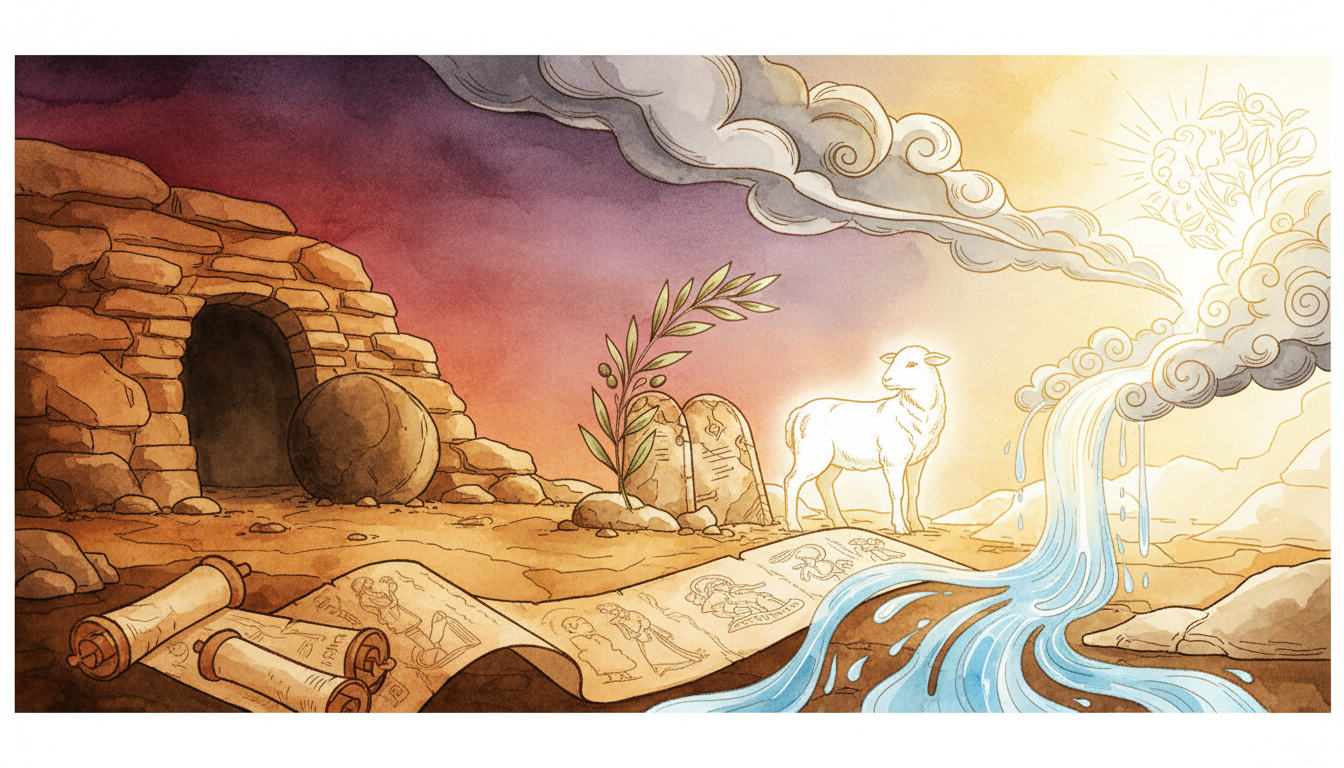
What Does the Bible Teach About Death, Resurrection, and Renewed Creation?
A six-chapter biblical exploration of death from Genesis through Revelation, showing how Hebrew holism (nephesh) and bodily resurrection hope enrich our understanding beyond Greek dualism. Each chapter anchors in primary texts and builds evidence progressively to reveal that biblical hope is MORE concrete and physical than disembodied existence—a recovery of the church's deepest tradition.
What you'll study
Death as Relational Rupture: God's First Word on Mortality
Genesis 2:16-17; Genesis 3:19
The Living Dead: Death, Sheol, and Conscious Existence in Israel's Experience
1 Samuel 28:11-15; Psalm 88; Isaiah 25:8; Job 14:1-22
The Resurrection Hope Emerges: From Uncertainty to Explicit Promise
Isaiah 26:19; Daniel 12:2; Job 14:14-15
Death Reinterpreted Through Christ: From Enemy to Defeated Foe
Romans 5:12-21; 1 Corinthians 15:20-58; Hebrews 2:14-15; John 11:25-26
Between Now and Then: Living as the Resurrected in the Already-Not-Yet
John 5:24-29; 2 Corinthians 5:1-10; Philippians 1:23; 1 Thessalonians 4:13-18; Luke 16:19-31
Death Abolished: The Final Victory in New Creation
Revelation 20:11-15; Revelation 21:4; Matthew 16:25-26; 1 Peter 1:3-5; Romans 8:18-25 (cultural context)
Chapter 1 · Free to read
Death as Relational Rupture: God's First Word on Mortality
Genesis 2:16-17; Genesis 3:19
The Text
Genesis 2:16-17: 'And the LORD God commanded him, "You may eat freely from every tree of the garden, but you must not eat from the tree of the knowledge of good and evil; for in the day that you eat of it, you will surely die."' Genesis 3:19: 'By the sweat of your brow you will eat your food. You will return to the ground, for dust you are and to dust you will return.'
Genesis 2:16-17; Genesis 3:19 (BSB) (The prohibition in Genesis 2:16-17 establishes the first divine command within a relational covenant: obedience maintains life; disobedience incurs death. The phrase 'you will surely die' (Hebrew: mot tamut, literally 'dying you shall die' or 'death-death you shall die') emphasizes the certainty and totality of the consequence. Genesis 3:19 reveals what death means concretely: a return to dust, toil, and separation. The progression from covenant life (2:16-17) to covenant-breaking (3:6) to death's reality (3:19) establishes death not as a natural biological process but as the direct relational consequence of severing the covenant bond with God.)
Key Terms
- מוֹת (mot) · mot
- Death; the state of being dead; separation or cessation of life. In Genesis 2:17, it refers to the penalty for covenant violation.
- חַיִּים (chayim) · chayim
- Life; living; the state of being alive. Chayim appears throughout Genesis 2-3 as the opposite and antithesis of death.
- עָפָר (aphar) · aphar
- Dust; earth; ground material. Genesis 2:7 uses aphar to describe the material from which Adam is formed; Genesis 3:19 uses it to describe the destination of human death.
- נְשָׁמַת־חַיִּים (neshamat chayim) · neshamat chayim
- Breath of life; the vital principle God breathes into Adam at creation. Literally 'breath of lives' (chayim in the plural, suggesting abundant vitality).
- בְרִית (b'rit) · b'rit
- Covenant; binding agreement; a relational bond established by divine initiative and sealed by obligation.
Historical Foundation
Creation to Second Temple Judaism (with NT crystallization)
Genesis 2-3 records God's first covenant with humanity—a relational bond established through the gift of life and maintained through obedience. The penalty for covenant-breaking is introduced as death, not merely biological cessation but rupture from the source of life itself. For over 1,000 years after the Babylonian exile (586 BCE), Jewish communities in diaspora and restored Jerusalem wrestled with theodicy—why do the righteous suffer and the wicked prosper?—without a clear doctrine of resurrection. This eschatological silence breaks in the Intertestamental period (especially 165 BCE onward, during the Maccabean crisis), when apocalyptic literature begins to envision resurrection as God's vindication of the faithful. The New Testament inherits this framework and makes resurrection the centerpiece of Christian faith: Christ's resurrection becomes the proof of His divinity and the guarantee of believers' future restoration. Understanding death's biblical definition—separation from the relational source of life—becomes foundational to understanding why resurrection matters at all. Without grasping Genesis 2-3's relational grammar of death, the NT's claims about resurrection can feel like alien mythology rather than the fulfillment of creation's original design.
Cultural World
The command structure in Genesis 2:16-17 reflects the household covenant pattern well-attested in the ancient Near East (ANE), particularly in Hittite suzerainty treaties and Egyptian wisdom instruction (such as the Instructions of Ptahhotep, circa 2400 BCE). In these texts, a superior (god, king, father) establishes a relationship with an inferior (subject, child, servant) by granting permission, issuing a command, and specifying the consequence for disobedience. The penalty is often death or exile—a severing of the relational bond. Genesis 2:16-17 follows this exact structure: (1) Grant: 'You may eat freely from every tree'; (2) Command: 'you must not eat from the tree of knowledge'; (3) Consequence: 'you will surely die.' This is not unique to Israel—the pattern is pan-ANE. However, the biblical text inverts the typical power dynamic: instead of an earthly sovereign wielding death as a tool of control, the God of creation institutes the command out of concern for the human creature's welfare. The command preserves the human from knowledge that would corrupt (Genesis 3:22 later clarifies that eating from the tree of knowledge would grant the couple 'knowledge of good and evil,' a typically divine prerogative). Additionally, the ANE concept of death as relational rupture appears in the Atrahasis epic (an ancient Babylonian narrative from circa 1700 BCE), where humans are created to serve the gods but are threatened with death—understood as separation from the divine household—if they prove disobedient. The biblical text shares the ANE semantic field but radically personalizes the relationship: the God of Genesis does not need human servants for labor but creates humans for relationship, communion, and stewardship. Death's threat is not arbitrary tyranny but the natural relational consequence of severing covenant bonds.
What the Evidence Shows
Scripture establishes death not as a biological inevitability programmed into creation but as a relational consequence of covenant violation. Genesis 2:7 presents human life as originating in God's breath—neshamat chayim, the vital principle God imparts. Humans are not naturally immortal; rather, their life depends on the continual presence of God's animating power. Genesis 2:16-17 introduces the first divine command within this relational framework: obedience to the command maintains the covenantal bond; disobedience severs it, incurring death. The phrase 'you will surely die' (mot tamut)—literally 'dying you shall die,' a Hebrew construction emphasizing absolute certainty—announces that death is the covenant penalty, not a biological accident. Genesis 3 narrates the breach: the couple eats from the forbidden tree, and the relational rupture becomes visible. They experience immediate spiritual/relational death (separation from God's presence, shame, fear—3:8-10) before physical death eventually occurs (Adam lives 930 years, Genesis 5:5, but dies). Genesis 3:19 specifies the physical manifestation: 'you will return to the ground, for dust you are and to dust you will return.' Death is the reversal of Genesis 2:7—the breath departs, the body returns to dust, the covenant bond is severed. This relational understanding of death pervades the Old Testament: Ecclesiastes 12:7 explicitly echoes the pattern ('the spirit returns to God who gave it'); Psalm 6:5 describes the grave as a place where God is not remembered—not punishment, but the absence of God's presence; Proverbs 11:30 speaks of the 'fruit of righteousness' as 'a tree of life,' inverting Genesis's forbidden knowledge and offering relational restoration through wisdom. For over a millennium, from the Babylonian exile (586 BCE) through the Persian and Hellenistic periods, this relational grammar of death persisted without explicit doctrinal development of resurrection. The Old Testament does not clearly teach a general bodily resurrection. However, the Intertestamental period (roughly 450–165 BCE, and especially after the Maccabean crisis of 165 BCE) witnesses an explosion of resurrection theology in apocalyptic literature: 1 Enoch (early 2nd century BCE), Jubilees (mid-2nd century BCE), and the Dead Sea Scrolls (Qumran texts, 2nd-1st centuries BCE) all envision resurrection as God's vindication of the faithful and reversal of death's power. Daniel 12:2 (dated to the Maccabean period, circa 165 BCE) marks the earliest canonical attestation of resurrection: 'Multitudes who sleep in the dust of the earth will awake, some to everlasting life, others to shame and everlasting contempt.' This is revolutionary: death, which Genesis established as a relational rupture caused by human covenant-breaking, is now understood as something God Himself will reverse through resurrection. The New Testament inherits and crystallizes this: Christ's resurrection (1 Corinthians 15:20-28, dated to Paul's writing circa 50-55 CE) becomes the proof and first fruit of the reversal. Paul explicitly connects Christ's resurrection to Adam's death: in 1 Corinthians 15:21-22, 'For since death came through a man [Adam], the resurrection of the dead comes also through a man [Christ].' Just as Adam's covenant violation brought death (relational rupture), Christ's obedience and resurrection bring life (relational restoration). Believers are united to Christ through faith and baptism (Romans 6:3-9) and thus share in His resurrection power. The relational grammar established in Genesis 2-3—life as covenantal communion with God, death as relational rupture—becomes the foundation of redemptive history. Resurrection is not a late Greek innovation (as earlier scholarship sometimes assumed) but the recovery and vindication of creation's original relational design: humans restored to communion with God, death's rupture healed, the breath of life restored.
Scholarly Witness
Henry emphasizes Genesis 2:16-17 as establishing the 'covenant of works'—a relational arrangement where obedience secures life and disobedience incurs death. He reads death as involving both immediate spiritual death (loss of innocence, separation from God) and ultimate physical death. His commentary preserves the relational grammar: death is not a natural law but a covenantal penalty.
Gill argues that 'dying thou shalt die' (mot tamut) indicates the certainty of death as a covenant consequence. He distinguishes between the immediate effects of the Fall (spiritual death, shame, alienation) and physical death as the outworking of that alienation over time. He also notes that the presence of the 'tree of life' in the garden suggests humans were not naturally immortal but depended on access to it—a detail reinforcing relational dependence on God's provision.
Vos develops the concept of 'covenant of works' into a fully relational framework, arguing that life in Genesis 2-3 is not mere existence but communion with God, and death is the rupture of that communion. He traces how this relational understanding of death persists through the OT and reaches its resolution in Christ's resurrection, which reverses the covenant penalty by restoring the communion that was broken. Vos's work bridges Genesis and NT theology through the lens of relational discontinuity and restoration.
Kline emphasizes the household covenant (pater familias) structure of Genesis 2-3, arguing that the command and consequence reflect ancient Near Eastern covenant patterns where the superior establishes order through command and maintains it through threat of death. He notes that death as a covenant penalty is relational—it severs the bond between God and human—not merely biological. This ANE-informed reading preserves the Reformation doctrine while grounding it in original cultural context.
Heiser argues that death in Genesis 2:17 must be understood within ANE covenant language and the cosmology of the divine council. He shows that the prohibition in Genesis 2:16-17 is not arbitrary but protective—it keeps humans from eating from the tree of knowledge (etz da'at) and thereby transgressing the boundary between human and divine prerogatives. Death, in this reading, is the relational consequence of boundary violation. Heiser further argues that the intertestamental development of resurrection theology (as seen in 1 Enoch, Jubilees, and Daniel) is rooted in Jewish reinterpretation of this original relational framework: resurrection becomes God's restoration of what was lost through death.
Enns traces the evolution of death theology from Genesis through the intertestamental period, showing how Israel's understanding of death (as relational rupture in Sheol, where God's presence is diminished) transforms in the Intertestamental period into explicit resurrection hope. He argues this is not theological regression but contextual development: when the Maccabees face martyrdom (165 BCE), the old Sheol theology no longer satisfies theodicy—only resurrection can vindicate the faithful who die for covenant faithfulness. Enns frames this as the organic development of biblical theology, not the intrusion of foreign ideas.
Discovery Questions
1.Genesis 2:16-17 says 'you will surely die' (mot tamut) if you eat from the forbidden tree, yet Adam eats the fruit in Genesis 3 and doesn't physically die for 930 years (Genesis 5:5). What does Scripture suggest happens to Adam and Eve immediately after they eat—before they physically die?
Death in Genesis 2:17 is not primarily biological death but relational death—immediate separation from God's presence. The couple experiences shame, fear, and alienation the very day they eat (3:8-10). Physical death follows (3:19) as the outworking of this spiritual rupture. This reveals that death is fundamentally about severed relationship with God, not merely about the body ceasing to function. The ANE covenant pattern supports this: when a subject violates the suzerain's command, the bond is broken and the subject is cut off from the relationship, even if the physical consequences take time.
2.Genesis 2:7 says God 'breathed into [Adam's] nostrils the breath of life' (neshamat chayim), and Ecclesiastes 12:7 says at death 'the spirit returns to God who gave it.' What does this pattern suggest about what makes life 'life' in Scripture's view—is it the body alone, or something about relational connection to God?
Life in Scripture is not autonomous biological existence but animated relationship—the divine breath, God's own vital power, sustaining the creature. When that breath departs (death), the body remains (dust), but the relational conduit is severed. This is why resurrection in the NT is not merely resuscitation (like Lazarus waking up) but restoration of the covenantal relationship itself: in Christ, the living God breathes new life into dead creatures, restoring them to communion. The intertestamental texts (1 Enoch, Jubilees) envisioned resurrection precisely because they understood death as relational rupture that only God's direct action could reverse.
3.Paul writes in 1 Corinthians 15:21-22: 'For since death came through a man [Adam], the resurrection of the dead comes also through a man [Christ]. For as in Adam all die, so in Christ all will be made alive.' How does Paul's logic here depend on understanding death as a relational consequence (from Genesis 2-3) rather than as a natural biological fact?
Paul's theology makes sense only if death is relational and covenantal, not merely biological. Adam's disobedience breaks the covenant, severing humanity's relational bond with God (death). Christ's obedience and resurrection restore the covenant—His resurrection is God's vindication of His faithfulness, and believers united to Christ (Romans 6:3-9) are restored to the relational bond that Adam severed. Resurrection is not merely 'life after death' but covenantal restoration. This shows that Genesis 2-3's relational grammar of death is the foundation upon which all NT resurrection theology is built.
4.The Old Testament (pre-Daniel) does not teach a clear doctrine of bodily resurrection, yet Genesis 2-3 establishes death as relational rupture. How does the intertestamental discovery of resurrection (especially after 165 BCE in texts like 1 Enoch and Daniel 12) fulfill or complete what Genesis begins but doesn't yet explain?
Genesis 2-3 establishes the problem: death is the relational consequence of covenant violation. But for over 1,000 years, Israel's theology (reflected in the Psalms, Proverbs, Job) acknowledges death's power without explaining how it could be reversed. The Maccabean crisis (165 BCE) shatters the old theology: the righteous are being martyred for faithfulness to the covenant, yet death seems to be winning. At this point (Daniel 12:2, 1 Enoch, Jubilees), resurrection theology explodes as the only theodically adequate response: God must vindicate the faithful by raising them from the dead, proving that death is not ultimate. The NT makes this explicit: Christ's resurrection is the proof that death's power is broken (1 Corinthians 15:54-57). The relational rupture that Genesis warned about has been reversed—not by human effort, but by God's direct covenantal action in Christ. Genesis's relational grammar of death is thus the seed; intertestamental resurrection theology is its growth; and NT proclamation is its fulfillment.
Connected Passages
- Ecclesiastes 12:7 — Echoes Genesis 2:7 and 3:19: at creation, God breathes the spirit into dust (life); at death, the spirit returns to God and the dust returns to earth (relational rupture completed). This frames death as the reversal of creation—not a natural process but a covenantal severance.
- Psalm 6:5 — Describes Sheol (the grave) as a place where God's name is not remembered—not because God is absent in a locative sense, but because communion with God (the definition of life in Genesis) is diminished. Death is relational separation from the living God's active presence.
- Proverbs 11:30 — The 'fruit of righteousness' is described as 'a tree of life'—inverting Genesis's forbidden tree. Wisdom (living according to God's covenant order) yields life (restored covenant relationship); folly yields death (covenant rupture).
- Daniel 12:2 (earliest canonical resurrection) — Marks the emergence of explicit resurrection hope: 'Multitudes who sleep in the dust of the earth will awake, some to everlasting life, others to shame.' This is the first canonical affirmation that death's relational rupture can be reversed—God will restore the faithful to life (covenant communion) and consign the unfaithful to shame (covenant rupture made permanent).
- 1 Corinthians 15:20-28 (Christ as the resurrection's first fruit) — Christ's resurrection is presented as the reversal of Adam's death: 'Christ has indeed been raised from the dead, the first fruits of those who have died' (15:20). His resurrection inaugurates the recovery of what Adam lost—covenantal communion restored, relational rupture healed, the 'breath of life' renewed through union with the living God.
- Romans 6:3-9 (baptism into Christ's death and resurrection) — Believers are baptized 'into Christ's death' and raised 'to new life'—they are restored to covenant relationship through incorporation into Christ. Death (relational rupture) and resurrection (relational restoration) are understood as realities believers participate in through Christ, not merely future doctrines.
- Revelation 21:3-4 (the consummation of covenantal restoration) — The final vision affirms the complete reversal of death's power: 'Now the dwelling of God is with men, and he will dwell with them. They will be his people, and God himself will be with them and be their God...He will wipe every tear from their eyes. There will be no more death or mourning or crying or pain.' Covenant communion is permanently restored; the relational rupture of Genesis 3 is eternally healed.
Takeaways
- Death in Scripture is fundamentally relational rupture—separation from God's covenantal presence—not merely biological cessation. Genesis 2:17's warning is not about the body's cessation but about the severing of communion with the God who breathes life into dust (Genesis 2:7). This is why Adam experiences immediate spiritual death (shame, fear, alienation in Genesis 3:8-10) before 930 years of physical life end. Understanding death relationally transforms how we read the entire biblical story: Sheol is not torture but the diminished state of separation from God's active presence; the grave is the place where covenant communion is suspended. This relational understanding is woven throughout the Old Testament (Psalm 6:5, Ecclesiastes 12:7) and becomes the foundation of the New Testament's resurrection hope.
- The emergence of resurrection theology in the Intertestamental period (especially after the Maccabean crisis, 165 BCE) was not a foreign import of Greek dualism but the natural development of Genesis's relational theology. When Israel faced the problem of righteous martyrs—faithful believers dying while the wicked prospered—only resurrection could restore the covenant theodicy: God must vindicate the faithful by reversing death's rupture and restoring communion. This is why Daniel 12:2 (the first canonical attestation of resurrection) and texts like 1 Enoch and Jubilees (Second Temple Jewish writings) all frame resurrection as God's covenantal action, not as the triumph of an immortal soul. The roots are Hebrew, not Greek.
- Christ's resurrection is the proof and reversal of Adam's covenant violation. Paul's logic in 1 Corinthians 15:21-22 ('as in Adam all die, so in Christ all will be made alive') only makes sense if death is understood as relational (covenant-breaking's penalty) rather than natural. Christ's obedience reverses Adam's disobedience; His resurrection restores the covenantal bond that the Fall severed. Believers united to Christ through faith and baptism (Romans 6:3-9) are already participating in resurrection life—not yet in bodily form, but truly in restored communion with God. This is why Paul can speak of believers being 'alive to God in Christ Jesus' (Romans 6:11) even before the final resurrection: the relational rupture is being healed now through incorporation into Christ.
- Grasping death's relational nature changes how we read suffering, grief, and the promise of resurrection. If death were merely biological, grief would be manageable through time and memory. But if death is relational rupture—the suspension of communion with the God who sustains life—then grief is cosmic: we mourn not just the absence of a person but the breaking of communion, the silence where communion should be. Yet this same relational understanding makes the resurrection's promise devastatingly real: not merely resuscitation, but the restoration of what was lost—communion with God made permanent, the divine breath restored, covenant healed. Revelation 21:3-4 captures this: 'Now the dwelling of God is with men...There will be no more death or mourning or crying or pain'—the final reversal of Genesis's relational rupture.
- The tree of life in Genesis 2 is not a literal botanical solution to mortality but a symbol of sustained covenant communion. Adam and Eve had access to it (they were not yet banned from the garden in Genesis 2), suggesting that life in God's presence was dependent not on magic fruit but on obedience and relationship. When they are expelled from the garden (Genesis 3:24) and access to the tree is cut off, the rupture becomes visible and permanent—until the resurrection. Revelation 22:2 shows the tree of life reappearing in the New Jerusalem, available to the redeemed—symbolizing the restoration of covenant communion. From Genesis 2 to Revelation 22, the arc is relational: access to life = access to God. Loss of access = death. Restoration of access = resurrection and eternal communion.
- Death understood as relational rupture explains why the biblical authors could speak of a present experience of 'spiritual death' (alienation from God through sin) before bodily death occurs. Jesus speaks of the spiritually dead being called to 'arise from the dead' (Ephesians 5:14) and warns that spiritual deadness is the real danger, not bodily death (Matthew 10:28: 'Do not be afraid of those who kill the body but cannot kill the soul; rather, be afraid of the One who can destroy both soul and body in hell'). Hell is presented not as torture by external force but as the ultimate relational rupture—permanent separation from God's presence. Understanding death as relational opens the entire Bible's language about spiritual condition, covenant status, and the stakes of our choices before God. We are making choices about relationship, not merely about biology.
Application
How does understanding death as relational rupture—separation from God's presence—change the way you grieve someone's death, pray for the unsaved, or think about your own mortality? Spend time this week journaling about one of these: (1) How does the concept of 'dying spiritually' (being separated from God's presence through sin) land differently now that you see it as the real death that physical death confirms? (2) If life is covenantal communion with God, what does it mean for you to be 'alive' right now—are you in communion with God, or in relational rupture? (3) What does resurrection hope change about how you face your own death or the death of someone you love, knowing that God promises to restore covenant communion permanently? The challenge is not intellectual but relational: let Genesis 2-3's language of life as presence and death as absence become real in your prayer, your relationships, and your understanding of what Jesus accomplished in His resurrection.
Continue the course — 5 more chapters
The Living Dead: Death, Sheol, and Conscious Existence in Israel's Experience
1 Samuel 28:11-15; Psalm 88; Isaiah 25:8; Job 14:1-22
How did early Israel understand death and the afterlife? What do the encounters with Sheol reveal about belief in conscious existence and God's power even beyond the grave?
The Resurrection Hope Emerges: From Uncertainty to Explicit Promise
Isaiah 26:19; Daniel 12:2; Job 14:14-15
How did the concept of bodily resurrection develop within the Hebrew Bible, and what does it reveal about God's ultimate intention for the human person?
Death Reinterpreted Through Christ: From Enemy to Defeated Foe
Romans 5:12-21; 1 Corinthians 15:20-58; Hebrews 2:14-15; John 11:25-26
How does Christ's resurrection fundamentally change what death means for believers? Why is Christ called 'the resurrection and the life,' and what does this claim do to death's power?
Between Now and Then: Living as the Resurrected in the Already-Not-Yet
John 5:24-29; 2 Corinthians 5:1-10; Philippians 1:23; 1 Thessalonians 4:13-18; Luke 16:19-31
What is the intermediate state between death and resurrection? How do believers live in confidence between Christ's resurrection and their own, and what does post-mortem consciousness tell us about God's care?
Death Abolished: The Final Victory in New Creation
Revelation 20:11-15; Revelation 21:4; Matthew 16:25-26; 1 Peter 1:3-5; Romans 8:18-25 (cultural context)
What does Scripture mean by death's final defeat? How does the promise of renewed creation (not escape from creation) reveal the full richness of biblical hope—more physical and embodied than disembodied immortality?
No credit card required
Sources Used
Every insight traces to a named source. 0 AI-generated interpretations.
Related courses
What Does Scripture Teach About Money? A Covenantal Vision Beyond Personal Virtue
This six-chapter course recovers the Bible's richest teaching on money as a covenantal and structural force, not merely a tool for individual moral performance. Beginning with the foundational text that distinguishes the love of money from money itself, the course traces how Hebrew economic law embedded justice into community structures, how Jesus named money as a rival power (mammon), and how apostolic practice revealed economics as a cosmic realignment. Each chapter starts with primary Scripture and shows how cultural, historical, and theological context deepens—not replaces—what the text already says. Learners will discover that biblical money teaching is far more concerned with concrete justice NOW in covenant community than with afterlife reward, and that wealth functions as a theological force requiring both personal AND corporate transformation. This is enrichment and recovery: the biblical text proves richer than inherited tradition suggested.
6 chapters
What Does the Bible Say About Marriage? A Biblical Foundation for Covenant, Creation, and Kingdom
This five-chapter course explores the Bible's teaching on marriage as a covenantal union rooted in creation, embodied in household life, revealing Christ's relationship to the Church, and extending into God's renewed creation. Rather than settling for reductive views (companionship-only or dualistic denial of embodied life), we return to the original biblical text to discover marriage's richer theological significance: it is simultaneously a creation mandate, a covenant bond, a sexual and relational union, and a sign of Christ's redemptive love. Each chapter is anchored in a key passage and progressively deepens our understanding through textual, theological, cultural, and historical evidence.
5 chapters
What Does the Bible Reveal About Anger as a Relational Response?
A five-chapter biblical exploration of anger as neither inherently sinful nor a mere emotion to suppress, but a morally complex relational response. This course traces how Scripture distinguishes between destructive and righteous anger, reveals anger and love coexisting in God's character, and shows how Christ's incarnation reframes human anger within redemptive justice. Learners will discover that the biblical text on anger is far richer than common tradition suggests—anger itself is morally neutral; the object, motive, and expression determine its ethical weight.
5 chapters
What Does the Bible Say About Tithing? A Covenant-Based System Revealed
This course traces the biblical teaching on tithes from Abraham through the early church, uncovering how tithing functioned not as a simple percentage but as a multifaceted covenant practice tied to priestly support, festival celebration, and care for the poor. We discover that the original text reveals something richer than the simplified 10% rule: a system rooted in relationship with God and community care. The course culminates in understanding how Jesus and the apostles transformed this practice into grace-motivated voluntary generosity, enriching rather than abandoning the principle of faithful giving.
5 chapters
What Does the Bible Say About the Holy Spirit?
A six-chapter course exploring the identity, roles, and work of the Holy Spirit across Scripture. Beginning with the Spirit's presence at creation and moving through Old Testament promises, Jesus's teaching, Pentecost, and the apostolic letters, this course builds a comprehensive biblical understanding of the Holy Spirit's personhood, functions in salvation and sanctification, and gifting of the church. Each chapter is anchored in a key passage and progresses from textual observation through historical context to theological synthesis, designed to deepen the learner's wonder at Scripture's revelation.
6 chapters
What Does the Bible Say About Anxiety? A Whole-Person Spiritual Practice
This five-chapter course explores biblical teaching on anxiety as an integrated concern involving spiritual trust, physical provision, communal belonging, and embodied rest. Beginning with Jesus' foundational teaching in Matthew 6, we trace how Hebrew wisdom, the Psalms, and Paul's letters present anxiety not as an isolated internal state to manage, but as a whole-person invitation to deeper trust in God's care. Through careful attention to biblical vocabulary, we discover how ancient authors understood the connection between body, spirit, community, and peace—offering a richer vision than modern tradition often recognizes.
5 chapters
Create your own Bible studies — free.
Ask any question. Get evidence from named scholars and curated datasets in minutes.
Get Started Free