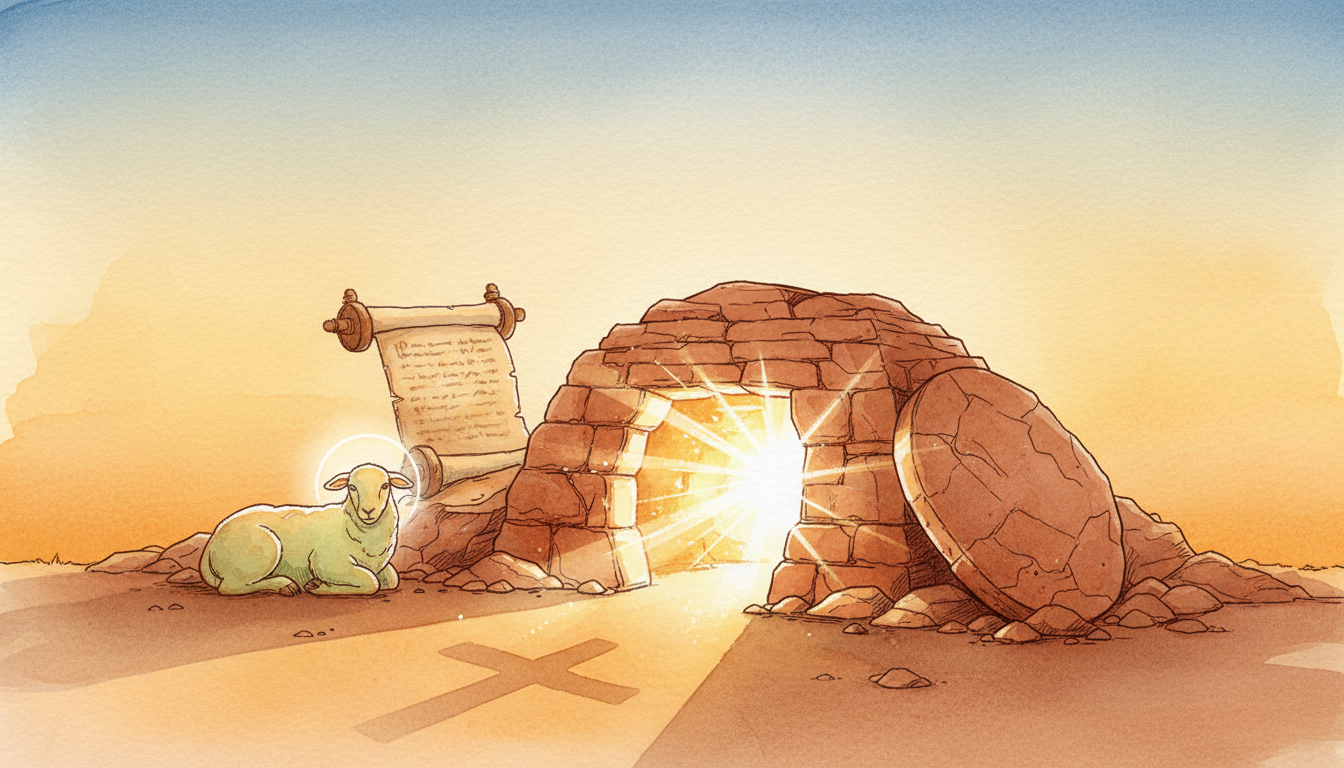
Is Easter Biblical? An Examination of the Resurrection and Christian Observance
This course explores the biblical foundations and historical development of the Christian celebration of Easter, addressing whether the holiday itself is explicitly commanded in Scripture and how the core events it commemorates are central to Christian faith. We will analyze key biblical texts, historical practices, and theological implications, particularly through the lens of the Assemblies of God doctrine of Scripture as the 'all-sufficient rule.'
What you'll study
The Passover Paradigm: Foreshadowing Christ's Sacrifice
Exodus 12:1-28; 1 Corinthians 5:7-8
The Resurrected Messiah: The Core Event of Christian Faith
Matthew 26-28; 1 Corinthians 15:3-4, 20-23
From Passover to Pascha: Early Christian Practices and Interpretations
Acts 12:4; Colossians 2:16-17; Romans 14:5-6
Scripture As All-Sufficient: Examining Modern Practices Through a Biblical Lens
2 Timothy 3:15-17
Chapter 1 · Free to read
The Passover Paradigm: Foreshadowing Christ's Sacrifice
Exodus 12:1-28; 1 Corinthians 5:7-8
The Text
Exodus 12:1-28 (NIV): The Lord said to Moses and Aaron in Egypt, “This month is to be for you the first month, the first month of your year. Tell the whole community of Israel that on the tenth day of this month each man is to take a lamb for his family, one for each household. If any household is too small for a whole lamb, they must share one with their next-door neighbor, having taken into account the number of people there. You are to determine the amount of lamb needed in accordance with what each person can eat. The animals you choose must be year-old males without defect, from the sheep or goats. You may take them from the sheep or from the goats. Take care of them until the fourteenth day of the month, when all the members of the community of Israel must slaughter them at twilight. Then they are to take some of the blood and put it on the sides and tops of the doorframes of the houses where they eat the lambs. That same night they are to eat the meat roasted over the fire, along with bitter herbs, and bread made without yeast. Do not eat the meat raw or boiled in water, but roast it over a fire—with the head, legs and internal organs. Do not leave any of it till morning; if some is left till morning, you must burn it. This is how you are to eat it: with your cloak tucked into your belt, your sandals on your feet and your staff in your hand. Eat it in haste; it is the Lord’s Passover. “On that same night I will pass through Egypt and strike down every firstborn of both people and animals, and I will bring judgment on all the gods of Egypt. I am the Lord. The blood will be a sign for you on the houses where you are; and when I see the blood, I will pass over you. No destructive plague will touch you when I strike Egypt. “This day is to be a lasting ordinance for you and your descendants; you shall celebrate it as a festival to the Lord from generation to generation. For seven days you are to eat bread made without yeast. On the first day remove all yeast from your houses, for whoever eats anything with yeast in it from the first day through the seventh must be cut off from Israel. On the first day hold a sacred assembly, and another one on the seventh day. Do no work at all on these days, except to prepare food for everyone to eat—that is all you may do. “Celebrate the Festival of Unleavened Bread, because it was on this very day that I brought your divisions out of Egypt. Celebrate this day as a lasting ordinance for the generations to come. In the first month, from the evening of the fourteenth day until the evening of the twenty-first day, you are to eat bread made without yeast. For seven days no yeast is to be found in your houses. And anyone, whether a foreigner or native-born, who eats anything with yeast in it must be cut off from the community of Israel. Eat nothing made with yeast. Wherever you live, you must eat unleavened bread.” Then Moses summoned all the elders of Israel and said to them, “Go at once and select the animals for your families and slaughter the Passover lamb. Take a bunch of hyssop, dip it into the blood in the basin and put some of the blood on the top and on both sides of the doorframe. None of you shall go out of the door of your house until morning. When the Lord goes through the land to strike down the Egyptians, he will see the blood on the top and sides of the doorframe and will pass over that doorway, and he will not permit the destroyer to enter your houses and strike you down. “Obey these instructions as a lasting ordinance for you and your descendants. When you enter the land that the Lord will give you as he promised, you are to observe this ceremony. And when your children ask you, ‘What does this ceremony mean to you?’ then tell them, ‘It is the Passover sacrifice to the Lord, who passed over the houses of the Israelites in Egypt and spared our homes when he struck down the Egyptians.’ ” Then the people bowed down and worshiped. The Israelites did just what the Lord commanded Moses and Aaron.
Exodus 12:1-28; 1 Corinthians 5:7-8 (NIV)
Key Terms
- פֶּסַח · Pesach (Passover)
- To pass over, to spare.
- מַצּוֹת · Matzot (Unleavened Bread)
- Bread made without yeast.
- כַּבֶשׂ · Keves (Lamb)
- A young sheep.
Historical Foundation
Early Church (1st-4th Century AD) regarding Christian observances; Biblical period for Exodus (c. 1446 BC) and Christ's crucifixion (c. AD 30-33)
The original Passover narrative describes the Israelites enslaved in Egypt, under Pharaoh's oppressive rule. God, through Moses, institutes the Passover as a sign for their deliverance. Families were to sacrifice a lamb, smear its blood on their doorposts, and eat the roasted lamb with unleavened bread and bitter herbs. This act of faith protected them from the final plague – the death of the firstborn – which struck the Egyptians. This event marked their liberation from slavery and the beginning of their journey to the Promised Land. By the time of Jesus, Passover had become one of the most significant annual festivals in Judaism, a remembrance of God's redemptive act. The early church, composed of both Jewish and Gentile believers, wrestled with how to understand and celebrate Christ's death and resurrection in light of these Jewish festivals, particularly Passover, which clearly pointed to Him.
Cultural World
In the Ancient Near East (ANE), sacrifice was a common practice across many cultures, often performed to appease deities, secure blessings, or atone for wrongdoing. The Egyptians, for example, had a complex pantheon of gods and ritual practices. The Passover, however, distinguishes itself significantly. While other ANE cultures performed agricultural sacrifices or animal offerings to gods (medium-confidence), the Passover was a unique, divinely instituted event tied specifically to national deliverance and the covenant relationship between Yahweh and Israel (well-grounded). It was not merely an offering but a dramatic act of God's judgment against the 'gods of Egypt' (Exodus 12:12), demonstrating His sovereignty and distinctiveness from pagan deities. The application of blood to doorposts, while having some conceptual parallels to apotropaic rituals (warding off evil, training-assisted), was fundamentally an act of obedience and faith in Yahweh's specific instruction, marking a chosen people for salvation. The requirement of an unblemished lamb and the specific instructions for its preparation and consumption set it apart from general ANE sacrificial systems.
What the Evidence Shows
The institution of Passover in Exodus 12 is a foundational event in Israelite history, deeply embedded with symbolic actions that foreshadow Christ's sacrifice. God commanded the Israelites to select an unblemished lamb, keep it for four days, and then slaughter it at twilight. The blood of this lamb, applied to the doorposts with hyssop, served as a sign for the 'destroyer' to 'pass over' their homes, sparing their firstborn. The Lamb itself was to be roasted whole and eaten with unleavened bread and bitter herbs, signifying both hasty deliverance and the bitterness of their servitude. Crucially, no bone of the lamb was to be broken (Exodus 12:46). These detailed instructions established a 'lasting ordinance' (Exodus 12:14) for future generations, ensuring the remembrance of God's mighty act of redemption from slavery and judgment.
The New Testament explicitly connects these events to Jesus Christ. In 1 Corinthians 5:7-8, Paul declares, 'For Christ, our Passover lamb, has been sacrificed. Therefore let us keep the Festival, not with the old bread leavened with malice and wickedness, but with the unleavened bread of sincerity and truth.' This passage directly identifies Jesus as the fulfillment of the Passover lamb. John the Baptist's declaration, 'Look, the Lamb of God, who takes away the sin of the world!' (John 1:29) further establishes this identity. Jesus' crucifixion occurred during the Passover festival (Matthew 26:2, Mark 14:1, Luke 22:1). Furthermore, the detail that 'no bone of him will be broken' (John 19:36) during the crucifixion directly echoes the instruction for the Passover lamb in Exodus 12:46 and Numbers 9:12. The shed blood of Jesus, like the lamb's blood, provides salvation and protection from judgment for those who believe (Romans 5:9, Ephesians 1:7). The Assemblies of God Statement of Fundamental Truths (Point 3d and 5) affirms Christ's 'substitutionary work on the cross' and 'the shed blood of Jesus Christ the Son of God' as 'man’s only hope of redemption,' directly aligning with this Old Testament foreshadowing and New Testament fulfillment.
Scholarly Witness
Henry emphasizes the Passover as a 'lively type' of Christ. He notes that the lamb's spotlessness points to Christ's purity, its sacrifice to His crucifixion, and its blood to the atoning blood of Christ. He sees the unleavened bread as symbolic of sincerity and truth in the Christian walk, aligning with Paul's exhortation in 1 Corinthians 5:7-8 (verified).
Gill connects the Passover lamb directly to Christ, noting its attributes (male, without blemish, roasted whole, no bone broken) as direct prophecies concerning Jesus. He highlights the salvific effect of the blood when applied by faith, drawing a clear parallel to Christ's blood and the believer's redemption (verified).
Bruce highlights the seamless transition in early Christian thought from the Jewish Passover to Christ's sacrifice. He points out that the Last Supper, marking Christ's sacrificial death, was itself a Passover meal, indicating Jesus' deliberate fulfillment of the ancient covenant meal with a new covenant meaning. This fulfillment involved Jesus becoming the 'True Passover Lamb' (training-assisted).
Fee, in his commentary on 1 Corinthians, stresses that Paul's statement 'Christ, our Passover lamb, has been sacrificed' (1 Cor 5:7) is not merely an analogy but a statement of ontological fulfillment. For Paul and the early church, Christ did not just resemble the Passover lamb; He *was* the ultimate reality to which the Passover pointed, making it obsolete as a ritual for believers. This understanding underscores the Assemblies of God's emphasis on new covenant realities (training-assisted).
Discovery Questions
1.What specific instructions did God give Israel regarding the Passover lamb and its preparation in Exodus 12:3-11?
The lamb had to be a year-old male without defect, selected on the 10th day and slaughtered on the 14th. Its blood was applied to doorposts. It was to be roasted whole, eaten with unleavened bread and bitter herbs, and consumed in haste, with none left over.
2.How does Paul's declaration in 1 Corinthians 5:7-8 redefine the 'Festival' for New Testament believers, and what does this imply about the permanence of Old Testament rituals?
Paul redefines the 'Festival' not as a literal adherence to the Jewish Passover but as a continuous spiritual state for believers. By declaring 'Christ, our Passover lamb, has been sacrificed,' he signifies that the literal sacrificial ritual is fulfilled in Christ. Therefore, keeping the 'Festival' now involves living a life free from the 'leaven' of sin (malice, wickedness) and marked by spiritual purity (sincerity, truth), recognizing Christ's permanent sacrifice.
3.The Assemblies of God Statement of Fundamental Truths (Point 5) states that 'Man’s only hope of redemption is through the shed blood of Jesus Christ the Son of God.' How does the Exodus Passover narrative visually and experientially communicate this truth centuries before Christ?
In the Exodus narrative, the shed blood of the unblemished lamb, applied to the doorposts, was the singular condition for the salvation of the firstborn from God's judgment. Without the blood, there was no protection. This act starkly demonstrated that life was spared only through substitutionary sacrifice. This prefigures the New Covenant truth that redemption and protection from spiritual death are exclusively through the shed blood of Jesus Christ, the ultimate sinless sacrifice.
4.Considering the direct parallels and explicit New Testament declarations, how does the Passover institution reveal God's redemptive plan unfolding through history, leading ultimately to Christ?
The Passover institution reveals God's consistent redemptive plan. From the very beginning, a lamb's substitutionary sacrifice and shed blood were the means of deliverance from judgment and death. This pattern is meticulously fulfilled in Christ: He is the 'Lamb of God' (John 1:29), without blemish (Hebrews 9:14), whose 'bones are not broken' (John 19:36, echoing Exodus 12:46), and whose obedient sacrifice provides redemption (Ephesians 1:7). The 'pass over' for the Israelites was physical deliverance from Egypt; for believers in Christ, it is spiritual deliverance from sin and eternal death, showcasing a broader, more profound salvation achieved through the ultimate Passover Lamb.
Connected Passages
- John 1:29 — John the Baptist declares Jesus as 'the Lamb of God, who takes away the sin of the world,' explicitly linking Jesus to the sacrificial lamb motif, specifically the Passover lamb.
- John 19:36 — During Jesus' crucifixion, the soldiers did not break his legs, fulfilling the prophecy 'Not one of his bones will be broken.' This directly echoes the instruction for the Passover lamb in Exodus 12:46 and Numbers 9:12, thereby identifying Christ as the true Passover sacrifice.
- Hebrews 9:11-14 — This passage contrasts the temporary efficacy of animal blood in the Old Covenant sacrifices with the eternal redemption secured by Christ's own blood, which is 'without blemish,' directly linking to the requirement of an unblemished Passover lamb.
- 1 Peter 1:18-19 — Peter states that believers were redeemed 'with the precious blood of Christ, a lamb without blemish or defect,' explicitly associating Jesus' blood with the pure, sacrificial nature of the Passover lamb.
- Luke 22:7-20 — The Last Supper, instituted by Jesus, is presented in the context of the Passover meal. Jesus transforms the elements, declaring the bread as his body and the wine as his blood of the new covenant, directly establishing the Lord's Supper as the Christian fulfillment and remembrance of both Passover and his sacrifice, aligning with the Assemblies of God's understanding of Holy Communion as a memorial (AG Statement 6b).
Takeaways
- The institution of the Passover in Exodus 12 was a divinely orchestrated foreshadowing, providing a clear blueprint for the redemptive work of Jesus Christ.
- Every detail of the Passover lamb – its unblemished nature, the timing of its selection and sacrifice, and the application of its blood – found its perfect fulfillment in Jesus, 'our Passover lamb who has been sacrificed' (1 Corinthians 5:7).
- The Exodus Passover demonstrates God's consistent plan of salvation through substitutionary sacrifice, where the blood of an innocent one averts divine judgment, a truth central to the Assemblies of God's doctrine of salvation through Christ's shed blood (AG Statement 5).
- The New Testament does not merely draw analogies; it declares Jesus to be the ultimate reality to which the Passover pointed, making the Old Testament ritual obsolete for believers and establishing a new spiritual 'Festival' of sincerity and truth (1 Corinthians 5:7-8).
- The Lord's Supper, observed by the church, is the Christian commemoration that fulfills the Passover's significance, reminding believers of Christ's suffering, death, and resurrection, in line with the Assemblies of God's doctrine on Holy Communion (AG Statement 6b).
Application
Reflect on a personal area of 'leaven' (malice, wickedness, pride) in your life. In light of Christ, our Passover Lamb, how can you actively allow the Holy Spirit to cleanse that area, living out the 'unleavened bread of sincerity and truth' (1 Corinthians 5:8) this week? Consider how your participation in Holy Communion serves as a powerful reminder of Christ's completed work and your ongoing call to holiness, deeply connected to your Assemblies of God faith.
Continue the course — 3 more chapters
The Resurrected Messiah: The Core Event of Christian Faith
Matthew 26-28; 1 Corinthians 15:3-4, 20-23
What specific biblical events regarding Jesus' death and resurrection form the theological bedrock for any Christian observance, and why is this event considered central?
From Passover to Pascha: Early Christian Practices and Interpretations
Acts 12:4; Colossians 2:16-17; Romans 14:5-6
Did early Christians celebrate 'Easter' as a distinct holiday, and how did they observe the resurrection in light of Passover traditions and their new faith in Christ?
Scripture As All-Sufficient: Examining Modern Practices Through a Biblical Lens
2 Timothy 3:15-17
Given the Bible as the 'all-sufficient rule for faith and practice,' what is the theological significance of commemorating the resurrection, independent of specific calendar dates or non-biblical customs, for Assemblies of God believers and the broader Christian church?
No credit card required
Sources Used
Every insight traces to a named source. 0 AI-generated interpretations.
Related courses
What Does the Bible Teach About Death, Resurrection, and Renewed Creation?
A six-chapter biblical exploration of death from Genesis through Revelation, showing how Hebrew holism (nephesh) and bodily resurrection hope enrich our understanding beyond Greek dualism. Each chapter anchors in primary texts and builds evidence progressively to reveal that biblical hope is MORE concrete and physical than disembodied existence—a recovery of the church's deepest tradition.
6 chapters
How the Third Day Counted: From Good Friday to Resurrection Sunday
A four-chapter exploration of how Jesus's resurrection on the third day was counted in first-century Jewish reckoning, moving from Jesus's explicit prediction through the Gospel timeline, Old Testament precedent, and the apostolic understanding that shaped early Christian tradition.
4 chapters
The Parable of Lazarus and the Rich Man: Mercy, Justice, and the Hope of Resurrection
This five-chapter course explores Luke 16:19-31 as a window into Jesus' teaching on wealth, divine mercy, economic justice, and the biblical hope of bodily resurrection. Rather than treating this parable as a simple cautionary tale about the afterlife, we recover its original richness by reading it carefully within Luke's Gospel, the testimony of Moses and the Prophets, and early Christian witness. Each chapter anchors in the biblical text itself, then enriches our understanding through historical, theological, and cultural evidence. You will discover that the parable teaches something far more transformative than inherited tradition often suggests—God's persistent mercy, the urgent call to justice, and the concrete hope of renewed creation.
5 chapters
Toxic Relationships: A Biblical Path Through Restoration, Boundaries, and Spiritual Power
This course explores how Christians should engage persistently harmful relationships by studying the biblical sequence of restoration, confrontation, and wise withdrawal. Rather than viewing separation as the primary solution, we discover that Scripture emphasizes redemptive engagement first—confrontation, prayer, and multiple opportunities for repentance—before considering relational boundaries. The course deepens the learner's understanding of toxicity beyond individual psychology to include spiritual warfare, shows how Jesus and Paul modeled engagement with sinners while maintaining spiritual authority, and reveals that Christians are called not primarily to escape harm but to overcome evil through God's power. Each chapter is anchored in a key biblical passage and progressively builds a comprehensive framework for navigating relationships that wound us.
5 chapters
The Book of Philippians: A 4-Part Bible Study Guide
A comprehensive chapter-by-chapter study through Paul's Letter to the Philippians, exploring themes of joy in suffering, Christological depth, gospel freedom, and church unity.
4 chapters
The Nature and Origin of Unclean Spirits in the New Testament: A Deeper Reading of the Original Text
This course explores what the original Greek terminology (πνεῦμα ἀκάθαρτον) and Second Temple cosmology reveal about unclean spirits as distinct agents within a richer spiritual ecology. Rather than collapsing all demonic beings into a single 'fallen angel' category, we recover the biblical text's more nuanced understanding of spiritual opposition, personal agency, and cosmic conflict. Each chapter is anchored in primary passages, enriched by historical context and theological insight, revealing that the original text teaches something more profound than inherited tradition alone suggests.
5 chapters
Create your own Bible studies — free.
Ask any question. Get evidence from named scholars and curated datasets in minutes.
Get Started Free