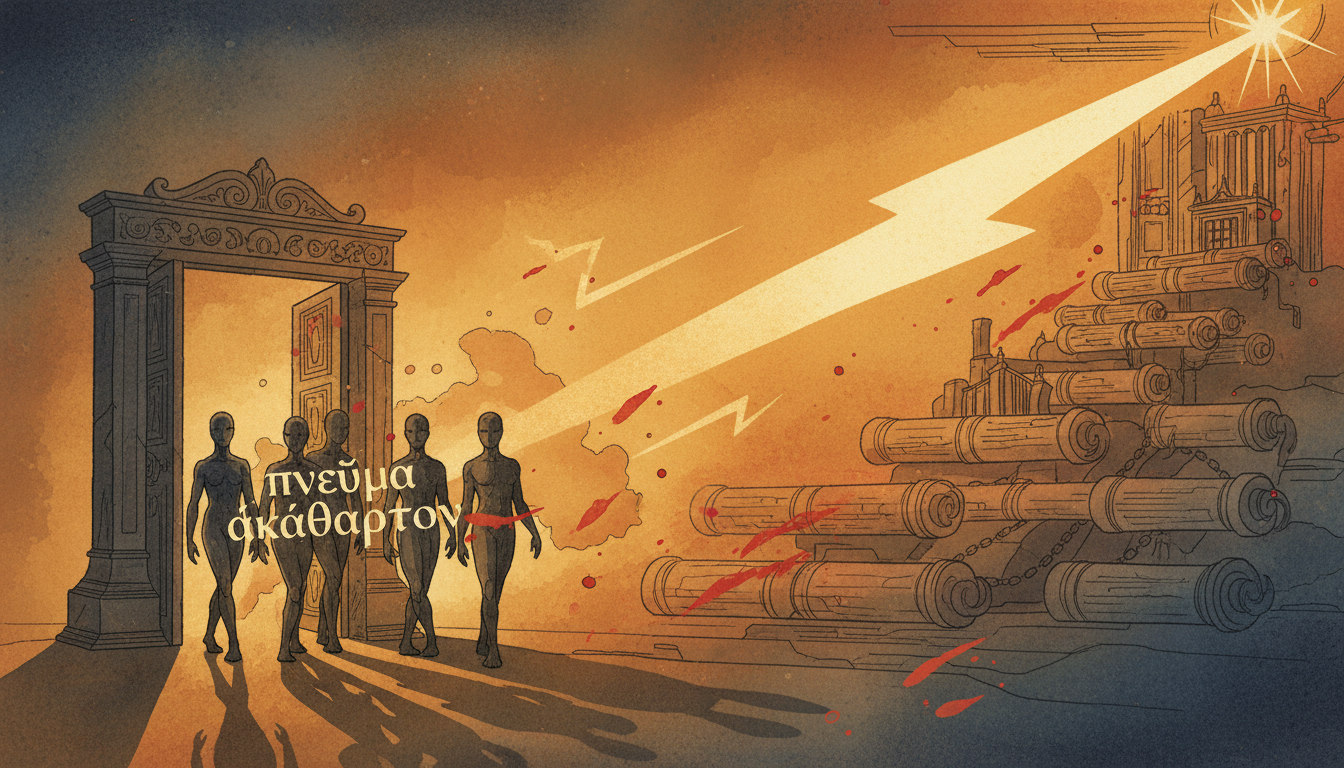
The Nature and Origin of Unclean Spirits in the New Testament: A Deeper Reading of the Original Text
This course explores what the original Greek terminology (πνεῦμα ἀκάθαρτον) and Second Temple cosmology reveal about unclean spirits as distinct agents within a richer spiritual ecology. Rather than collapsing all demonic beings into a single 'fallen angel' category, we recover the biblical text's more nuanced understanding of spiritual opposition, personal agency, and cosmic conflict. Each chapter is anchored in primary passages, enriched by historical context and theological insight, revealing that the original text teaches something more profound than inherited tradition alone suggests.
What you'll study
The First Encounter: Jesus's Authority Over Unclean Spirits (Mark 1:23-26)
Mark 1:23-26 - 'Just then there was in their synagogue a man with an unclean spirit, and he cried out, "What have you to do with us, Jesus of Nazareth? Have you come to destroy us? I know who you are, the Holy One of God." But Jesus rebuked him, saying, "Be silent, and come out of him!" And the unclean spirit, convulsing him and crying with a loud voice, came out of him. They were all amazed, and they kept on asking one another, "What is this? A new teaching—with authority! He commands even the unclean spirits, and they obey him."'
The Cosmic Fear: Unclean Spirits, the Abyss, and Hierarchical Order (Mark 5:1-20 and Luke 8:31)
Mark 5:1-20 - 'They came to the other side of the sea, to the country of the Gerasenes. And when he had stepped out of the boat, immediately a man out of the tombs with an unclean spirit met him... Jesus asked him, "What is your name?" He replied, "My name is Legion; for we are many." He begged him earnestly not to send them out of the country... Now there on the hillside a great herd of swine was feeding... The unclean spirits came out and entered the swine; and the herd, numbering about two thousand, rushed down the steep bank into the sea, and were drowned in the sea.' AND Luke 8:31 - 'They begged him not to order them to go back into the abyss.'
The Origin: Fallen Angels, Genesis 6, and the Foundation of Demonic Reality (Genesis 6:1-4, Jude 6, and 2 Peter 2:4)
Genesis 6:1-4 - 'When people began to multiply on the face of the ground, and daughters were born to them, the sons of God saw that they were fair; and they took wives for themselves of all that they chose... The Nephilim were on the earth in those days—and also afterward—when the sons of God went in to the daughters of humans, who bore children to them. These were the mighty men that were of old, warriors of great renown.' Jude 6 - 'And the angels who did not keep their own position, but left their proper dwelling, he has kept in eternal chains under gloomy darkness for the judgment of the great day.' 2 Peter 2:4 - 'For if God did not spare the angels when they sinned, but cast them into hell and committed them to chains of gloomy darkness to be kept until the judgment...'
Jesus's Teaching on Spiritual Vacancy and Return: The Deeper Reality of Unclean Spirits (Matthew 12:43-45)
Matthew 12:43-45 - 'When the unclean spirit has gone out of a person, it wanders through waterless regions looking for a resting place, but it finds none. Then it says, "I will return to my house from which I came." And when it comes, it finds it empty, swept, and put in order. Then it goes and brings along seven other spirits more evil than itself, and they enter and live there; and the last state of that person is worse than the first. So will it be also with this evil generation.'
Spiritual Warfare and Embodied Wholeness: Paul's Cosmic Framework and the Church's Authority (Ephesians 6:12; Acts 8:7; 1 Corinthians 10:20)
Ephesians 6:12 - 'For our struggle is not against enemies of blood and flesh, but against the rulers, against the authorities, against the cosmic powers of this present darkness, against the spiritual forces of evil in the heavenly places.' Acts 8:7 - 'For unclean spirits, crying with loud voices, came out of many who were possessed; and many others who were paralyzed or lame were cured.' 1 Corinthians 10:20 - 'No, I imply that what pagans sacrifice, they sacrifice to demons and not to God. I do not want you to become partners with demons.'
Chapter 1 · Free to read
The First Encounter: Jesus's Authority Over Unclean Spirits (Mark 1:23-26)
Mark 1:23-26 - 'Just then there was in their synagogue a man with an unclean spirit, and he cried out, "What have you to do with us, Jesus of Nazareth? Have you come to destroy us? I know who you are, the Holy One of God." But Jesus rebuked him, saying, "Be silent, and come out of him!" And the unclean spirit, convulsing him and crying with a loud voice, came out of him. They were all amazed, and they kept on asking one another, "What is this? A new teaching—with authority! He commands even the unclean spirits, and they obey him."'
The Text
Mark 1:23-26 (BSB): 'Just then there was in their synagogue a man with an unclean spirit, and he cried out, "What have you to do with us, Jesus of Nazareth? Have you come to destroy us? I know who you are, the Holy One of God." But Jesus rebuked him, saying, "Be silent, and come out of him!" And the unclean spirit, convulsing him and crying with a loud voice, came out of him. They were all amazed, and they kept on asking one another, "What is this? A new teaching—with authority! He commands even the unclean spirits, and they obey him."'
Mark 1:23-26 (Berean Standard Bible (BSB). Alternative translations (NIV, ESV, NASB) render the core terms identically: pneuma akatharton (unclean spirit), epitimao (rebuke), and exousia (authority). The passage is remarkably consistent across major Greek manuscripts, including early papyri like P45 (3rd century AD).)
Key Terms
- πνεῦμα ἀκάθαρτον (pneuma akatharton) · PNEUM-uh ah-KATH-ar-ton
- An unclean spirit; a supernatural being opposed to God's holiness, capable of inhabiting and controlling human bodies. In Jewish taxonomy, these are distinct from angels—they are fallen or rebellious spiritual entities aligned with Satan's kingdom.
- ἐπιτιμάω (epitimao) · eh-pit-ee-MAH-oh
- To rebuke, reprove, or speak sternly to; often used of authoritative command. In Mark, Jesus uses this verb to silence the spirit and order its departure. It conveys not mere scolding but the exercise of sovereign authority.
- ἐξουσία (exousia) · ex-OO-see-ah
- Authority, power, right, or jurisdiction; the legitimate power to command and be obeyed. In Mark 1:27, the crowd recognizes that Jesus teaches and acts with exousia—not merely persuasive skill but actual divine authority over creation and spiritual beings.
- θέλησις/θέλημα (thelesis/thelema) · THEL-uh-sis / THEL-uh-muh
- Will, desire, or purpose; often used of God's will or intention. Implied in the demon's fearful question, 'Have you come to destroy us?'—the spirit recognizes that Jesus's will is hostile to demonic presence.
Historical Foundation
Second Temple Judaism and Early Greco-Roman Christianity (1st century AD)
First-century Palestine existed under Roman occupation, yet Jewish religious life flourished in local synagogues. The synagogue served not as a temple substitute but as a gathering place for teaching, prayer, and community discernment. Capernaum, on the northern shore of the Sea of Galilee, was a thriving fishing village and administrative center. Demons and unclean spirits were understood in Second Temple Judaism as real spiritual entities—fallen beings or agents of Satan—who could afflict human bodies and minds. This was not viewed as psychological illness alone but as genuine spiritual possession. The Jewish worldview, informed by texts like 1 Enoch and reflected in the Dead Sea Scrolls, recognized a cosmic conflict between God's kingdom and demonic rebellion. When Jesus entered the synagogue to teach 'with authority' (exousia), Mark signals that something unprecedented is happening: divine power is directly confronting the spiritual darkness that held people captive.
Cultural World
[WELL-GROUNDED] Unclean spirits in the New Testament reflect the Second Temple Jewish understanding of demonic beings, rooted in earlier biblical tradition (Genesis 6:1-4; Jude 6; 2 Peter 2:4) and developed through the intertestamental period. The Levitical purity logic—which separates clean from unclean, holy from profane—creates a theological category for beings that actively oppose God's order. In the ANE, particularly Mesopotamian thought, demons (edimmu, gallu) inhabited desolate places and were understood as agents of chaos or underworld powers. Israel's understanding differs crucially: demons are not impersonal forces but created beings in rebellion against the one God. The pseudepigraphal Book of 1 Enoch (2nd century BC, though reflecting earlier traditions) describes fallen watchers and their offspring as corrupting humanity and teaching forbidden knowledge—this was standard Second Temple Jewish cosmology reflected in Qumran texts and quoted by Jude (Jude 6, 'the angels who did not keep their proper domain'). The Dead Sea Scrolls (especially the Thanksgiving Hymns and Community Rule from Qumran Cave 1, 2nd-1st century BC) depict cosmic dualism: humanity exists within two spiritual realms, the domain of the Prince of Light and the domain of the Prince of Darkness. This cosmological backdrop makes Jesus's exorcisms not incidental healings but frontal assaults on Satan's kingdom. Mark frames the exorcism as a public sign that the kingdom of God has invaded the kingdom of darkness.
What the Evidence Shows
Mark presents Jesus's first recorded encounter with a demonized person not as an anomaly but as the inaugural public demonstration of His authority and the arrival of God's kingdom. The passage occurs immediately after Jesus enters the Capernaum synagogue and teaches with a new kind of authority (exousia)—authority that moves the crowd to recognize something supernatural is happening. When the unclean spirit erupts and cries out, it does three critical things: (1) it acknowledges Jesus's identity as 'the Holy One of God,' (2) it expresses terror—'Have you come to destroy us?'—indicating it recognizes an existential threat, and (3) it speaks in the first person plural ('us'), suggesting a network of demonic entities aware of Jesus's arrival. The spirit's fear is not irrational; it knows that Jesus represents the kingdom of God breaking into the kingdom of darkness. Jesus's response is stunning in its simplicity and authority. He does not perform a ritual, invoke God, or engage in dialogue. He rebukes the spirit and commands it to leave. The spirit obeys—convulsing the man violently and departing with a loud shriek. The physical manifestation (convulsion, loud voice) validates the exorcism: the spirit's departure is visible, audible, public. The crowd's response is the interpretive key: they do not praise the healing of the man (though that occurs). Instead, they ask, 'What is this? A new teaching—with authority! He commands even the unclean spirits, and they obey him.' They recognize that Jesus's authority extends beyond Torah interpretation to direct command over the spiritual realm itself. This is what makes the teaching 'new'—not novel doctrine, but a demonstration of divine power that validates every word Jesus speaks. The exorcism functions as a sign: the kingdom of God is not merely proclaimed; it is demonstrated through the subjugation of Satan's agents. By commanding the unclean spirit to obey, Jesus proves that His authority is cosmic, not merely institutional.
Scholarly Witness
Henry emphasizes that the demon's cry 'What have you to do with us?' reveals the spirit's terror before Jesus's presence. He argues this shows the demon perceived Jesus as the eternal adversary of Satan's kingdom. Henry notes: 'The unclean spirit's acknowledgment of Christ as the Holy One of God, though intended as a reproach, is a true testimony to his divinity.' For Henry, the exorcism proves Christ's authority over all creation—visible and invisible.
Gill argues that the spirit's use of the plural 'us' indicates a network of demons present and aware, though only one inhabited the man. He notes that demons 'know their time is short' and fear Jesus because He is the Judge appointed over them. Gill emphasizes the involuntary nature of the spirit's confession: 'It speaks truth against its will, being forced by the power and presence of Christ.' This aligns with Gill's conviction that demons are real, personal beings, not metaphors for illness.
Barnes frames the exorcism as a public demonstration that the kingdom of God is superior to Satan's dominion. He emphasizes that Mark includes this narrative precisely because it 'proves that Jesus had power over the invisible world—a power that no mere teacher or healer could possess.' Barnes argues the crowd's amazement at Jesus's 'authority' (exousia) rather than the miracle itself reveals they understood this as a cosmic, not merely medical, power.
Cole argues that Mark 1:23-26 establishes the paradigm for Spirit-empowered ministry reflected in Acts and the epistles. He connects Jesus's exorcism authority to the Great Commission in Mark 16:17: 'these signs will accompany those who believe...they will cast out demons.' Cole emphasizes that in Assemblies of God tradition, exorcism is not merely a historical sign but an ongoing ministry of the Holy Spirit-empowered church. The authority Jesus demonstrates is transferable to His disciples.
Heiser argues that Mark 1:23-26 must be understood against the background of a divine council cosmology present throughout Scripture. He contends that unclean spirits are not autonomous demons but remnants of a rebellious divine council—fallen beings created as God's subordinates who now oppose His will. Heiser emphasizes that Jesus's authority over demons proves His sovereignty over the created order, including the invisible spiritual hierarchy. This reading aligns with passages like Colossians 1:15-17 (Christ as 'firstborn of all creation' to whom 'all things hold together') and Psalm 82 (God's judgment of rebellious members of the divine council).
Keener contextualizes Mark 1:23-26 within ancient Mediterranean possession phenomena and Jewish exorcism practices. He argues that while possession was real and culturally recognized, Jesus's method differs radically: no formula, no ritual, no negotiation—only sovereign command. Keener emphasizes that Mark's account is credible within its cultural context (possession was expected in synagogues) while being extraordinary in its simplicity and authority. For Assemblies of God, Keener's work validates that demons are real, that exorcism is biblical, but that Christian exorcism differs from pagan magic through the authority of Christ and His Spirit.
Discovery Questions
1.Read Mark 1:24 carefully: the demon says, 'I know who you are, the Holy One of God.' Why would a demon speak truth about Jesus's identity when its entire nature is opposed to Him? What does this tell us about the reality of Jesus's divine nature?
The demon's acknowledgment proves Jesus is not merely a human teacher or healer but a being whose divine identity is immediately apparent to the spiritual realm. The spirit recognizes 'the Holy One'—the one set apart from all evil—and knows instinctively that this presence threatens its existence. This validates what Mark has already proclaimed in 1:1 ('the gospel of Jesus Christ, the Son of God') and 1:11 (the Father's voice: 'You are my beloved Son'). Even Satan's agents confess what many humans will deny.
2.Compare Mark 1:25 with the exorcism methods described in Acts 19:13-16 (the seven sons of Sceva attempting exorcism by invoking 'the Jesus that Paul preaches'). What is the crucial difference in how Jesus commands versus how these Jewish exorcists attempt to cast out demons?
Jesus's authority is not delegated or borrowed—it is direct and personal. He does not pray, invoke God's name, or use a formula. He commands as one who has inherent sovereignty. The sons of Sceva attempt to use Jesus's name as a magical formula, as if the name itself holds power independent of relationship to Jesus. They fail because they lack the authority that comes from union with Christ. This distinction is critical for Assemblies of God understanding: exorcism authority flows from relationship with Jesus through the Holy Spirit, not from techniques, formulas, or ritualistic knowledge. The believer's authority is derivative (based in Christ's authority) but real.
3.Mark 1:27 records that the crowd's amazement centers on Jesus's 'authority' (exousia). Connect this to Jesus's later statement in Matthew 28:18-20: 'All authority in heaven and on earth has been given to me... Go therefore and make disciples of all nations.' What does the exorcism demonstrate about the scope of Jesus's authority?
The exorcism proves that Jesus's authority extends beyond teaching and healing human bodies—it extends to the spiritual realm itself. When Matthew 28:18 declares that 'all authority in heaven and on earth' belongs to Jesus, Mark 1:23-26 has already shown us what that means in practice. Heaven (the spiritual realm where demons exist) bows to Jesus's command. The disciples will later exercise this same authority in the name of Jesus (Mark 16:17; Acts 16:18), but always as a delegation from Christ. This validates Assemblies of God Fundamental Truth #3(i): Jesus is exalted at the right hand of God, and 'angels and principalities and powers having been made subject unto Him.'
4.Synthesize Mark 1:23-26 with Luke 4:35-36. Mark emphasizes the spirit's fear and violent departure; Luke adds that after the exorcism, 'power came out from him.' What does this reveal about the nature of exorcism authority in Jesus's ministry—is it merely suppressive (containing demons), or is it transformative (releasing the kingdom of God's power)?
Luke's note that 'power came out from him' suggests that exorcism is not merely negative (demon removal) but positive (the presence and power of God's kingdom displacing demonic presence). The man is not left as a vacuum but is filled with the reality of God's dominion. This aligns with Jesus's proclamation in Mark 1:15 that 'the kingdom of God is at hand'—it is not distant or merely future but actively present and invading demonic territory. For believers baptized in the Holy Spirit (Assemblies of God Fundamental Truth #7), this suggests that spiritual authority is not merely about forbidding evil but about actively channeling God's presence and power into situations enslaved by demonic oppression.
Connected Passages
- Genesis 6:1-4 and Jude 6; 2 Peter 2:4 — Establish the canonical basis for understanding demons as fallen spiritual beings created by God but in rebellion against Him. Jude explicitly references the Enochian tradition, connecting Genesis's cryptic 'sons of God' narrative to the demonic realm Jesus encounters. These passages teach that demons are not mythological but real agents of cosmic rebellion whom Christ has come to judge.
- Colossians 1:15-17 — Paul affirms that Christ is 'the image of the invisible God, the firstborn of all creation. For by him all things were created...all things have been created through him and for him. And he is before all things, and in him all things hold together.' Mark's exorcism demonstrates this principle: spirits created for God's order now obey Christ's command, proving His cosmic sovereignty over creation visible and invisible.
- 1 John 3:8 — John states, 'The reason the Son of God appeared was to destroy the works of the devil.' Mark 1:23-26 shows this destruction in progress: Christ is dismantling Satan's dominion by expelling demons and liberating the possessed. This passage frames exorcism not as incidental healing but as central to Christ's redemptive purpose.
- Luke 10:17-20 — When the seventy disciples return from their mission, they report with joy, 'Lord, even the demons submit to us in your name.' Jesus responds, 'Do not rejoice that the spirits submit to you; rather rejoice that your names are written in heaven.' This passage shows that Mark 1:23-26 establishes a paradigm: authority over demons is a sign of the kingdom, but ultimate security comes from relationship with God, not from mastery over spiritual forces.
- Mark 16:15-18 (Great Commission) — Jesus tells His disciples, 'These signs will accompany those who believe: ...they will cast out demons.' Mark 1:23-26 is the foundational sign that validates Jesus's authority and establishes the paradigm that His followers will replicate. For Assemblies of God, this passage justifies the ongoing practice of deliverance ministry as a fruit of Spirit-baptism and empowerment.
- Acts 2:32-36 and Philippians 2:9-11 — Both passages declare Christ's exaltation and the subjection of all things to Him. Mark 1:23-26 is the historical demonstration of this cosmic reality: even in His earthly ministry, before His resurrection, demons obey Christ's command, prefiguring the complete subjection that will culminate at His return.
- Ephesians 6:10-12 — Paul writes, 'Our struggle is not against flesh and blood, but against the rulers, against the authorities, against the powers of this dark world and against the spiritual forces of evil in the heavenly realms.' Mark 1:23-26 validates that spiritual warfare is real and that Christ's authority is sufficient to overcome it. The exorcism is not anomalous but normative for those who understand the true nature of human conflict.
Takeaways
- Jesus's authority over unclean spirits reveals that the kingdom of God is not merely proclaimed but actively invades and displaces the kingdom of darkness. When Jesus rebukes the demon and commands it to leave, He demonstrates that divine sovereignty is not distant or theoretical but immediately present and enforceable. This validates Mark's opening declaration: Jesus is the Son of God whose authority extends over all creation—visible and invisible.
- The demon's involuntary confession of Jesus's identity as 'the Holy One of God' proves that divine truth is recognizable to the spiritual realm even before it is fully comprehended by human observers. The crowd will acclaim Jesus's authority based on what they witness; the demon confesses what it perceives. For believers, this suggests that encountering Christ's power produces unavoidable recognition of His reality and lordship.
- The crowd's amazement focuses not on the man's healing but on Jesus's authority and the nature of His teaching. This reveals that in Jesus's ministry, miracles and teaching are inseparable: the signs validate the message. A 'new teaching with authority' means teaching that is backed by demonstrated cosmic power. For Assemblies of God, this frames preaching that is anointed by the Holy Spirit—the word and the power work together.
- The simplicity and directness of Jesus's command—'Be silent, and come out of him!'—contrasts sharply with the ritual formulas and mediating invocations used by Jewish and pagan exorcists. This demonstrates that true spiritual authority is direct, personal, and flows from union with God's own being. Later, when believers cast out demons in Jesus's name (Mark 16:17; Acts 16:18), they exercise authority that is derivative but genuine—given by Christ and empowered by the Holy Spirit.
- The involuntary nature of the spirit's violent convulsion and loud shriek as it departs proves that the exorcism is real, public, and observable. The demon does not go quietly but protests violently, demonstrating its loss of control. This validates that spiritual conflict is real and visible—not a matter of private psychological adjustment but of cosmic power breaking into the physical realm and displacing demonic occupation.
- For Assemblies of God specifically: Mark 1:23-26 demonstrates that Spirit-empowered authority over demons is not a special gift for apostles alone but a normative sign accompanying believers in Christ (Mark 16:17; Acts 8:6-7; 16:16-18). The exorcism establishes the paradigm that those baptized in the Holy Spirit carry Christ's delegated authority into situations of spiritual bondage. This validates the tradition's emphasis on both the power of the Spirit and the reality of spiritual warfare.
Application
If Jesus's authority over demons is real and transferable to His Spirit-empowered followers, what changes in how you view spiritual conflict in your own life and ministry? Consider: (1) Do you recognize that struggles in your life or in others' lives may have spiritual dimensions that require more than behavioral or psychological solutions? (2) If you are baptized in the Holy Spirit (Fundamental Truth #7), are you exercising the authority Christ has given to cast out deception, fear, oppression, and demonic influence—not through personal power but through confident reliance on Jesus's name and the Spirit's presence? (3) How does recognizing Christ's cosmic authority over all spiritual powers shift your posture from anxiety about spiritual opposition to confidence in Christ's supremacy? The challenge is not to become obsessed with demons or to see demonic influence behind every problem, but to recognize where spiritual bondage is real and to minister with the confidence that Christ's authority is sufficient and available. This is the posture Mark calls us to: amazement at Christ's power and willingness to let that power work through us.
Continue the course — 4 more chapters
The Cosmic Fear: Unclean Spirits, the Abyss, and Hierarchical Order (Mark 5:1-20 and Luke 8:31)
Mark 5:1-20 - 'They came to the other side of the sea, to the country of the Gerasenes. And when he had stepped out of the boat, immediately a man out of the tombs with an unclean spirit met him... Jesus asked him, "What is your name?" He replied, "My name is Legion; for we are many." He begged him earnestly not to send them out of the country... Now there on the hillside a great herd of swine was feeding... The unclean spirits came out and entered the swine; and the herd, numbering about two thousand, rushed down the steep bank into the sea, and were drowned in the sea.' AND Luke 8:31 - 'They begged him not to order them to go back into the abyss.'
What does the Gerasene demoniac account and the spirits' fear of the abyss reveal about the hierarchy of spiritual forces, their multiplicity, and their ultimate destination in God's cosmic order?
The Origin: Fallen Angels, Genesis 6, and the Foundation of Demonic Reality (Genesis 6:1-4, Jude 6, and 2 Peter 2:4)
Genesis 6:1-4 - 'When people began to multiply on the face of the ground, and daughters were born to them, the sons of God saw that they were fair; and they took wives for themselves of all that they chose... The Nephilim were on the earth in those days—and also afterward—when the sons of God went in to the daughters of humans, who bore children to them. These were the mighty men that were of old, warriors of great renown.' Jude 6 - 'And the angels who did not keep their own position, but left their proper dwelling, he has kept in eternal chains under gloomy darkness for the judgment of the great day.' 2 Peter 2:4 - 'For if God did not spare the angels when they sinned, but cast them into hell and committed them to chains of gloomy darkness to be kept until the judgment...'
What is the canonical foundation for understanding unclean spirits and demonic beings—and how do the fallen angels of Genesis 6 and their judgment connect to New Testament pneumatology?
Jesus's Teaching on Spiritual Vacancy and Return: The Deeper Reality of Unclean Spirits (Matthew 12:43-45)
Matthew 12:43-45 - 'When the unclean spirit has gone out of a person, it wanders through waterless regions looking for a resting place, but it finds none. Then it says, "I will return to my house from which I came." And when it comes, it finds it empty, swept, and put in order. Then it goes and brings along seven other spirits more evil than itself, and they enter and live there; and the last state of that person is worse than the first. So will it be also with this evil generation.'
What does Jesus's parable reveal about the nature of unclean spirits, their relational character, and the necessity of restoration—not merely removal—for true liberation?
Spiritual Warfare and Embodied Wholeness: Paul's Cosmic Framework and the Church's Authority (Ephesians 6:12; Acts 8:7; 1 Corinthians 10:20)
Ephesians 6:12 - 'For our struggle is not against enemies of blood and flesh, but against the rulers, against the authorities, against the cosmic powers of this present darkness, against the spiritual forces of evil in the heavenly places.' Acts 8:7 - 'For unclean spirits, crying with loud voices, came out of many who were possessed; and many others who were paralyzed or lame were cured.' 1 Corinthians 10:20 - 'No, I imply that what pagans sacrifice, they sacrifice to demons and not to God. I do not want you to become partners with demons.'
How does Paul's teaching on spiritual warfare, the early church's continued authority over unclean spirits, and the connection between idolatry and demonic forces reveal a systemic and relational understanding of spiritual bondage and liberation?
No credit card required
Sources Used
Every insight traces to a named source. 0 AI-generated interpretations.
Related courses
Unclean Spirits in the New Testament: A Deeper Biblical Cosmology
This course explores what unclean spirits truly are according to New Testament texts, moving beyond simplified notions of 'demons' to recover a richer biblical understanding of spiritual bondage and liberation. Through close reading of primary passages—from Jesus's first encounter with an unclean spirit to Paul's cosmic framework of spiritual warfare—we discover that the original texts reveal a more integrated, relational, and systemic spirituality than tradition often teaches. The biblical cosmology includes not only personal possession but also structural spiritual forces, not only contamination but also restoration of embodied wholeness. By grounding each chapter in canonical texts and enriching them with historical, linguistic, and theological insights, we will see that Scripture's teaching on unclean spirits is deeper, more comprehensive, and more liberating than we may have realized.
5 chapters
Baptism in the New Testament: Incorporation into Christ and God's Covenant Community
A five-chapter study exploring how baptism in the New Testament incorporates believers into Christ and God's covenant community, transforming the whole person into resurrection life. This course moves from Jesus's own baptism as the foundational pattern, through the early church's practice and theology, to Paul's vision of baptism as death-and-resurrection union with Christ, and finally to baptism's role in both individual transformation and corporate belonging. Each chapter is anchored in primary biblical texts and enriched by historical, cultural, and theological insight.
5 chapters
How Does the New Testament Define and Describe Grace?
A 5-chapter Bible course that progressively explores the New Testament's definition and description of grace (charis), from its foundational introduction and contrast with law, to its role in justification, salvation by faith, godly living, and personal empowerment, using key passages and evidence types like textual, linguistic, theological, relational, and commentary.
5 chapters
What Does the Bible Say About the Holy Spirit?
A six-chapter course exploring the identity, roles, and work of the Holy Spirit across Scripture. Beginning with the Spirit's presence at creation and moving through Old Testament promises, Jesus's teaching, Pentecost, and the apostolic letters, this course builds a comprehensive biblical understanding of the Holy Spirit's personhood, functions in salvation and sanctification, and gifting of the church. Each chapter is anchored in a key passage and progresses from textual observation through historical context to theological synthesis, designed to deepen the learner's wonder at Scripture's revelation.
6 chapters
Divorce in the Bible: A Covenant and Compassion Reading
This course uncovers what the original biblical text reveals about divorce—not as a permission-versus-prohibition binary, but as a communal covenant issue centered on pastoral mercy and protecting the vulnerable. Beginning with Deuteronomy 24's protective framework, we trace how Jesus reinterprets divorce in light of God's design for permanence, how Paul navigates real pastoral crises in the church, and what the ancient sources tell us about hardness of heart, covenant breaking, and grace. By grounding each chapter in the primary text and enriching it with historical, linguistic, and theological evidence, learners discover that the Bible's teaching on divorce is far more nuanced, compassionate, and theologically profound than common tradition suggests.
6 chapters
Arminian Theology and Assemblies of God Doctrine: A Biblical Foundation
This course examines how Arminian theology influences Assemblies of God doctrine on salvation, sanctification, and the Holy Spirit by anchoring each major theological claim in Scripture. Rather than beginning with denominational positions, we start with what the biblical text itself teaches about divine sovereignty, human choice, Spirit empowerment, and Christian transformation. Each chapter investigates a key passage that illuminates this intersection, progressively building a biblical framework that explains why both Arminianism and Pentecostalism emphasize human response to God's gracious initiative. By the course's end, learners will understand how the Pentecostal movement inherited and developed distinctively Arminian answers to the deepest questions about salvation and the Spirit.
5 chapters
Create your own Bible studies — free.
Ask any question. Get evidence from named scholars and curated datasets in minutes.
Get Started Free