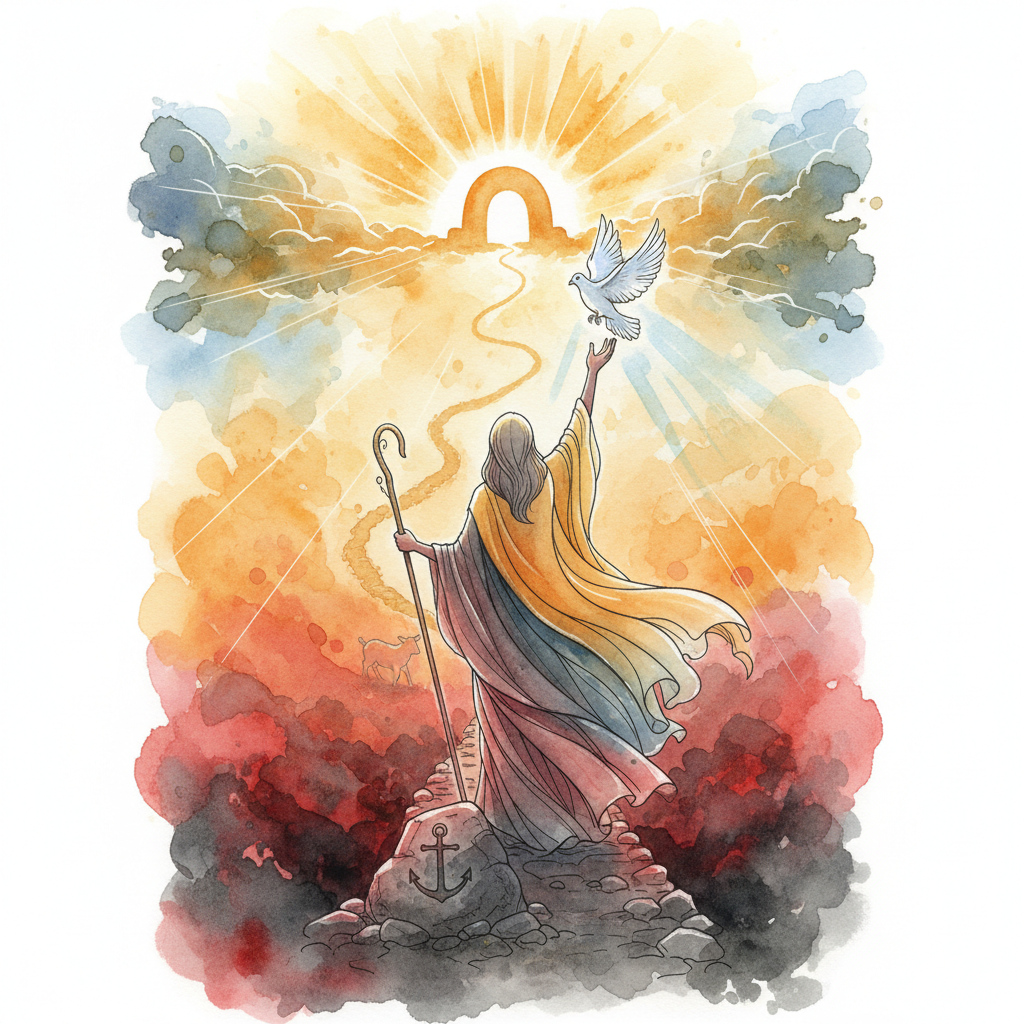
Suffering in the Believer's Life: Participation in Christ's Redemptive Mission
A biblical exploration of how suffering in the believer's life participates in Christ's redemptive mission and the renewal of creation. This course moves beyond viewing suffering as merely personal testing or character refinement to discover the richer biblical vision: that believers' suffering, when aligned with Christ's redemptive work, actively participates in the restoration of all things. Through careful study of foundational passages, historical context, and theological interpretation, learners will encounter a faith deeper and more costly than inherited traditions suggest—and discover that God invites believers into something far greater than personal spiritual growth.
What you'll study
The Foundation: Suffering Produces Perseverance, Character, and Hope (Romans 5:1-5)
Romans 5:1-5
The Whole-Person Reality: Why Suffering Is Never Merely Spiritual (2 Corinthians 12:1-10 with Hebrew Etymology)
2 Corinthians 12:1-10; Philippians 3:8-10
Suffering as Identification with Christ's Redemptive Work (1 Peter 2:19-25; 4:12-19)
1 Peter 2:19-25; 1 Peter 4:12-19
Active Participation, Not Passive Endurance: Filling Up What Is Lacking (Colossians 1:24-29)
Colossians 1:24-29
Comfort as Solidarity: God's Presence and Purpose in Corporate Suffering (2 Corinthians 1:3-11 with Isaiah 52-53)
2 Corinthians 1:3-11; Isaiah 52:13-53:12
Suffering and Glory: The Consummation of Redemptive Participation (Romans 8:28-39; 2 Corinthians 4:16-18)
Romans 8:28-39; 2 Corinthians 4:16-18
Chapter 1 · Free to read
The Foundation: Suffering Produces Perseverance, Character, and Hope (Romans 5:1-5)
Romans 5:1-5
The Text
Therefore, since we have been justified through faith, we have peace with God through our Lord Jesus Christ, through whom we have gained access by faith into this grace in which we stand. And we rejoice in the hope of the glory of God. Not only that, but we also rejoice in our sufferings, because we know that suffering produces perseverance; perseverance, character; and character, hope. And hope does not disappoint us, because God has poured out His love into our hearts through the Holy Spirit, whom He has given us.
Romans 5:1-5 (BSB) (Berean Standard Bible (BSB) — a translation emphasizing word-for-word accuracy with contemporary readability, preserving the Greek argument structure.)
Key Terms
- δικαιόω (dikaioō) · dikaioō
- To declare righteous, to acquit, to place in right legal standing before God. In Romans, it refers to God's forensic act of imputing Christ's righteousness to the believer through faith, removing the legal barrier between the sinner and God.
- ὑπομονή (hypomonē) · hypomonē
- Perseverance, patient endurance, steadfast persistence. Not passive resignation but active, determined endurance under pressure—'remaining under' the trial without fleeing or compromising. In classical Greek, it denoted the endurance of hardship; in biblical usage, it becomes a virtue shaped by faith in God's faithfulness.
- δοκιμή (dokimē) · dokimē
- Proof, testing, approved character. Originally meant the process of testing metals to determine purity; extended to mean character proven and approved through trial. Not abstract knowledge but experiential verification—the proof that faith is real because it has been tested and not failed.
- ἐλπίς (elpis) · elpis
- Hope, confident expectation, future certainty. Not wishful thinking but anchored assurance in God's promises. In Paul, hope is not 'I hope it might happen' but 'I am confident God's promises will be fulfilled' because they rest on God's character, demonstrated through Christ's resurrection and the Spirit's indwelling.
Historical Foundation
Mid-First Century CE — The Early Church Under Roman Persecution and Jewish Pressure
The Roman Empire under Nero (54-68 CE) was consolidating control and demanding loyalty through emperor worship and participation in civic religious rites. Early Christian communities—composed of both Jewish and gentile converts—faced exclusion from synagogues, economic hardship, family rejection, and sporadic but real threat of arrest and execution. The Jerusalem temple still stood (destruction would come in 70 CE), and Jewish messianic expectations were volatile. Within this crucible, Paul writes to a mixed community in Rome itself—the capital of the empire—to explain how justification by faith, not works of the law, creates peace with God and produces a counter-cultural resilience. The promise is not escape from suffering, but transformation through it. For the Assemblies of God tradition, which emphasizes the Holy Spirit's empowering presence in everyday life (not merely in prayer closets), this passage anchors how the Spirit enables believers to 'flesh out' their faith in hostile circumstances. Paul's theology of suffering is radically incarnational: God's grace enters the messiness of real persecution and transforms it into spiritual maturity.
Cultural World
Roman-era household codes and patronage networks shaped how Paul's audience understood 'access' (prosagōgē) and 'standing' (stēkō). In the Roman world, a patron-client relationship granted a client 'access' to the patron's resources and household. Paul reframes this: through Christ, believers gain access to God as the ultimate patron, assured of His favor (grace/charis) not by merit or social status but by faith. The ANE covenant tradition, especially the suzerainty treaty model (king to vassal), informs Paul's language of 'peace' (shalom/eirēnē). A suzerainty treaty established peace between unequal parties—the king granted protection; the vassal offered loyalty. Paul inverts this: God, the supreme power, grants peace to sinners (the powerless, 5:6) through Christ, the mediator. This is not pragmatic détente but covenantal reconciliation. The concept of 'glory' (doxa) carries OT weight: in the Hebrew Bible, God's glory is His manifested power and presence (Exodus 24:16-17, Isaiah 6:3). Believers 'rejoice in hope of the glory of God' means they await the future revelation of God's transformative power when Christ returns—but that hope reshapes present suffering. The household analogy runs throughout: the Spirit is 'poured out into our hearts' (verse 5), a domestic image of intimate indwelling, echoing the OT pattern of God's Spirit filling the tabernacle and dwelling among His people. For Paul's Roman audience facing persecution, the household of God (oikos theou) becomes the true patronage network, more reliable than political power or social standing.
What the Evidence Shows
Paul's argument in Romans 5:1-5 establishes a redemptive trajectory for suffering that fundamentally reshapes how believers understand hardship in light of Christ's justification. The passage moves through four interconnected claims: (1) Justification by faith creates peace with God and secure access to His grace (verses 1-2). This is not peace with circumstance but peace with the One who controls all circumstances. Matthew Henry notes that 'sin breeds the quarrel between us and God,' and justification 'takes away the guilt' that separates the sinner from God's friendship. John Gill emphasizes that this peace flows 'through our Lord Jesus Christ' as the Mediator—not a generic peace but reconciliation made possible by the Incarnation and Atonement. (2) Believers 'rejoice in suffering' because suffering is not meaningless but purposeful (verse 3). The Greek verb chauchamai (rejoice/boast) is the same verb used in verse 2 for rejoicing in God's glory. Paul claims the same kind of joy is possible in trials because trials have a divine design. (3) Suffering produces a progression: perseverance (hypomonē) → character (dokimē) → hope (elpis) (verses 3-4). This is not metaphorical but a genuine causal sequence. The Jamieson-Fausset-Brown commentary notes that hypomonē is 'quiet endurance' rooted in trust that trials are 'divinely appointed' and 'needed discipline.' Dokimē is not abstract virtue but 'experimental evidence that we have believed through grace'—faith tested and proven real. Hope emerges not from wishful thinking but from this proven reliability. (4) The foundation of this entire trajectory is the Holy Spirit: 'God has poured out His love into our hearts through the Holy Spirit' (verse 5). For the Assemblies of God tradition, this is the critical clause: the Spirit is not a doctrine but a dynamic presence that 'enfleshs' God's Word in daily life. The Spirit's indwelling makes perseverance possible because believers are not alone; they carry God's presence into their suffering. The evidence shows that Paul does not deny suffering but transforms its meaning through three theological realities: Christ's justifying work (legal standing), the Spirit's indwelling presence (relational reality), and hope as a rational response to proven character. This was radical for first-century believers under Roman persecution: suffering was not proof of God's absence but evidence of His transformative work in progress.
Scholarly Witness
Henry emphasizes that justification removes the guilt that 'breeds the quarrel between us and God' and that sin creates not only 'strangeness' but 'enmity.' He notes that 'There is more in this peace than barely a cessation of enmity, there is friendship and loving-kindness,' and that God 'is either the worst enemy or the best friend.' This frames peace with God not as pragmatic détente but as restored friendship—a theological foundation for enduring suffering without bitterness.
Gill clarifies that we are 'justified by faith objectively and relatively, as that relates to the object Christ, and his righteousness'—faith is not the ground of justification but the means by which we apprehend the true ground, Christ's imputed righteousness. This distinction is crucial: the believer's standing is utterly secure not because faith is strong but because Christ's righteousness is perfect and is continually applied by faith.
JFB defines hypomonē as 'quiet endurance of what we cannot but wish removed'—and crucially notes that it differs from mere Stoic hardihood: 'this proud, stoical hardiness has nothing in common with the grace of patience...which is either the meek endurance of ill because it is of God...or the calm waiting for promised good till His time to dispense it come.' They emphasize that the believer's perseverance is rooted in conviction that trials are 'divinely appointed,' 'the needed discipline of God's children,' and 'not sent without abundant promises.' This grounds hope not in escape but in God's faithfulness.
The AG tradition, drawing on David W. Augsburger's Communicating Good, insists that the Spirit-filled life 'reaches beyond an experience in point of time to affect the moment-by-moment realities of life—into the kitchen, on the job, into the classroom, or wherever life is lived.' The concern that 'the church has been more concerned about an initial evidence than permanent, life-changing evidences' reflects a crucial perspective: the Spirit's work is not mystical escapism but practical empowerment for faithful witness in ordinary contexts. This directly enriches Romans 5:1-5: the hope and perseverance Paul describes are not private spiritual experiences but public testimonies—'enfleshed' faith that transforms how believers work, serve, and endure.
Ward's emphasis on personal encounter with Jesus Christ—'I must bring you to Jesus, not to some doctrine. Suddenly you are aware of His presence. You touch Him. That is salvation'—provides a corrective to overly abstract theology. Romans 5:1-5, in this light, is not merely doctrinal explanation but proclamation of a relational reality: peace with God is not a formula but a friendship made real through the Spirit's presence. This supports the reading that 'rejoicing in suffering' is possible because the sufferer is not alone—the Spirit has been 'poured out into our hearts.'
The suzerainty treaty model of the ancient Near East (where a great king extends peace to a vassal, not vice versa) illuminates Paul's reversal: God, the supreme power, voluntarily grants peace to sinners—'the powerless' (verse 6). This is not transaction but covenant grace. Paul's first-century audience, many of them from Asia Minor where Hittite and other ANE traditions were known (through cultural memory), would have recognized this inversion as theologically radical.
Contemporary study of Pauline theology emphasizes that 'hope' (elpis) in Romans is not optimism but theologically reasoned confidence based on God's demonstrated reliability through Christ's resurrection and the ongoing presence of the Spirit. This aligns with classical commentary tradition while incorporating more rigorous analysis of the Greek semantic field and first-century context. The progression perseverance → character → hope is not mystical but rationally defensible: proven experience creates justified confidence.
Discovery Questions
1.Look carefully at the verbs in Romans 5:1-5. What action does the believer take, and what action does God (or the Spirit) take? What does this pattern reveal about Paul's view of how faith works in the midst of suffering?
Paul presents a paradox: the believer's standing is entirely God's work (justification, grace, access), but the believer's response is actively volitional ('we rejoice'). However, the transformation itself—from suffering to perseverance to character—is not the believer's effort but a causal sequence God sets in motion. The Jamieson-Fausset-Brown commentary emphasizes this: perseverance is not human willpower but 'meek endurance...because it is of God.' The Spirit is the hidden agent (verse 5: 'God has poured out His love into our hearts through the Holy Spirit'). For the Assemblies of God tradition, this resolves a critical tension: we are not self-improved through suffering; we are transformed by the indwelling Spirit. The believer 'rejoices' not because suffering is good but because the Spirit's transformative work through that suffering produces hope. This is the 'enfleshed' faith Augsburger describes—not escape but empowerment.
2.Paul uses the term 'rejoice' (chauchamai) twice in Romans 5:1-5—once when speaking of 'the hope of the glory of God' (verse 2) and once when speaking of 'our sufferings' (verse 3). Are these the same kind of rejoicing, or is Paul making a distinction? How is this possible?
Paul is not claiming that suffering itself is good or joyful—that would be incoherent. Rather, he is saying that the believer's horizon has fundamentally shifted. Rejoicing in the 'hope of God's glory' is forward-looking (verse 2); rejoicing 'in our sufferings' (verse 3) is present-tense but anchored in the same hope. The connection is the causal chain: suffering → perseverance → character → hope (verses 3-4). The believer rejoices in present suffering because they are confident in the future outcome—and more importantly, because they are experiencing real, present transformation. John Gill's comment is key: the believer has 'peace of God, which passes all understanding'—the Spirit's indwelling creates a joy that transcends circumstantial happiness. For the Assemblies of God emphasis on practical faith: the believer is not pretending that persecution is fun, but they are experiencing the Spirit's actual presence and real growth in character. That is worth rejoicing over, even while suffering. This is counter-cultural resilience.
3.Romans 5:5 says 'God has poured out His love into our hearts through the Holy Spirit, whom He has given us.' How does this verse anchor and complete the argument Paul has been building in verses 1-4? What does the Spirit's presence have to do with whether hope will disappoint us?
Paul is not claiming that hope will not disappoint because circumstances will improve or suffering will end. Rather, hope will not disappoint because God's love, mediated through the indwelling Holy Spirit, is an unbreakable reality. The Spirit is not a feeling but a person—God's own presence dwelling in the believer. If the believer's hope is anchored in God's proven love and demonstrated through Christ's death (verses 6-8) and the Spirit's indwelling (verse 5), then hope cannot ultimately fail because it is rooted in the one who cannot fail. Matthew Henry emphasizes that this creates not merely 'a cessation of enmity' but 'friendship and loving-kindness'—the believer has become God's intimate friend. The Assemblies of God tradition adds critical nuance: this is not abstract assurance but relational presence. The Spirit 'has been given to us' (verse 5)—the perfect tense suggests an ongoing, perpetual gift. The believer is never alone in suffering; the Spirit who poured God's love into the heart is constantly accessible. This makes the perseverance of verses 3-4 not a lonely, isolated endurance but a sustained partnership with God. Hope does not disappoint because the one who gave the promise is present with us, transforming us in real time.
4.Bring together what you've discovered about Paul's teaching on suffering (verses 3-4), the role of the Spirit (verse 5), and the foundation of justification and peace (verses 1-2). How would a believer in Rome facing persecution, potential arrest, or economic hardship actually live differently because of Romans 5:1-5? What would change about how they understood their trials?
A first-century believer in Rome reading Romans 5:1-5 would experience a fundamental reorientation of meaning. Rather than interpreting persecution as evidence of God's absence or abandonment, they would understand it as the arena where God's Spirit is actively transforming their character. Their peace with God (verse 1) is unshakeable because it rests on Christ's justification, not on political stability or social acceptance. When they face mockery at work (the 'grubby interchange of the workbench or marketplace' that Augsburger mentions), they are not simply enduring—they are participating in a sequence of transformation: perseverance building character, character building hope, hope sustained by the Spirit's love. They would find that their faith is being tested and proven real, like gold refined in fire. Most radically, they would understand that the trial itself is not a detour from their spiritual growth but the primary site of that growth. The Assemblies of God emphasis on the Spirit-filled life is crucial here: they are not alone in that suffering. The same Spirit that empowered the apostles, that spoke through the prophets, that raised Jesus from the dead—that Spirit dwells in them, continuously pouring God's love into their hearts. This transforms suffering from meaningless pain into redemptive transformation. They would go to work, face injustice, and instead of bitterness, they would experience the Spirit producing perseverance. They would encounter hardship and feel character deepening. They would suffer and discover hope. This is not escape theology but incarnational theology: God in Christ was willing to suffer; God's Spirit empowers believers to suffer redemptively. The promise is not 'you won't suffer' but 'your suffering will mean something, and you will not go through it alone.'
Connected Passages
- James 1:2-4 — James parallels Paul's sequence exactly: 'Consider it pure joy, my brothers and sisters, whenever you face trials of many kinds, because you know that the testing of your faith produces perseverance [hypomonē]. Let perseverance finish its work so that you may be mature and complete, not lacking anything.' James uses the same Greek word and the same causal logic as Romans 5:3-4. Together, these passages establish a canonical consensus: perseverance through trials produces maturity. This is not a Pauline peculiarity but a core New Testament conviction about redemptive suffering.
- 2 Corinthians 4:16-18 — Paul himself expands this teaching: 'Therefore we do not lose heart. Though outwardly we are wasting away, yet inwardly we are being renewed day by day. For our light and momentary troubles are achieving for us an eternal glory that far outweighs them all. So we fix our eyes not on what is seen, but on what is unseen, since what is seen is temporary, but what is unseen is eternal.' Here Paul reiterates that present suffering is producing something of eternal value ('achieving for us an eternal glory'). The 'fixing our eyes' on unseen reality is the lived practice of the hope described in Romans 5:1-5.
- 1 Peter 1:6-9 — Peter directly addresses suffering believers: 'In all this you greatly rejoice, though now for a little while you may have had to suffer grief in all kinds of trials. These have come so that the proven genuineness of your faith—of greater worth than gold, which perishes even though refined by fire—may result in praise, glory and honor when Jesus Christ is revealed.' The metallurgical imagery ('refined by fire') mirrors Romans 5:4's 'character' (dokimē, proven genuineness). Peter, addressing persecution explicitly, reinforces Paul's claim that suffering is the means by which faith is proven and authenticated. Both apostles transform suffering from meaninglessness into purposefulness.
- Romans 8:28-29 — Later in the same epistle, Paul provides the ultimate framework: 'And we know that in all things God works for the good of those who love him, who have been called according to his purpose. For those God foreknew he also predestined to be conformed to the image of his Son, that he might be the firstborn among many brothers and sisters.' This is the 'why' of Romans 5:3-4: God is working through suffering to conform believers to Christ's image. Suffering is not random but purposeful—it is the means by which believers are being 'conformed' (symmorphizō) to Christ.
- Hebrews 12:1-2 — Hebrews applies the same logic in the context of the 'cloud of witnesses' (the patriarchs and OT saints who endured): 'Let us throw off everything that hinders and the sin that so easily entangles, and let us run with perseverance [hypomonē] the race marked out for us, fixing our eyes on Jesus, the pioneer and perfecter of faith.' Jesus himself is presented as the exemplar of redemptive suffering: he 'endured the cross' (verse 2). The believer's perseverance in suffering is not arbitrary but an imitation of Christ's own pattern of redemptive obedience.
- Genesis 3:6, Romans 5:12-19 (Adam-Christ parallel) — Romans 5:6-21 (the extended passage following 5:1-5) establishes that suffering entered the world through Adam's sin (verse 12: 'death through sin'). Importantly, the promise of Romans 5:1-5 is not escape from suffering (which cannot happen in a fallen world) but redemption through suffering. Christ's 'obedience' (verse 19) contrasts with Adam's disobedience; Christ's death produces 'justification and life for all people' (verse 18). The suffering that Paul describes in 5:3-4 is therefore not punishment but participation in Christ's redemptive obedience. Believers suffer in a fallen world, but their suffering is transformed by the Spirit into conformity to Christ.
- 1 Corinthians 13:4-7 (Love as the foundation of perseverance) — Paul elsewhere defines love (agapē) as 'patient [makrothymia], love is kind...it always protects, always trusts, always hopes, always perseveres [hypomenei].' This illuminates Romans 5:5: 'God has poured out His love [agapē] into our hearts.' The perseverance of Romans 5:3 is not grim determination but the fruit of love's presence. God's love, indwelling via the Spirit, produces hypomonē as its natural expression. Suffering becomes bearable not through willpower but through experiencing the Spirit's love.
- Philippians 4:4-7 — Paul writes: 'Rejoice in the Lord always. I will say it again: Rejoice!...And the peace of God, which transcends all understanding, will guard your hearts and your minds in Christ Jesus.' This echoes Romans 5:1-5's promises of peace and rejoicing. Again, Paul is addressing believers in a hostile environment (Philippi had imprisoned him), yet he calls them to 'rejoice'—the same verb (chauchamai) used in Romans 5:2-3. The 'peace of God' (4:7) is the same reconciliation and security promised in Romans 5:1. Together these passages establish a consistent Pauline conviction: the Spirit-indwelled believer experiences present peace and joy even in persecution because their hope is anchored in God's future vindication and present transformation.
Takeaways
- **Justification is the foundation, not the destination.** Salvation begins with peace with God and secure standing (Romans 5:1-2), made possible by Christ's forensic work. The Assemblies of God tradition rightly emphasizes this: you cannot live a Spirit-filled life from a place of guilt and separation. But justification is not the endpoint—it is the launching pad for transformation. The believer who truly grasps that they are 'at peace with God' through Christ is freed from self-protective anxiety to embrace the Spirit's work in their life.
- **Suffering is a tool for redemptive transformation, not a punishment or a sign of God's absence.** Paul's sequence (suffering → perseverance → character → hope) is not metaphorical but a genuine causal chain. When trials come—workplace injustice, family rejection, health crises, social exclusion—the believer can identify these as the very sites where the Spirit is producing maturity. This does not make suffering pleasant, but it makes it meaningful. First-century believers facing Roman persecution needed this message; modern believers facing spiritual complacency, relational conflict, or existential uncertainty need it equally. Your trial is not a deviation from God's plan; it is the plan.
- **Character is proven, not assumed.** Paul uses dokimē—tested genuineness, approved reliability. Just as gold is authentic when it survives the refiner's fire, faith is genuine when it perseveres through trial. This has profound implications: you cannot claim faith until it has been tested. You cannot claim to trust God's love until that love has sustained you through hardship. The Spirit-filled life is not a static possession but an ongoing authentication. The Assemblies of God emphasis on practical faith—'enfleshed' in the marketplace, the workbench, the family—is exactly right: faith is proven in the real world, not in theory.
- **Hope is rational confidence in God's proven reliability, not wishful thinking.** Because God 'poured out His love into our hearts through the Holy Spirit,' hope does not rest on circumstances improving but on the person of God being present and trustworthy. This is extraordinarily important for the believer facing uncertain outcomes: your hope need not depend on the trial ending (it might not), the persecution stopping (it might continue), or the illness being healed (it might not be). Your hope depends on God's character and presence, which are permanent. The Spirit's indwelling is the guarantee that God's love is real, present, and operative.
- **The Holy Spirit is not a doctrine but a dynamic person who transforms believers from within.** Romans 5:5 is the hinge of the passage: 'God has poured out His love into our hearts through the Holy Spirit, whom He has given us.' The Spirit is not a feeling, an experience, or a gift you must maintain through effort. The Spirit is God's own presence, perpetually indwelling. This aligns perfectly with the Assemblies of God conviction that the Spirit-filled life is not contained in prayer closets but 'manifests in the busy interchanges of life.' The Spirit sustains perseverance in the workplace, produces character in relationships, and anchors hope in the midst of uncertainty. You are never alone in your suffering because the Spirit of God actually dwells in you.
Application
This week, identify one area of ongoing difficulty in your life—relational conflict, professional frustration, financial pressure, health anxiety, or spiritual confusion. Instead of asking 'When will this go away?' ask 'What is the Spirit producing in me through this trial?' Name one concrete way—one thing your character looks like, one conversation you handle with more patience, one choice you make with more faith—that is actually different because of your struggle. Write it down. Then ask: Is this real spiritual growth? Is this the work of the Spirit? If so, is the trial producing the very thing my heart needs? This is not saying your struggle is good; it is asking whether God is working for your transformation within it. Bring this reflection to prayer: ask the Spirit to show you the redemptive purpose already in motion. Then report back: What character is being produced? What does genuine perseverance through your trial actually look like?
Continue the course — 5 more chapters
The Whole-Person Reality: Why Suffering Is Never Merely Spiritual (2 Corinthians 12:1-10 with Hebrew Etymology)
2 Corinthians 12:1-10; Philippians 3:8-10
How does Paul's 'thorn in the flesh' and the biblical language of suffering reveal that believers suffer as embodied persons, not abstract spirits, and what does this teach about participation in Christ's incarnate redemption?
Suffering as Identification with Christ's Redemptive Work (1 Peter 2:19-25; 4:12-19)
1 Peter 2:19-25; 1 Peter 4:12-19
How does Peter frame believers' suffering as identification with and participation in Christ's suffering and redemptive mission, and what does this mean for how we understand the meaning of our pain?
Active Participation, Not Passive Endurance: Filling Up What Is Lacking (Colossians 1:24-29)
Colossians 1:24-29
What does Paul mean by 'filling up what is lacking in Christ's afflictions,' and how does this radical claim transform suffering from something merely to be survived into something that participates in ongoing redemptive work?
Comfort as Solidarity: God's Presence and Purpose in Corporate Suffering (2 Corinthians 1:3-11 with Isaiah 52-53)
2 Corinthians 1:3-11; Isaiah 52:13-53:12
How does the Old Testament vision of the Servant's vicarious suffering and Paul's teaching on comfort reframe suffering as corporate and connected to God's redemptive mission for creation, not merely individual refinement?
Suffering and Glory: The Consummation of Redemptive Participation (Romans 8:28-39; 2 Corinthians 4:16-18)
Romans 8:28-39; 2 Corinthians 4:16-18
How do these passages unite suffering and future glory into a single redemptive narrative, and what does this teach believers about the ultimate meaning and destination of their pain in God's plan to renew all creation?
No credit card required
Sources Used
Every insight traces to a named source. 0 AI-generated interpretations.
Related courses
Baptism in the New Testament: Incorporation into Christ and God's Covenant Community
A five-chapter study exploring how baptism in the New Testament incorporates believers into Christ and God's covenant community, transforming the whole person into resurrection life. This course moves from Jesus's own baptism as the foundational pattern, through the early church's practice and theology, to Paul's vision of baptism as death-and-resurrection union with Christ, and finally to baptism's role in both individual transformation and corporate belonging. Each chapter is anchored in primary biblical texts and enriched by historical, cultural, and theological insight.
5 chapters
Bible Verses About Peace: Understanding Shalom, Eirene, and Christ's Redemptive Peace
This course explores biblical passages about peace through a progressive journey from Old Testament foundations to New Testament fulfillment. Students will discover the rich theological depth of peace in Scripture, distinguishing between Hebrew shalom and Greek eirene, understanding how Christ's Atonement establishes peace with God, and learning how believers experience the supernatural peace of God through the Holy Spirit. Each chapter anchors learning in a key biblical text, enriched by historical, linguistic, and theological insight.
5 chapters
Strength in the Biblical Vision: God as Source, Relational Resilience, and Perseverance Across Life's Dimensions
A five-chapter exploration of biblical strength moving from God as the ultimate source, through the paradox of strength in weakness, to relational resilience, character formation, and finally synthesis into practice. This course recovers the richer original texture of biblical 'strength'—not mere physical power but divine empowerment, moral resolve, covenant faithfulness, and spiritual endurance expressed through faith, community, and perseverance. Each chapter anchors in primary biblical passages while progressively deepening understanding through textual, theological, historical, and relational evidence.
5 chapters
What Does the Bible Say About Depression? A Whole-Person Framework for Deep Emotional Suffering
This course explores how Scripture speaks to depression not as a spiritual failing or a merely clinical problem, but as a whole-person condition affecting body, soul, and spirit together. Through laments, prophetic testimony, and Christ's own suffering, we discover that the Bible honors emotional darkness as legitimate human experience while pointing toward God's presence, comfort, and redemption. We'll recover the richness of Hebrew and Greek vocabulary, learn from biblical figures who wrestled with despair, and discover how Scripture offers resources that modern frameworks alone cannot—not because it denies the physical reality of suffering, but because it refuses to separate it from the spiritual and relational dimensions of healing.
5 chapters
The Book of Philippians: A 4-Part Bible Study Guide
A comprehensive chapter-by-chapter study through Paul's Letter to the Philippians, exploring themes of joy in suffering, Christological depth, gospel freedom, and church unity.
4 chapters
The Nature and Origin of Unclean Spirits in the New Testament: A Deeper Reading of the Original Text
This course explores what the original Greek terminology (πνεῦμα ἀκάθαρτον) and Second Temple cosmology reveal about unclean spirits as distinct agents within a richer spiritual ecology. Rather than collapsing all demonic beings into a single 'fallen angel' category, we recover the biblical text's more nuanced understanding of spiritual opposition, personal agency, and cosmic conflict. Each chapter is anchored in primary passages, enriched by historical context and theological insight, revealing that the original text teaches something more profound than inherited tradition alone suggests.
5 chapters
Create your own Bible studies — free.
Ask any question. Get evidence from named scholars and curated datasets in minutes.
Get Started Free