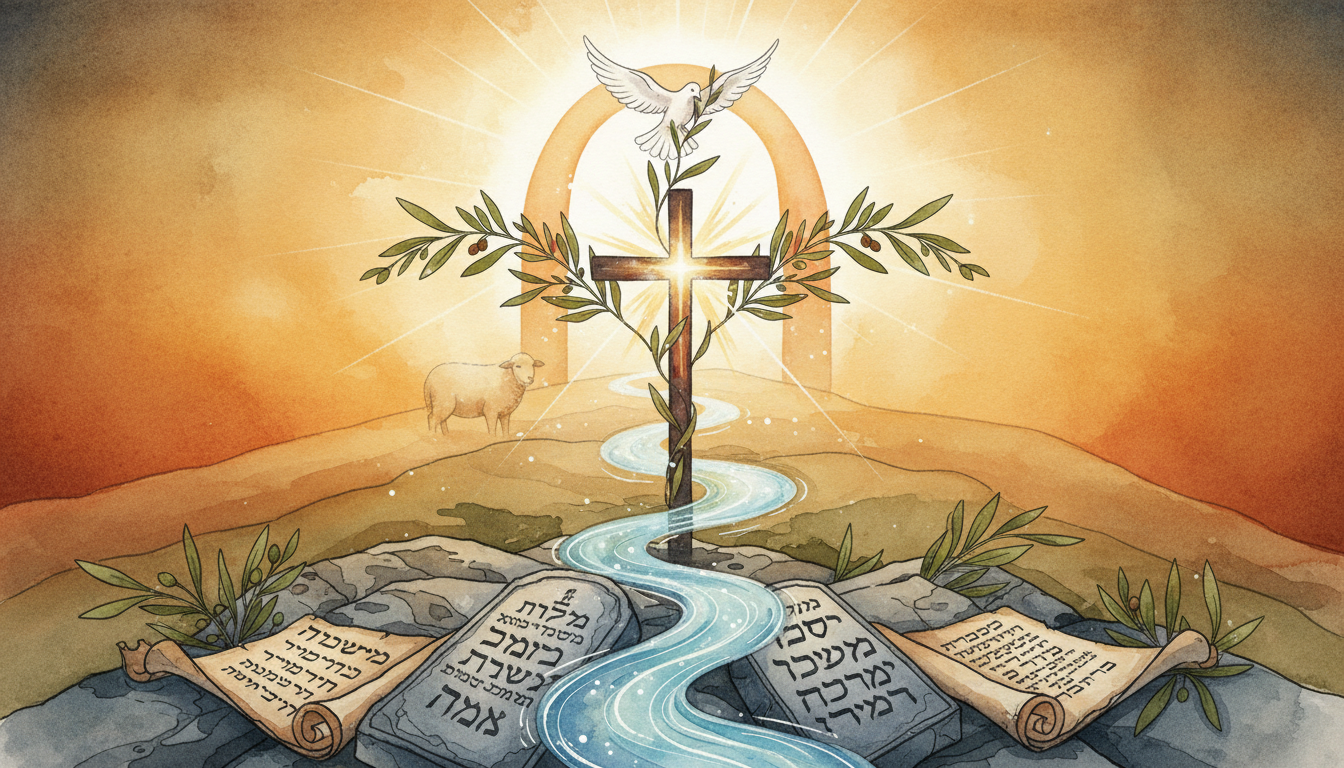
Bible Verses About Peace: Understanding Shalom, Eirene, and Christ's Redemptive Peace
This course explores biblical passages about peace through a progressive journey from Old Testament foundations to New Testament fulfillment. Students will discover the rich theological depth of peace in Scripture, distinguishing between Hebrew shalom and Greek eirene, understanding how Christ's Atonement establishes peace with God, and learning how believers experience the supernatural peace of God through the Holy Spirit. Each chapter anchors learning in a key biblical text, enriched by historical, linguistic, and theological insight.
What you'll study
The Foundation of Peace: Isaiah 53:5 and the Atonement
Isaiah 53:5 - 'But he was pierced for our transgressions, he was crushed for our iniquities; the punishment that brought us peace was on him, and by his wounds we are healed.'
The Hebrew Concept of Shalom: Old Testament Prophecy and Messianic Hope
Isaiah 9:6-7 - 'For to us a child is born, to us a son is given, and the government will be on his shoulders. And he will be called Wonderful Counselor, Mighty God, Everlasting Father, Prince of Peace. Of the increase of his government and peace there will be no end...'
Christ's Peace Proclaimed and Fulfilled: From Prophecy to Incarnation
Luke 2:14 - 'Glory to God in the highest heaven, and on earth peace to those on whom his favor rests.' and John 14:27 - 'Peace I leave with you; my peace I give you. I do not give to you as the world gives. Do not let your hearts be troubled and do not be afraid.'
Peace with God: The Theology of Justification and Reconciliation
Romans 5:1-11 - 'Therefore, since we have been justified through faith, we have peace with God through our Lord Jesus Christ, through whom we have gained access by faith into this grace in which we now stand.'
The Peace of God: The Supernatural Rest and Protection of Believers
Philippians 4:6-7 - 'Do not be anxious about anything, but in every situation, by prayer and petition, with thanksgiving, present your requests to God. And the peace of God, which transcends all understanding, will guard your hearts and your minds in Christ Jesus.'
Chapter 1 · Free to read
The Foundation of Peace: Isaiah 53:5 and the Atonement
Isaiah 53:5 - 'But he was pierced for our transgressions, he was crushed for our iniquities; the punishment that brought us peace was on him, and by his wounds we are healed.'
The Text
But he was pierced for our transgressions, he was crushed for our iniquities; the punishment that brought us peace was on him, and by his wounds we are healed.
Isaiah 53:5 (BSB) (This is the Berean Standard Bible (BSB) translation. The Hebrew text reads: וְהוּא מְחֹלָל מִפְּשָׁעֵינוּ מְדֻכָּא מֵעֲוֹנֹתֵינוּ אֲשׁוּמַת שְׁלוֹמֵנוּ עָלָיו וּבַחֲבֻרָתוֹ נִרְפָּא לָנוּ (v'hu m'cholal mif'sha'einu m'dukka me'avonoteinu ashumat shlomenu alav u'b'chaburato nirpa lanu). The text emphasizes three dimensions of the Servant's work: (1) violation/piercing, (2) crushing, (3) bearing punishment that produces peace. The final clause speaks of healing through 'wounds' or 'stripes.')
Key Terms
- מְחֹלָל (m'cholal) · m'cholal
- pierced, wounded, profaned. From the root חלל (chalal), which can mean to pierce through, wound, or desecrate. In military contexts, it describes the piercing of a body by weapon.
- מְדֻכָּא (m'dukka) · m'dukka
- crushed, bruised, broken. From the root דכא (daka), meaning to break, shatter, crush under weight or pressure.
- אֲשׁוּמַת שְׁלוֹמֵנוּ (ashlumat shlomenu) / מוּסַר שְׁלוֹמֵנוּ (musar shlomenu) · ashlumat / musar shlomenu
- 'the punishment/discipline that brought us peace' or 'the chastisement of our peace.' אֲשׁוּמָה (ashuma) = punishment, chastisement, discipline. שָׁלוֹם (shalom) = peace, wholeness, completeness, right relationship, harmony.
- בַחֲבֻרָתוֹ (b'chaburato) · b'chaburato
- by his wounds, bruises, stripes, weals. From חַבְרוּרָה (chabura), a wound or welt left by a blow or lashing.
Historical Foundation
Second Temple Judaism & First Century AD
During the Second Temple period (516 BC - 70 AD), Jewish theology was wrestling with the meaning of suffering, divine justice, and God's redemptive purposes. The temple had been rebuilt, but Israel remained under foreign rule—first Persian, then Greek, then Roman. Messianic expectations were high but contested. When Jesus was crucified around 30 AD, His followers were devastated: a messiah was not supposed to die, let alone die shamefully on a Roman cross. Isaiah 53 became the hermeneutical key that allowed apostles like Peter, Paul, and the author of Hebrews to reframe Christ's death not as a failure but as the fulfillment of Scripture's deepest promise. The passage is set against a backdrop where suffering and vicarious atonement were already known categories in Jewish sacrifice theology, but Isaiah 53 uniquely applied them to a personal, eschatological figure—the Suffering Servant who bears the sins of the many.
Cultural World
Isaiah 53 engages the ancient Near Eastern (ANE) context of sacrifice and vicarious substitution, though it radically reframes these patterns. In ancient Mesopotamian religion, substitute figures were sometimes used in rituals to transfer illness or misfortune from a king or community to an animal or slave. The Hittite 'Substitute King Ritual' is a famous example: during plague, a prisoner might be ritually killed as a substitute to appease divine wrath. In Levantine temple religion, the scapegoat ritual (Leviticus 16) functioned similarly—the goat bore the sins of the people and was driven into the wilderness. However, Isaiah 53 uniquely depicts the Servant as a willing, voluntary victim whose suffering is redemptive and vicarious in a new way: not a one-time ritual but a singular, unrepeatable act that establishes a new covenant relationship. The language of 'pierced' and 'crushed' evokes the ANE imagery of divine judgment and punishment (the wrath of deity), but the text inverts it: the Servant absorbs this wrath so others do not have to bear it. This is both within ANE conceptual categories (substitution, divine punishment) and against ANE assumptions (that the deity would accept a voluntary victim as a final, sufficient atonement). The result is a christological framework foreign to ANE religion proper but comprehensible within its sacrificial vocabulary.
What the Evidence Shows
The evidence reveals that Isaiah 53:5 presents Christ's substitutionary death as the mechanism by which peace between God and humanity is restored. [1] The passage claims that the Servant 'was pierced for our transgressions' and 'crushed for our iniquities'—language of vicarious, representative suffering in which one person bears the penalty justly due to another. [2] The central theological claim is that 'the punishment that brought us peace was on him': divine justice requires punishment for sin, but the Servant receives that punishment in our place, so that the obstacle to peace (guilt and separation from God) is removed. [3] This reading is anchored in the primary text, not in extracanonical sources. The New Testament apostles confirm that they understood Isaiah 53 in precisely this way. Peter writes that Christ 'bore our sins in his body on the cross' (1 Peter 2:24, referencing Isaiah 53:5), and he frames this as the ground of healing and restoration. Paul declares that God 'made him who knew no sin to be sin for us, so that in him we might become the righteousness of God' (2 Corinthians 5:21)—applying Isaiah's vicarious suffering to Christ's person and work. Hebrews applies Isaiah 53:12 ('he bore the sin of many') to Christ's singular, final sacrifice. [4] The Assemblies of God tradition affirms this reading as central to its doctrine of salvation. Fundamental Truth #3 states that Christ's 'substitutionary work on the cross' is one of the defining declarations of Scripture about the Son of God. [5] The Divine Healing position paper explicitly anchors healing—physical and spiritual—in Isaiah 53:4-5: 'Deliverance from sickness is provided for in the Atonement, and is the privilege of all believers.' This connects Isaiah's language of healing ('by his wounds we are healed') to the redemptive work of Christ's death. The paper notes that Jesus fulfilled Isaiah 53:4, demonstrating that the Servant's work encompassed both physical and spiritual healing. The original Hebrew deepens this understanding. The term shalom (peace) is not merely the absence of conflict but the restoration of right relationship with God. When Isaiah says 'the punishment that brought us peace was on him,' he means that Christ's bearing of the divine punishment (the consequence of transgression) removes the barrier that separates humanity from God. Sin creates alienation; punishment is the just divine response; but Christ absorbs the punishment, so that those for whom he died are no longer under condemnation. They are reconciled to God. The peace is therefore covenantal: a new, unbroken relationship with the Creator. [6] The term m'cholal (pierced) carries both physical and ceremonial force. It denotes the literal wounding of the body but also—in a Levitical register—the treatment of the Victim as defiled, unclean, cast outside the camp. This resonates with the Gospel accounts of crucifixion as a form of ultimate shame and rejection. Yet this defilement is the means of restoration. The wounded, rejected Servant becomes the vehicle of peace. [7] The crushing (m'dukka) suggests not a clean, ceremonial death but an overwhelming, violent impact—suggesting the full weight of divine judgment. Yet in God's design, this crushing is redemptive. The paradox is staggering: what looks like defeat and destruction is actually the victory that reconciles the world to God.
Scholarly Witness
Isaiah 53:1 announces that the gospel report—the testimony of Christ's person and work—would have unequal reception: believed by some, rejected by many, especially the Jews who had prior prophetic advantage. The 'arm of the Lord' refers to divine power revealed in miracles, the success of the gospel, and the Spirit's work in the conscience.
The 'report' of Isaiah 53:1 is the gospel proclamation itself—the doctrine of Christ's love, grace, mercy, obedience, sufferings, death, and the offer of free salvation. The 'arm of the Lord' is God's powerful and efficacious grace, specifically the grace of the Spirit necessary for true spiritual belief. Without the Spirit's inner working, the gospel report, though externally proclaimed, remains ineffectual.
Isaiah 53:2-3 depicts the Servant's humiliation through gradual, unnoticed growth (like a tender shoot from a dead stump—the house of David), invisibility to the world, and ultimately, rejection and sorrow. This humiliation stands in stark contrast to the exaltation promised in Isaiah 52:13. The Servant's lack of outward beauty or majesty is providential, designed to prevent focus on the merely physical rather than the moral and spiritual beauty of his person.
Heiser argues that Isaiah 53's substitutionary language must be read within Second Temple Jewish expectation of a Suffering Messiah. The Servant bearing 'our iniquities' reflects the Jewish understanding of representative suffering—one figure bearing the consequence (divine punishment) that justly falls on the many. This interpretation was not invented by Christians but recovered from the text's own internal logic, then applied to Jesus.
Cole demonstrates that Isaiah 53's vicarious atonement language (especially 'the punishment that brought us peace') reflects a coherent Hebrew legal and covenantal tradition wherein one party can represent and bear responsibility for another. The Servant's death is not mystical but juridical—a real transaction in which the just penalty is transferred from the guilty to the innocent willing substitute.
The AG tradition affirms that Isaiah 53 is the Old Testament source text for understanding Christ's substitutionary atonement and its redemptive fruits. The Statement of Fundamental Truths explicitly cites 1 Corinthians 15:3 and 2 Corinthians 5:21 as the New Testament declaration of Christ's substitutionary work. The Position Paper on Divine Healing grounds the healing dimension of the atonement directly in Isaiah 53:4-5, teaching that both spiritual and physical healing flow from Christ's vicarious suffering.
Discovery Questions
1.Read Isaiah 53:5 carefully. What three things does the text say the Servant is or was? (Hint: Look for the active verbs describing what happens TO him.)
The Servant is pierced (wounded, violated), crushed (broken, overwhelmed), and bears the punishment that brings peace. These are not three separate outcomes but three dimensions of a single redemptive act. The piercing and crushing are the *means* by which he bears the punishment. The evidence shows that physical suffering and violent death are intrinsic to the Servant's work—not incidental to it.
2.Why does the text say 'the punishment that brought us peace was upon HIM'? What does this tell us about the nature of the punishment, and why would bearing it produce peace?
The text assumes a legal transaction: sin incurs divine judgment; judgment demands punishment; but if an innocent party bears the punishment, the guilty party is freed from it. Peace is not the absence of conflict but the restoration of relationship—specifically, the removal of the obstacle (guilt, condemnation) that separated the people from God. The Servant's suffering accomplishes what no individual could accomplish for themselves. The Hebrew word shalom includes both the legal verdict ('no longer condemned') and the relational reality ('reconciled to God'). The AG Position Paper on Peacemaking confirms this: shalom means 'the quality of relationships' restored—harmony with God, self, others, and creation.
3.Look at 1 Peter 2:24 and 2 Corinthians 5:21 in your Bible. How do the New Testament authors specifically connect Isaiah 53:5 to Christ? What do they say the connection proves?
Both Peter and Paul confirm that Isaiah 53's language of vicarious suffering and bearing of sins is not metaphorical but historical—fulfilled literally in Christ's death and resurrection. Peter says by his wounds we are healed. Paul says Christ was made sin (bore the identity and consequence of sin) so we become the righteousness of God (reconciled, justified, at peace). The canonical chain (Isaiah → Peter → Paul) shows that this interpretation is not a later invention but the apostles' own lived understanding of Scripture. They read the crucifixion through Isaiah 53 and saw Isaiah 53 confirmed in the cross.
4.The Assemblies of God teaches that divine healing is provided in the Atonement. How does Isaiah 53:5 support the claim that physical healing—not just forgiveness of sin—is part of what Christ won on the cross?
The text uses the language of physical wounds (m'cholal, pierced; chabura, stripes) producing physical healing (rapa, to heal, to restore to health). Isaiah 53:4 explicitly says the Servant 'took up our infirmities and carried our sorrows'—using the Hebrew term for sickness (choli) and grief. The AG Divine Healing Position Paper cites both verses to argue that Jesus' atonement encompasses the healing of the whole person—spiritual and physical. This is not a later theological addition but rooted in the text itself. The Servant's wounding and the people's healing are presented as a single, unified redemptive act. The evidence suggests that the original text envisions comprehensive restoration: justification (legal standing), reconciliation (relationship with God), and wholeness (physical and emotional restoration).
Connected Passages
- Isaiah 52:13-15 (The Servant's Exaltation Begins) — Immediately preceding Isaiah 53, this passage announces that the Servant, though disfigured and rejected, will be exalted and will sprinkle nations. Isaiah 53 explains how humiliation leads to exaltation—through the sacrifice that atones for sin.
- Isaiah 53:4 (The Servant Bears Infirmities) — This verse precedes verse 5 and uses parallel language: the Servant 'took up our infirmities and carried our sorrows.' It establishes the principle of vicarious bearing that verse 5 applies to transgression and iniquity. Matthew 8:17 quotes Isaiah 53:4 to show that Jesus' healing miracles were the fulfillment of the Servant's work.
- Isaiah 53:6 (We Like Sheep Have Gone Astray) — This verse explains the cause of the need for the Servant's suffering: humanity's rebellion and self-directed sin. The Servant's substitutionary death is the response to human transgression. 1 Peter 2:25 quotes this verse, identifying Christ as the Shepherd who brings the straying sheep back.
- Isaiah 53:10-11 (The Servant's Satisfaction and Justification) — These verses complete the atonement narrative: the Servant's soul becomes a guilt offering, and through his knowledge, he justifies many by bearing their iniquities. This is the outcome of the suffering described in verse 5—a new covenant relationship in which the many are declared righteous.
- 1 Peter 2:24-25 (NT Application of Isaiah 53) — Peter explicitly applies Isaiah 53:5 to the crucifixion: 'He himself bore our sins in his body on the cross... by his wounds you have been healed.' Peter emphasizes that through Christ's piercing, the straying sheep (the people) are now restored. This is canonical commentary on Isaiah's meaning.
- 2 Corinthians 5:21 (God Made Him Sin for Us) — Paul summarizes the transaction of Isaiah 53 in forensic language: Christ 'who knew no sin' was 'made sin for us' (bearing the identity and consequence of sin) so that we 'become the righteousness of God' (reconciled, justified, at peace). This is vicarious substitution applied to justification.
- Hebrews 10:10 (His Body Once for All) — The author of Hebrews argues that Christ's singular offering (unlike the repeated Levitical sacrifices) fulfilled Isaiah 53:12—'he bore the sin of many.' Christ's wounding is the final, sufficient sacrifice that removes the barrier to peace.
- Romans 5:6-11 (Peace Through Reconciliation) — Paul develops the fruit of the atonement: 'While we were still sinners, Christ died for us.' Through his death, we are justified and reconciled to God. The peace Isaiah promised (absence of condemnation, restored relationship) becomes the reality of the believer's new status.
- Leviticus 16 (The Day of Atonement & Scapegoat) — Isaiah 53 draws on the sacrificial tradition, especially the scapegoat ritual where one animal bears the sins of the people. However, Isaiah transforms this into a portrait of a personal, willingly suffering Servant whose death is final and efficacious in a way the annual ritual could never be.
- Genesis 3:15 (The Protoevangelium) — The promise that the Serpent's seed will be crushed (Genesis 3:15) anticipates the Servant's crushing in Isaiah 53:5 and 53:10. The Servant's humiliation is the means of defeating sin and death—the victory promised at creation's fall.
Takeaways
- Christ's substitutionary death is not a doctrine imposed on Isaiah 53 from outside but emerges directly from the text itself. The Servant is pierced and crushed 'for our transgressions' and 'for our iniquities'—language that establishes a legal transaction wherein one party bears the penalty justly due to another. The New Testament apostles (Peter, Paul, the author of Hebrews) unanimously understood Isaiah 53 this way, confirming that it is the text's own witness. Your tradition (Assemblies of God Fundamental Truth #3) rests on this textual foundation, not on later theological invention.
- The punishment the Servant bears removes the barrier to peace between God and humanity. Shalom (peace) is not mere absence of war but the restoration of right relationship—with God, with self, with others, and with creation. The Hebrew term carries covenantal weight: it means access to the 'good life' as God intended. Sin disrupts shalom; the divine response is judgment; but the Servant absorbs the judgment so that the guilty are freed from condemnation. The peace is therefore both legal (a new verdict: 'not guilty') and relational (reconciliation, restored fellowship). This is the heart of the gospel and the foundation of assurance.
- The Servant's wounding produces healing—a paradox at the heart of the atonement. His piercing (m'cholal) and his wounds (chabura) are the instruments of our restoration. This is why the Assemblies of God affirms that divine healing (physical and spiritual) is an integral part of the gospel, provided in the Atonement. The text itself makes no distinction between the healing of the soul and the healing of the body; both flow from the Servant's vicarious suffering. To embrace the atonement fully is to expect and seek healing as one dimension of the peace Christ purchased.
- The suffering and humiliation of the Servant are real, not symbolic. The language of piercing, crushing, and bearing wounds describes actual violence and anguish. Yet this suffering is not meaningless agony but redemptive work—it accomplishes what nothing else could: the reconciliation of the world to God. This grounds Christian faith in historical reality, not abstraction. The cross is not a theological symbol but a historical act in which God's justice and mercy met. The Servant's tears, blood, and death are the price of peace.
- The reception of this message has always been mixed—some believe, many do not (Isaiah 53:1). Matthew Henry and John Gill note that despite the prior prophecy, the Jews' unbelief in Jesus was the fulfillment of Isaiah's warning. This teaches that the evidence (Scripture itself) can be clear, yet faith requires the 'arm of the Lord'—the work of the Spirit in the heart. Do not be surprised or discouraged when others reject what you see in Scripture. The Spirit's inner witness is essential to true belief. Conversely, your own belief is not your achievement but God's work in you (Ephesians 2:8-9).
- Christ's substitutionary work is the foundation of all other Gospel blessings: justification (legal standing before God), sanctification (growth in holiness), divine healing (restoration of the whole person), and ultimately glorification (the completion of redemption). Isaiah 53 is the lens through which all other redemptive doctrines come into focus. To understand the Atonement deeply is to understand why evangelism matters (Christ died for the lost), why healing is available (he bore our sicknesses), why holiness is possible (his death breaks sin's power), and why the church exists (to proclaim the Servant's work until He comes again).
Application
This week, spend time meditating on one specific aspect of Isaiah 53:5—either the piercing, the crushing, the peace it produces, or the healing it brings. Ask the Spirit to make this not merely intellectual but visceral: really feel the weight of the Servant's suffering and the height of the peace he purchased. Then ask yourself: *Which part of the atonement do I most need to experience right now?* Is it the removal of guilt (peace with God)? The power to break a sin pattern (sanctification)? Physical healing or wholeness? The assurance that I am loved and forgiven? Bring that specific need before God in prayer, not as doubt but as prayer of faith anchored in what Christ has already accomplished. Write down one way you will respond to what Christ did for you—perhaps in worship, service, witness, or seeking his healing grace. Share it with a trusted believer or prayer partner. The gospel is not information to believe but reality to enter and live in.
Continue the course — 4 more chapters
The Hebrew Concept of Shalom: Old Testament Prophecy and Messianic Hope
Isaiah 9:6-7 - 'For to us a child is born, to us a son is given, and the government will be on his shoulders. And he will be called Wonderful Counselor, Mighty God, Everlasting Father, Prince of Peace. Of the increase of his government and peace there will be no end...'
What does the Old Testament anticipate about the coming Messiah's role as 'Prince of Peace,' and how does the concept of shalom encompass wholeness, justice, and righteousness?
Christ's Peace Proclaimed and Fulfilled: From Prophecy to Incarnation
Luke 2:14 - 'Glory to God in the highest heaven, and on earth peace to those on whom his favor rests.' and John 14:27 - 'Peace I leave with you; my peace I give you. I do not give to you as the world gives. Do not let your hearts be troubled and do not be afraid.'
How does the angels' proclamation at Jesus' birth announce the fulfillment of Old Testament peace prophecies, and what does Jesus mean by distinguishing His peace from worldly peace?
Peace with God: The Theology of Justification and Reconciliation
Romans 5:1-11 - 'Therefore, since we have been justified through faith, we have peace with God through our Lord Jesus Christ, through whom we have gained access by faith into this grace in which we now stand.'
How does Paul explain that justification by faith in Christ creates peace with God, and what is the relationship between Christ's Atonement, God's wrath, and reconciliation?
The Peace of God: The Supernatural Rest and Protection of Believers
Philippians 4:6-7 - 'Do not be anxious about anything, but in every situation, by prayer and petition, with thanksgiving, present your requests to God. And the peace of God, which transcends all understanding, will guard your hearts and your minds in Christ Jesus.'
What does Paul mean by the 'peace of God' that 'surpasses understanding,' and how does this supernatural peace function as a guard and protector in believers' lives through the Holy Spirit's work?
No credit card required
Sources Used
Every insight traces to a named source. 0 AI-generated interpretations.
Related courses
Strength in the Biblical Vision: God as Source, Relational Resilience, and Perseverance Across Life's Dimensions
A five-chapter exploration of biblical strength moving from God as the ultimate source, through the paradox of strength in weakness, to relational resilience, character formation, and finally synthesis into practice. This course recovers the richer original texture of biblical 'strength'—not mere physical power but divine empowerment, moral resolve, covenant faithfulness, and spiritual endurance expressed through faith, community, and perseverance. Each chapter anchors in primary biblical passages while progressively deepening understanding through textual, theological, historical, and relational evidence.
5 chapters
Bible Verses About Hope: A Canonical Study of Biblical Hope from Promise to Fulfillment
This five-chapter course traces the biblical theology of hope through primary texts and their historical contexts, from Old Testament expressions of trust in exile to New Testament proclamation of hope anchored in Christ's resurrection. Each chapter begins with a foundational passage and explores how linguistic, theological, and historical evidence deepens our understanding of what the Bible means by hope—not optimism or wishful thinking, but confident trust in God's character and promises despite present circumstances.
5 chapters
Suffering in the Believer's Life: Participation in Christ's Redemptive Mission
A biblical exploration of how suffering in the believer's life participates in Christ's redemptive mission and the renewal of creation. This course moves beyond viewing suffering as merely personal testing or character refinement to discover the richer biblical vision: that believers' suffering, when aligned with Christ's redemptive work, actively participates in the restoration of all things. Through careful study of foundational passages, historical context, and theological interpretation, learners will encounter a faith deeper and more costly than inherited traditions suggest—and discover that God invites believers into something far greater than personal spiritual growth.
6 chapters
What Does Scripture Teach About Money? A Covenantal Vision Beyond Personal Virtue
This six-chapter course recovers the Bible's richest teaching on money as a covenantal and structural force, not merely a tool for individual moral performance. Beginning with the foundational text that distinguishes the love of money from money itself, the course traces how Hebrew economic law embedded justice into community structures, how Jesus named money as a rival power (mammon), and how apostolic practice revealed economics as a cosmic realignment. Each chapter starts with primary Scripture and shows how cultural, historical, and theological context deepens—not replaces—what the text already says. Learners will discover that biblical money teaching is far more concerned with concrete justice NOW in covenant community than with afterlife reward, and that wealth functions as a theological force requiring both personal AND corporate transformation. This is enrichment and recovery: the biblical text proves richer than inherited tradition suggested.
6 chapters
What Does the Bible Reveal About Anger as a Relational Response?
A five-chapter biblical exploration of anger as neither inherently sinful nor a mere emotion to suppress, but a morally complex relational response. This course traces how Scripture distinguishes between destructive and righteous anger, reveals anger and love coexisting in God's character, and shows how Christ's incarnation reframes human anger within redemptive justice. Learners will discover that the biblical text on anger is far richer than common tradition suggests—anger itself is morally neutral; the object, motive, and expression determine its ethical weight.
5 chapters
What Does the Bible Say About Tithing? A Covenant-Based System Revealed
This course traces the biblical teaching on tithes from Abraham through the early church, uncovering how tithing functioned not as a simple percentage but as a multifaceted covenant practice tied to priestly support, festival celebration, and care for the poor. We discover that the original text reveals something richer than the simplified 10% rule: a system rooted in relationship with God and community care. The course culminates in understanding how Jesus and the apostles transformed this practice into grace-motivated voluntary generosity, enriching rather than abandoning the principle of faithful giving.
5 chapters
Create your own Bible studies — free.
Ask any question. Get evidence from named scholars and curated datasets in minutes.
Get Started Free